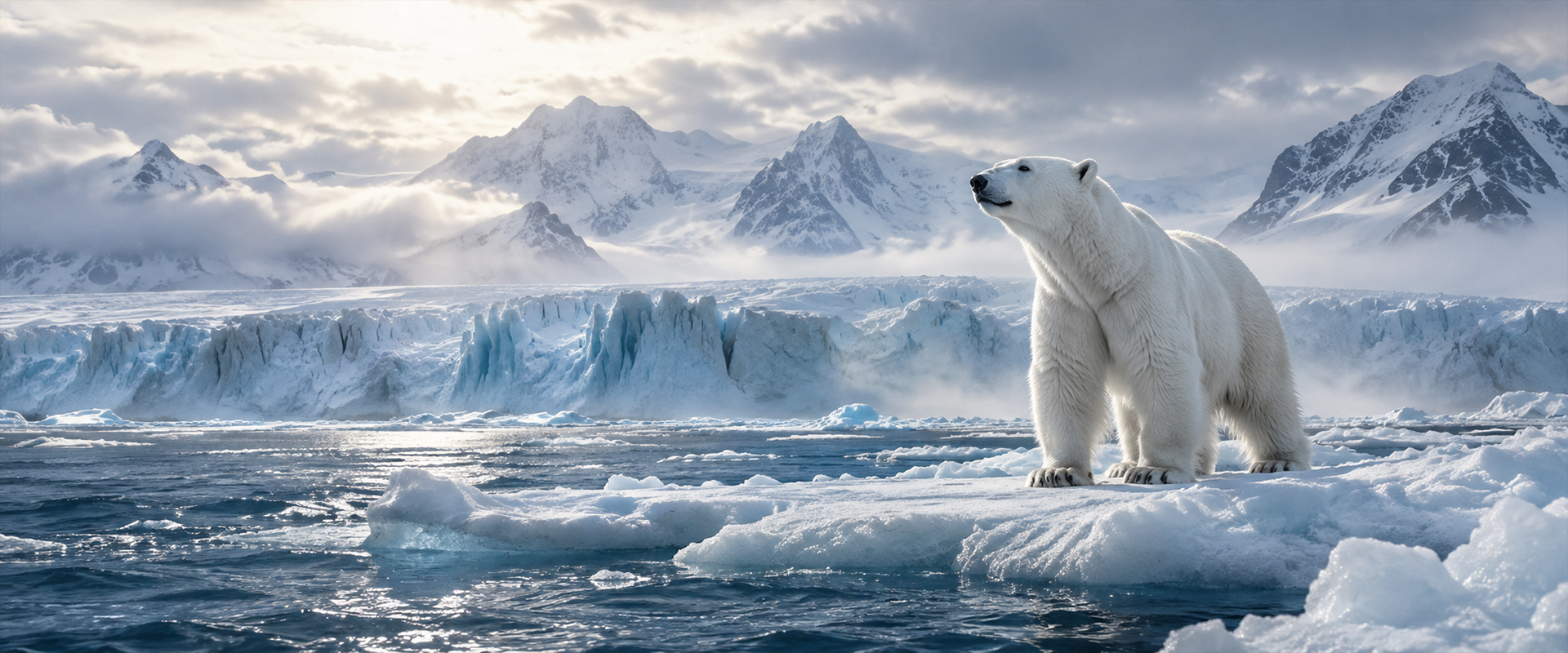
Polar Bears in Svalbard – Where They Live, How to See Them and How to Observe Them Safely
Polar Bears in Svalbard – Where They Live, How to See Them and How to Observe Them Safely
Men of Sea Guide to Svalbard – Part 5
Last updated: September 2026
Polar bear viewing regulations checked: 25 September 2026
The polar bear is one of the most important symbols of Svalbard, and for many travellers seeing one in its natural habitat remains one of the greatest dreams associated with a journey to the Arctic.
But a polar bear is not an attraction waiting beside a fixed itinerary. It is a wild animal moving across vast areas between islands, sea ice and the open ocean.
During many seasons of our Svalbard expeditions, we have observed polar bears in many different situations: on sea ice, along the shore, hunting seals, attempting to hunt reindeer, feeding on animal carcasses, swimming in the sea, and females caring for their cubs. We have photographed them both from land and from our yacht.
I have seen hundreds of polar bears in Svalbard. Yet after years of such encounters, one thing remains unchanged: a polar bear sighting can never be guaranteed.
What we can do is understand their habitat, monitor current sea-ice conditions, plan an expedition route carefully and know where — and why — the probability of encountering a polar bear may be higher.
That is exactly what this guide is about.
Polar Bears in Svalbard – Key Facts
| Feature | Information |
| English name | Polar bear |
| Norwegian name | Isbjørn |
| Scientific name | Ursus maritimus |
| Family | Ursidae |
| Typical adult male weight | approx. 300–700 kg |
| Typical adult female weight | approx. 150–350 kg |
| Adult body length | approx. 180–260 cm |
| Typical lifespan | approx. 15–25 years; some females may live to around 30 |
| Main habitat | sea ice and Arctic coastal areas |
| Main food in Svalbard | seals, especially ringed seals |
| Population | Svalbard polar bears belong to the Barents Sea population |
| Number of recognised subpopulations worldwide | 19 |
| IUCN status | Vulnerable – VU |
| Protection in Svalbard | fully protected since 1973 |
The Norwegian Polar Institute describes the polar bear as the largest living bear species and emphasises its exceptional adaptation to life and hunting on sea ice.
Svalbard or Spitsbergen?
These two names are often used interchangeably, but they do not mean the same thing. Svalbard is the entire archipelago. Spitsbergen is the largest island in Svalbard.
Longyearbyen, Isfjorden, Hornsund and the north-western coast are all located on Spitsbergen. Nordaustlandet, Edgeøya, Barentsøya, Kvitøya and Kongsøya are other islands within the Svalbard archipelago.
So the answer to both questions — “Are there polar bears in Svalbard?” and “Are there polar bears in Spitsbergen?” — is yes. Their actual distribution, however, is much more complex.
Why Is the Polar Bear a Symbol of Svalbard?
Few animals are as strongly associated with a landscape as the polar bear is with the Arctic. In Svalbard, its significance goes far beyond wildlife alone. Polar bears are deeply connected with the history of the archipelago, the culture of former trappers, scientific research, safety regulations and modern expedition tourism. The expression “King of the Arctic” is therefore not accidental.
The origin of the word Arctic is also fascinating. The Greek word árktos means “bear”, but the name Arctic does not come directly from the polar bear. It refers primarily to the northern constellations associated with the Bear, especially Ursa Major. The Greek arktikos meant “of the Bear” or “northern”, while antarktikos meant “opposite the Arctic”.
So the popular claim that Antarctica literally means “the land without polar bears” is an appealing shortcut, but it is not an accurate explanation of the word’s origin.
The Polar Bear Is Really a Marine Mammal
This is one of the most important things to understand about polar bears. We see a huge bear walking across tundra and instinctively think of it as a land animal. Its ecology tells a different story.
The Latin name Ursus maritimus means “sea bear”. The polar bear’s primary hunting habitat is sea ice. Sea ice gives bears access to seals, which provide the highly energetic fat they need. The Norwegian Polar Institute emphasises that this dependence on ice-associated seals is one of the main reasons why polar bears are so strongly connected with sea ice.
This leads to one of the key principles for understanding the species: Sea ice is not just part of the polar bear’s landscape. It is its hunting platform.
During my expeditions, I have repeatedly seen polar bears swimming in the sea, sometimes far from land. I have seen with my own eyes just how capable they are in the water — although I often joke that “a polar bear swims like a dog”. Watching polar bears move across drifting ice, I have also seen how naturally they jump into the sea. Entering the water appears to be a completely normal part of their movement through the Arctic environment.
What Do Polar Bears Eat in Svalbard?
The most important prey species is the ringed seal. Another very important prey species is the larger bearded seal. Polar bears also feed on other seal species and carrion. They may feed on whale carcasses, hunt birds, eat eggs and occasionally attempt to hunt reindeer.
The Norwegian Polar Institute has also documented polar bears eating birds, eggs and vegetation. That does not mean these food sources are energetically equivalent to seals. Seal fat provides far more energy.
During our expeditions, we have repeatedly observed polar bears hunting seals and using other available food sources. A whale carcass washed ashore with polar bears feeding on it is a scene I have witnessed many times. We have also observed attempts to hunt reindeer.
It is fascinating behaviour, but it is important to keep it in perspective: reindeer are not a primary food source for polar bears in Svalbard.
I have also observed a hunting technique in which polar bears drive reindeer towards the water. Once in the sea, reindeer become much easier prey. When the shore is covered with deep snow, a polar bear may also find it easier to catch a reindeer struggling through the snow.
How Do Polar Bears Hunt Seals?
Ringed seals must regularly surface through breathing holes in the ice. A polar bear can wait patiently beside such a hole and react when a seal approaches the surface.
Another strategy is to hunt seals resting on the ice. The bear may approach extremely slowly, using irregularities in the sea ice and its pale coat as camouflage.
Spring and early summer are particularly important because seals give birth to pups and later go through their moulting period.
For polar bears, this is a crucial time to build up energy reserves for the rest of the season. Seal pups are vulnerable at this time, and sometimes their mothers also become prey.
Several years ago, we observed a remarkable scene. A polar bear found a seal pup and its mother on the ice. The mother escaped into the water and appeared to try to draw the bear away from her pup. The bear remained beside the pup for a long time and eventually succeeded in drawing the adult seal back within reach and catching her as well.
Watching a polar bear hunt from a safe distance is one of the most extraordinary wildlife experiences in the Arctic. But it is important to remember that interference by a yacht, ship or person can change the outcome of a hunt and potentially deprive the bear of a meal.
How Big Is a Polar Bear?
The difference in size between males and females is considerable.
Adult males may weigh approximately 300–700 kg, while adult females typically weigh around 150–350 kg. Adult polar bears are generally around 180–260 cm long. Their body mass also changes considerably throughout the year, and females can more than double their weight during the course of a season.
When photographing or observing a bear in the Arctic landscape, it is surprisingly easy to lose your sense of scale. A solitary polar bear on a huge field of ice may look almost small. It is only when something provides perspective — an ice ridge, moraine, ice floe or paw print — that its true size becomes apparent.
From time to time I have watched polar bears stand on their hind legs to survey their surroundings. Seeing a fully grown polar bear upright is an impressive sight.
Do Polar Bears Hibernate in Winter?
No. This is another widespread misconception. Unlike brown bears, most polar bears remain active during winter. It is primarily pregnant females that enter true maternity dens.
Other bears may temporarily rest in snow shelters during severe weather, but they do not undergo traditional winter hibernation.
Polar Bear Reproduction – How Are Cubs Born?
The main mating season is April and May. Polar bears have a fascinating reproductive mechanism known as delayed implantation. A female may be fertilised in spring, but intensive embryo development does not begin until autumn. A pregnant female prepares a snow den in autumn.
The cubs are usually born around the New Year period. At birth they weigh only around 0.5 kg. Twins are most common, although litters may contain between one and three cubs. By the time the family leaves the den in late March or early April, the cubs weigh around 10 kg. They remain with their mother for approximately 2.5 years.
In Svalbard, particularly important historical denning areas are found in the eastern and north-eastern parts of the archipelago. The Norwegian Polar Institute identifies Kongsøya, Svenskøya, Edgeøya, Nordaustlandet and Hopen among important denning regions.
Changing sea-ice conditions, however, are making some traditional areas more difficult for females to access. Many polar bears are equipped with tracking devices, either collars or tags, but the exact real-time locations of individual bears are not information made available to tourists.
How Many Polar Bears Are There in Svalbard?
There is no single current figure showing how many polar bears live permanently in Svalbard.
This is why the frequently repeated claim that “there are about 3,000 polar bears in Svalbard” is misleading. The polar bears encountered in the archipelago belong to the Barents Sea polar bear population, whose range includes Svalbard, the sea ice of the Barents Sea and Russia’s Franz Josef Land. A full Norwegian-Russian survey in 2004 estimated the population at approximately 1,900–3,600 animals, with a central estimate close to 3,000. Telemetry studies suggested that only around 300 bears at that time behaved as more locally resident animals associated with Svalbard.
In 2015, polar bears were counted again on the Norwegian side, and the study did not indicate a decline in the number of locally associated bears compared with 2004. However, an equivalent survey could not be completed on the Russian side, so the results should not be regarded as a new complete census of the entire Barents Sea population.
Guests sometimes arrive on our expeditions with the impression that if there are “3,000 polar bears in Svalbard”, bears must be standing on every beach and shoreline. That is simply not the case. The real number of bears locally present around Svalbard at any one time is much lower, and their distribution changes constantly.
Local Coastal Bears and Pelagic Bears
Satellite-collar studies have revealed two very different movement strategies. Some polar bears remain relatively close to Svalbard for much of the year. Others — described in research as pelagic bears — follow the sea ice across vast distances, often moving towards Franz Josef Land.
Animals living near the ice edge can potentially access seals for a greater part of the year. Polar bears that remain on land during summer must rely on much poorer food sources.
This explains one of the fundamental principles of polar bear watching in Svalbard: A place where we saw a polar bear last year does not automatically become a “polar bear spot” the following season.
During one of my recent expeditions to northern Svalbard, we encountered polar bears mainly on remote northern islands. Participants wondered why the bears were choosing such distant and isolated places. The answer lies in their extraordinary mobility and migratory behaviour.
Where Can You See Polar Bears in Svalbard?
In theory, a polar bear can appear almost anywhere in Svalbard. That does not mean the probability of seeing one is the same everywhere.
The Norwegian Polar Institute notes that western Spitsbergen generally has lower polar bear densities for much of the year because there is less sea ice. More bears are generally found along the eastern coast, in northern fjords and in regions more strongly influenced by sea ice. In spring, glacier fronts may also be important because ringed seals can concentrate in these areas.
For anyone planning an expedition, the most important factors are therefore not the names of supposedly “guaranteed” polar bear locations, but four variables: sea ice, food, season and the ability to reach an area safely.
In broader terms, important regions include northern Spitsbergen, the east coast, Hinlopenstretet, Nordaustlandet, Edgeøya, Barentsøya and areas adjacent to drifting pack ice. But this is not a list of guaranteed sightings.
Are There Polar Bears in Isfjorden?
Yes. Polar bears do occur in Isfjorden, but particularly in summer they are not seen there frequently.
The Norwegian Polar Institute’s guide to Isfjorden states clearly that polar bear sightings during summer are uncommon, although tracks may be found. At the same time, satellite-collar data show that some females do use the Isfjorden region.
This distinction is important: “A polar bear can appear here” is not the same as “this is a reliable place to plan regular polar bear sightings.”
During our expeditions in Isfjorden, we treat polar bear safety exactly as seriously as anywhere else in Svalbard. Before every landing, we assume that a bear could be present.
There is a certain duality in polar bear encounters during our expeditions.
On one hand, everyone wants to see a polar bear, but spotting and identifying one from a distance can be surprisingly difficult. We have probably sailed past bears on the shore more than once without immediately realising what we were looking at. From a distance, a polar bear can easily be mistaken for a rock, a patch of snow or yet another reindeer. Success often depends on patience and careful observation. I have experienced several situations in which we had already sailed past a polar bear before finally recognising it from another angle.
On the other hand, whenever I lead a trek, I am always aware — and make our guests aware — that a polar bear could potentially be behind any rock. We have to move in a way that keeps us prepared for that possibility. For me, this awareness comes naturally because I have encountered polar bears many times, including several genuinely close situations. More about safety later in this guide.
Can Polar Bears Appear Near Longyearbyen?
Yes. It happens, but it is not a typical everyday situation.
In 2020, while our yacht was moored in the marina, I watched three polar bears walking among buildings on the opposite side of Adventfjorden. In December 2023, fresh polar bear tracks were found around 250 metres from the dog kennels in Adventdalen, prompting the Governor to issue a warning and search for the animal. Polar bears have also appeared at the entrance to Adventfjorden in more recent seasons.
The Norwegian Polar Institute also uses tracking data from collared females living in the Isfjorden region to monitor situations in which bears approach Longyearbyen.
If a polar bear appears in or immediately around Longyearbyen, the official recommendation is clear: move away calmly, get to a safe place and notify the Governor of Svalbard. In an emergency, call 112.
On one occasion I watched a female with a cub moving towards Longyearbyen while the Governor’s services attempted to deter them. A helicopter flying low over the animals was unable to resolve the situation, so the bears were eventually tranquillised and transported in a special sling beneath the helicopter to a safer area.
The fact that polar bears are not normally seen in central Longyearbyen should never create a false sense of security once you leave the inhabited area.
When Is the Best Time to See Polar Bears in Svalbard?
There is no single honest answer to the question of the “best month to see polar bears in Svalbard.” The table below shows the relationship between polar bear ecology, sea ice and practical accessibility to different parts of the archipelago.
It is not a table showing percentage chances of seeing a polar bear.
| Month | Conditions and behaviour | From an expedition perspective |
| January | winter, polar night, bears active on sea ice | no practical expedition sailing |
| February | increasing daylight, strong winter conditions | still primarily a winter land season |
| March | important sea-ice period; females begin emerging with cubs | 500 m minimum polar bear distance |
| April | extremely important period for seal hunting | extensive ice; marine activity heavily dependent on conditions |
| May | intensive feeding on sea ice | broader marine season begins; 500 m rule still applies |
| June | considerable ice remains in parts of the archipelago; midnight sun | much greater yacht accessibility; 500 m until 30 June |
| July | sea ice retreats north and east | very good access to many parts of the archipelago |
| August | seasonal ice minimum; some bears ashore, others near ice | broad yacht access to northern and eastern regions depending on ice |
| September | some local bears remain on land | weather becomes more dynamic |
| October | winter conditions gradually return | sailing becomes increasingly demanding |
| November | rapidly decreasing daylight, seasonal ice begins forming | very limited marine tourism |
| December | polar night, pregnant females in maternity dens | effectively outside the yacht expedition season |
From an expedition perspective, there is an important paradox: The conditions that are most typical for polar bears are not always the conditions in which Svalbard is easiest to explore by yacht.
In summer, a yacht may travel hundreds of nautical miles between fjords and islands, while some polar bears may be far to the north near the ice edge.
Does Travelling by Yacht Increase Your Chances of Seeing a Polar Bear?
A yacht does not guarantee an encounter. What it provides is mobility. That is the fundamental difference.
An expedition yacht allows the route to change according to weather, sea-ice conditions, information about navigational conditions and what is happening in different parts of the archipelago. During our expeditions, we never treat a polar bear as a fixed item on the schedule.
The route is dynamic. Sometimes the most interesting region becomes inaccessible because of ice. At other times conditions allow us to travel much farther than originally planned.
That ability to adapt is one of the greatest advantages of travelling through Svalbard by yacht. A yacht can explore successive fjords, islands and coastlines while responding to changing conditions.
A responsible expedition operator should never guarantee a polar bear sighting.
What Are the Minimum Polar Bear Distances in Svalbard?
Legal status checked: 25 September 2026
Since 1 January 2025, the Svalbard Environmental Protection Act has included specific minimum distances for polar bear observation.
| Period | Minimum distance |
| 1 July – end of February | 300 m |
| 1 March – 30 June | 500 m |
The law also prohibits unnecessary disturbance, attracting or pursuing polar bears.
If a person or vessel unintentionally comes closer than the legal minimum distance, they must withdraw to the permitted distance as soon as the bear is detected. 300 or 500 metres is a minimum distance — not a target. This distinction is extremely important.
The regulation does not mean: “If we are exactly 301 metres from the bear, everything is permitted.” The prohibition on disturbing or pursuing a polar bear applies independently of the minimum distance. If the way a boat is being operated causes the bear to change direction, stop resting, abandon a hunt or move away from people, the observation may still be inappropriate even at a greater distance.
How Did the Polar Bear Rules Change in 2025?
Until the end of 2024, the principal rule was primarily the prohibition on unnecessarily disturbing polar bears. From 1 January 2025, specific statutory minimum distances of 300 m and 500 m were introduced.
This matters because many articles, videos and travel guides still available online were created under the previous rules. Anyone planning a trip to Svalbard should therefore always check current regulations, rather than relying on an account written several years ago.
What Must You Not Do When Watching a Polar Bear?
The simplest principle is: An observer should not cause the animal to change its behaviour.
You must not intentionally approach closer than the permitted distance, follow a bear with a boat, block its route, attract it, go ashore in order to get closer or deliberately provoke a reaction for photography.
A good example comes from Lomfjorden in August 2026. A person aboard a ship used a sound signal to wake a resting polar bear. The bear stood up and moved elsewhere. The Governor considered this deliberate disturbance and issued a NOK 50,000 fine. The fine was accepted and paid.
The lesson is clear: A better photograph never justifies altering a polar bear’s behaviour.
Based on the Regulations Above and Our Years of Experience, We Follow Our Own Operational Principles
We understand that everyone wants to see a polar bear, and that for many guests it is one of the main hopes of a Svalbard expedition. But Svalbard is the bears’ home, and that must be respected.
When we see polar bears in the water or along the shore, our first concern is the safety of both our guests and the bears, and behaving in a way that does not disturb them or alter their normal activity. We do not approach bears in a way that violates the regulations or causes visible concern.
If we are stationary near sea ice or anchored and bears approach our position on their own, we remain cautious and again try not to disturb them. If they simply pass by, we reduce our activity. If they remain in our area for longer, we try to leave calmly and give them the space.
If we know a polar bear is ashore, we do not start a trek. If we are already hiking when a bear is detected, we stop the trek and return safely to the yacht.
Two situations from recent seasons illustrate this approach particularly well.
One of our expedition objectives was Kvitøya. After many days of working our way through the ice, we finally reached the island. On the beach, a polar bear was feeding on a walrus carcass. Although Kvitøya had been the main objective of our expedition — following the story of Salomon Andrée’s balloon expedition and his companions — we abandoned the landing.
Perhaps, in the context of the island’s history, the presence of a polar bear waiting on the beach ultimately gave the moment even greater meaning.
Another situation occurred during an expedition to northern Svalbard. Our destination was Sjuøyane, the northernmost group of islands in the Svalbard archipelago. During a trek, we spotted a polar bear resting on the next beach. The trek was stopped immediately and we returned to the yacht without delay.
Safety on Land – How Should You Travel in Polar Bear Country?
Outside inhabited areas, you should always assume that a polar bear may be present. In summer, a bear may appear not only near the coast, but also in valleys and on glaciers. In winter, areas of land-fast ice with suitable ringed-seal habitat are particularly important. On a professionally organised expedition, the most important principle is prevention — and in practice, careful observation.
Before landing, the surrounding terrain should be watched carefully. In places with restricted visibility, the route must be planned accordingly and particular caution is required. Fresh tracks, a dead animal, remains of prey or recent information about a polar bear may be sufficient reason to change or abandon a landing.
This is one of the situations in which an experienced guide is far more valuable than simply knowing the rules. The primary objective is not to allow an encounter with a polar bear on land to develop in the first place. When we arrive somewhere intending to hike, we spend considerable time observing the area before going ashore.
During the landing itself — one of the most demanding moments from a safety perspective — people remaining on the yacht continue observing the surrounding terrain and communicate with the group by radio. During the trek we move cautiously and maintain continuous observation. We also try not to move completely silently, because an accidental close-range surprise encounter is something we particularly want to avoid. We constantly scan our surroundings.
I have even experienced a situation in which a polar bear followed our route and appeared behind us, approaching from the direction we had just come from.
Firearms and Deterrents
The Governor of Svalbard requires people travelling outside inhabited areas to be properly prepared for the possibility of encountering a polar bear and to carry appropriate deterrent equipment. Official guidance also identifies firearms as part of the safety equipment used during travel outside settled areas.
The situation is different for participants in an organised expedition. Participants in commercial tourism activities are not individually required to carry their own deterrent equipment; responsibility for appropriate expedition safety rests with the operator and guide.
New Field Operation Safety Regulations also came into force on 1 January 2026. From 1 July 2027, tourism and field activities outside inhabited areas will be subject to requirements concerning approved Svalbard guides.
A firearm is not the primary method of “dealing with polar bears”. The primary method is preventing a critical situation from developing in the first place.
Based on my own experience, pyrotechnic deterrents — particularly flares — can be highly effective in appropriate circumstances. Each participant in our trekking groups carries a flare after receiving instruction in its use and carries it in a way that allows quick access. During one trek, I had to use a flare when a polar bear approached our group.
After the flare landed near the animal, the intense light, noise and smoke were enough to make the bear turn around and begin moving away from us.
In addition to a rifle, the person leading our trekking group also carries a signal pistol, allowing a flare to be deployed over a greater distance.
Renting a Rifle in Svalbard – Experience Matters
In Svalbard, it is possible to rent a rifle intended for polar bear protection from an authorised provider. The person renting the firearm must have the appropriate documentation, such as a Norwegian firearms licence, a valid European Firearms Pass or a specific permit allowing them to borrow a firearm. When applying for such permission, the Governor also requires documentation demonstrating appropriate competence in handling firearms.
Simply carrying a rifle is not a guarantee of safety.
In a dangerous situation, familiarity with the specific firearm, its operation and regular training all matter. A rifle rented for a few days by someone who has never fired that particular weapon — or has little practical experience with firearms at all — may create only an illusion of security.
For this reason, during Men of Sea expeditions we use our own firearms, which we know well and train with regularly. Even then, we regard a firearm only as the final layer of protection.
The foundations of safety are terrain observation, proper planning and, above all, preventing a close encounter from occurring.
What Should You Do If You See a Polar Bear?
The correct response depends on the situation. If the bear is far away and has been detected early, the best solution is usually to give it space and prevent the distance from decreasing. From a yacht, this also means analysing the direction in which the bear is moving.
The vessel should not be positioned in its path and should not be used to force an encounter.
If a polar bear is detected before a landing, the landing can simply be cancelled. If a bear appears during a trek, the priorities are to keep the group together, maintain awareness of the animal’s position and withdraw according to the guide’s procedure. An unexpected close encounter is a serious situation and not a time for improvisation.
Available deterrent measures, including pyrotechnic devices where appropriate, may have to be used effectively. Official material from the Governor and the Norwegian Polar Institute emphasises that human behaviour is one of the key factors determining whether an encounter develops into a dangerous conflict.
Do Polar Bears Attack People?
Yes, but attacks are rare. The risk is nevertheless real, and the consequences can be fatal.
Fatal attacks and serious injuries have occurred in Svalbard. The Norwegian Polar Institute emphasises that the main objective should always be to prevent critical encounters in the first place.
In 2011, a polar bear attacked a British expedition camp at Von Postbreen. A 17-year-old participant was killed and four other people were injured. (The Guardian)
In 2020, a man staying at a campsite near Longyearbyen was fatally attacked by a polar bear while sleeping in a tent. (The Guardian)
In 2022, a polar bear entered a tent camp at Sveasletta on the northern side of Isfjorden and injured a tourist. The bear was shot while being deterred and was later euthanised by the Governor because of its injuries. (Governor of Svalbard)
These incidents are not reasons to be afraid of travelling to Svalbard. They are reasons for professional preparation and for choosing experienced expedition operators.
How Well Can Polar Bears Swim?
Extremely well. Telemetry data from the Norwegian Polar Institute document swimming crossings of 100–300 km, sometimes lasting three or four days. Long-distance swimming, however, requires a great deal of energy.
This is particularly important for females travelling with cubs, because young bears have much poorer insulation in cold water. Tracking data indicate that females with cubs avoid long swims in spring and begin swimming more extensively later in summer.
Polar bears also dive. The Norwegian Polar Institute has frequently recorded dives of around 5–6 m, less commonly deeper than 10 m, with the deepest dive recorded by the research team reaching 13.9 m.
What Does Declining Sea Ice Mean for Polar Bears?
Changes in sea-ice cover directly influence how polar bears hunt, move and reach breeding areas. For years, scientists have observed later sea-ice formation around traditional denning areas and longer swimming distances in some parts of the population. Some traditional denning regions are considerably less accessible today than they were several decades ago.
At the same time, it is important to avoid oversimplification: Less sea ice does not automatically mean that every year will show a proportional decline in polar bear numbers. The effects of environmental change on a population are complex and may appear with a delay. The Norwegian Polar Institute nevertheless makes clear that continued long-term loss of sea ice will have negative consequences for the species.
2026 Update – Avian Influenza in Polar Bears
A new health issue emerged in 2026. In May, Svalbard recorded the first confirmed European case of highly pathogenic H5N5 avian influenza in a polar bear. A young male was found dead in Raudfjorden.
In August 2026, the Governor reported a second confirmed case, involving a young polar bear found on Æøya near Virgohamna.
At present, there is no basis for claiming that highly pathogenic avian influenza is a major threat to the entire Barents Sea polar bear population. It is, however, a new development that is now being monitored.
From Intensive Hunting to Full Protection
The history of the relationship between people and polar bears in Svalbard was once very different.
For more than a century, polar bears were hunted intensively. The Norwegian Polar Institute reports that an average of around 300 bears were killed each year. Over approximately a century, this amounted to tens of thousands of animals. Polar bears were not only killed. Some were also captured alive and transported to Europe as attractions for zoos.
In 1973, polar bears received full protection, and Norway, Canada, the United States, the Soviet Union and Denmark signed an international agreement on polar bear conservation. Since then, the Barents Sea population has recovered substantially. (Norwegian Polar Institute)
It represents an extraordinary change in perspective: An animal that had been intensively hunted for generations became one of the most strongly protected symbols of the Arctic.
How to Photograph Polar Bears in Svalbard
Photographing polar bears is one of the most demanding forms of wildlife photography available in the Arctic. The challenge is not simply the equipment.
At the same time, a photographer has to control: distance, animal behaviour, movement of the yacht, exposure of white fur and ice, light, focus and composition.
A Telephoto Lens Has Become Even More Important
With legal minimum distances of 300 and 500 metres, a long telephoto lens is not a luxury. It is a basic tool. And unfortunately, there are few compromises here. With many types of wildlife photography, skill and field experience can compensate for equipment to a large extent. When photographing a polar bear from several hundred metres away, the quality of the lens and camera becomes much more significant. A high-resolution sensor — for example the Sony A7R V that I use — provides additional freedom when cropping later, but it cannot replace sufficient focal length.
At very long distances, another problem appears that not even the most expensive lens can solve: atmospheric turbulence. Humid layers of air above the sea at different temperatures can destroy fine detail even when autofocus is perfect.
From a Yacht, Shutter Speed Is Crucial
At sea, both the bear and the photographer may be moving. Even slight yacht motion can cause blur with long focal lengths. For this reason, a sufficiently fast shutter speed often matters more than obsessively keeping ISO as low as possible.
White Does Not Mean the Photograph Should Be Dark
Camera metering systems often try to render a very bright scene as middle grey. With snow, ice and pale fur, exposure and the histogram need to be monitored carefully. The aim is to preserve detail in the highlights without unnecessarily darkening the entire photograph.
You Do Not Always Need a Close-Up
One of the most important things I have learned through years of photographing polar bears in Svalbard is slightly counterintuitive:
The best polar bear photograph is not always the one in which the bear fills the frame.
A polar bear on a small ice floe surrounded by empty space, beneath a glacier front or against a huge Arctic landscape can say much more about the Arctic than a tight portrait. The environment is part of the story. It gives the image context.
Of course, it is easier for me to say this now that I already have hundreds of close-range polar bear photographs. Today I am increasingly interested in stories, space and the relationship between the animal and its environment.
But there is something even more important that I try to tell people travelling with me: The most beautiful image they may take home is sometimes the one seen with their own eyes and remembered deeply long after the expedition ends.
How to Photograph Polar Bears Without Disturbing Them
There is one overriding rule: A good photograph never justifies changing the behaviour of the animal.
If the bear is sleeping — photograph a sleeping bear. If it is walking in a particular direction — do not try to position the yacht in front of it. If it is hunting — do not change the situation to create a better photograph. If it is a female with cubs — give the family especially generous space.
What About Drones?
In Svalbard, drones are not a simple solution for photographing polar bears. Since 2025, drone use has been prohibited in all protected areas. Even outside protected areas, a drone must not be operated in a way that disturbs wildlife. (Governor of Svalbard)
In practical terms, a drone is not a tool for flying up to a polar bear to obtain a dramatic photograph or video.
12 Interesting Facts About Polar Bears
- Ursus maritimus means “sea bear”.
- The polar bear is the largest living bear species.
- Only pregnant females spend winter in true maternity dens.
- Females can more than double their body mass between spring and late summer.
- Ringed seals are the most important prey species for polar bears in Svalbard.
- Polar bears can swim more than 100 km across open water; movements of 100–300 km have been recorded.
- The deepest polar bear dive recorded by the Norwegian Polar Institute was 13.9 m.
- A newborn polar bear cub weighs only around half a kilogram.
- Cubs normally stay with their mother for approximately 2.5 years.
- Polar bears have delayed implantation — mating occurs in spring, but active embryo development begins only later in the year.
- Polar bears can hunt reindeer, although reindeer are not a primary part of their diet.
- Some polar bears remain relatively local to Svalbard, while others travel enormous distances between Svalbard and Russia’s Franz Josef Land.
Why Does Seeing a Polar Bear Remain So Special?
After many sightings, you might imagine that another polar bear encounter eventually becomes ordinary. It does not.
I still wait for every new encounter, and when one happens, it brings excitement and genuine joy. Sometimes we see a bear from an enormous distance — little more than a white point moving across the ice. At other times, we can spend much longer observing its natural behaviour: resting, walking, swimming or hunting.
Every encounter is different. But the greatest value does not lie in how close we managed to get. The most valuable observation is one in which the animal can continue doing exactly what it would have done if we had never been there.
That is how we understand wildlife observation during Men of Sea expeditions.
FAQ – Polar Bears in Svalbard
Are there polar bears in Svalbard?
Yes. Svalbard lies within the range of the Barents Sea polar bear population. Polar bears can potentially appear almost anywhere in the archipelago, although their distribution is strongly influenced by sea ice.
How many polar bears live in Svalbard?
There is no single current figure for “the polar bears of Svalbard”. The entire Barents Sea population was estimated in 2004 at approximately 1,900–3,600 animals, while around 300 bears showed a more locally resident pattern around Svalbard.
Are there polar bears in Spitsbergen?
Yes. Spitsbergen is the largest island in Svalbard and polar bears do occur there.
Where is the best place to see polar bears in Svalbard?
There is no guaranteed location. In general, the eastern and northern parts of the archipelago and areas associated with sea ice are more important polar bear habitat than the relatively warmer west coast of Spitsbergen.
Can you see polar bears in Isfjorden?
Yes. In spring they may occur on sea ice and ice floes, while during summer they may be encountered walking along the shores of fjords or swimming in the sea.
Do polar bears come to Longyearbyen?
Yes, occasionally. Polar bears sometimes appear near the town and in Adventdalen.
What is the best time to see polar bears in Svalbard?
There is no single best month. Polar bear distribution depends primarily on sea ice, food availability and individual movement strategies, while access to different regions of Svalbard also changes throughout the season.
Are there polar bears in Svalbard in summer?
Yes. Some bears remain on the islands during summer, while others move north or east with the sea ice.
Are polar bears dangerous?
Yes. A polar bear is a large predator and can potentially attack a human. Fatal and non-fatal attacks have occurred in Svalbard, which is why special safety procedures apply outside inhabited areas. From my own field experience, I consider the polar bear one of the most dangerous large land predators a person can encounter.
How far away must you stay from a polar bear in Svalbard?
At least 300 metres, and from 1 March to 30 June at least 500 metres. Regardless of distance, it is prohibited to unnecessarily disturb, attract or pursue a polar bear.
Can you photograph polar bears in Svalbard?
Yes, provided you comply with the law and do not change the animal’s natural behaviour.
Can you follow a polar bear with a boat?
No. The minimum legal distance does not give you the right to pursue a polar bear in a way that disturbs it.
Can polar bears swim?
Yes, extremely well. The Norwegian Polar Institute has recorded swimming journeys of 100–300 km lasting several days.
What do polar bears eat in Svalbard?
Primarily ringed seals and bearded seals. They also use carrion and may eat birds, eggs and occasionally other prey, including reindeer.
Do polar bears hibernate in winter?
Most do not. Winter maternity dens are primarily used by pregnant females.
Does a yacht expedition guarantee seeing a polar bear?
No. No responsible expedition can guarantee an encounter with a wild polar bear. A yacht provides mobility and allows large areas to be explored, but the animal ultimately determines where it is.
Sources and Further Reading
| Source | Used for |
| Norwegian Polar Institute | biology, reproduction, population, diet, migration, sea ice |
| Governor of Svalbard | legislation, safety, current regulations, enforcement cases |
| Lovdata | current wording of Section 30a of the Svalbard Environmental Protection Act |
| Field Operation Safety Regulations | safety requirements for tourism and field activities from 2026 |
| Cruise Handbook – Norwegian Polar Institute | polar bear distribution, Isfjorden and Svalbard regions |
MEN OF SEA SVALBARD GUIDE SERIES
A. Part 1 – How to Get to Svalbard
B. Part 2 – What to Pack for Svalbard
C. Part 3 – When Is the Best Time to Visit Svalbard?
D. Part 4 – What to see in Svalbard. 5 key places and experiences in Spitsbergen.
E. Part 5 – Polar Bears in Svalbard – Where They Live, How to See Them and How to Observe Them Safely
LOOK ALSO AT:
Glacier Trekking in Svalbard
Zodiac Landings in Svalbard
Photography in Svalbard
Svalbard Yacht Expeditions
Svalbard Wildlife
About the Author of This Guide
Marek Rajtar jest założycielem Men of Sea, skipperem, fotografem i organizatorem wypraw w Arktyce i północnej Norwegii.
Marek Rajtar is the founder of Men of Sea, a skipper, photographer and organiser of expeditions in the Arctic and Northern Norway.
For more than a decade, he has been leading yacht expeditions across Svalbard, the Lofoten Islands and Northern Norway, exploring these regions both from the sea and during hikes and land-based expeditions. He has led numerous expeditions and trips around Svalbard, in the waters of Northern Norway and among the islands of Lofoten. His achievements include several records, new routes in the High North that he discovered himself, and a number of awards. He is also the author of many publications that have appeared in various media outlets.
His experience includes sailing in Arctic conditions, expedition route planning, landscape and wildlife photography, and observing wildlife in its natural environment. As a result, Men of Sea guides are not based solely on online sources — they are enriched with knowledge and observations gained during real expeditions.
When writing about places such as Svalbard, Lofoten or Northern Norway, Marek Rajtar draws on experience gathered over successive seasons spent in the North, with particular attention to weather conditions, access from the sea, safety, photography and the practical aspects of travelling in these regions.
Marek Rajtar
Captain • Photographer • Expedition Organiser
Men of Sea