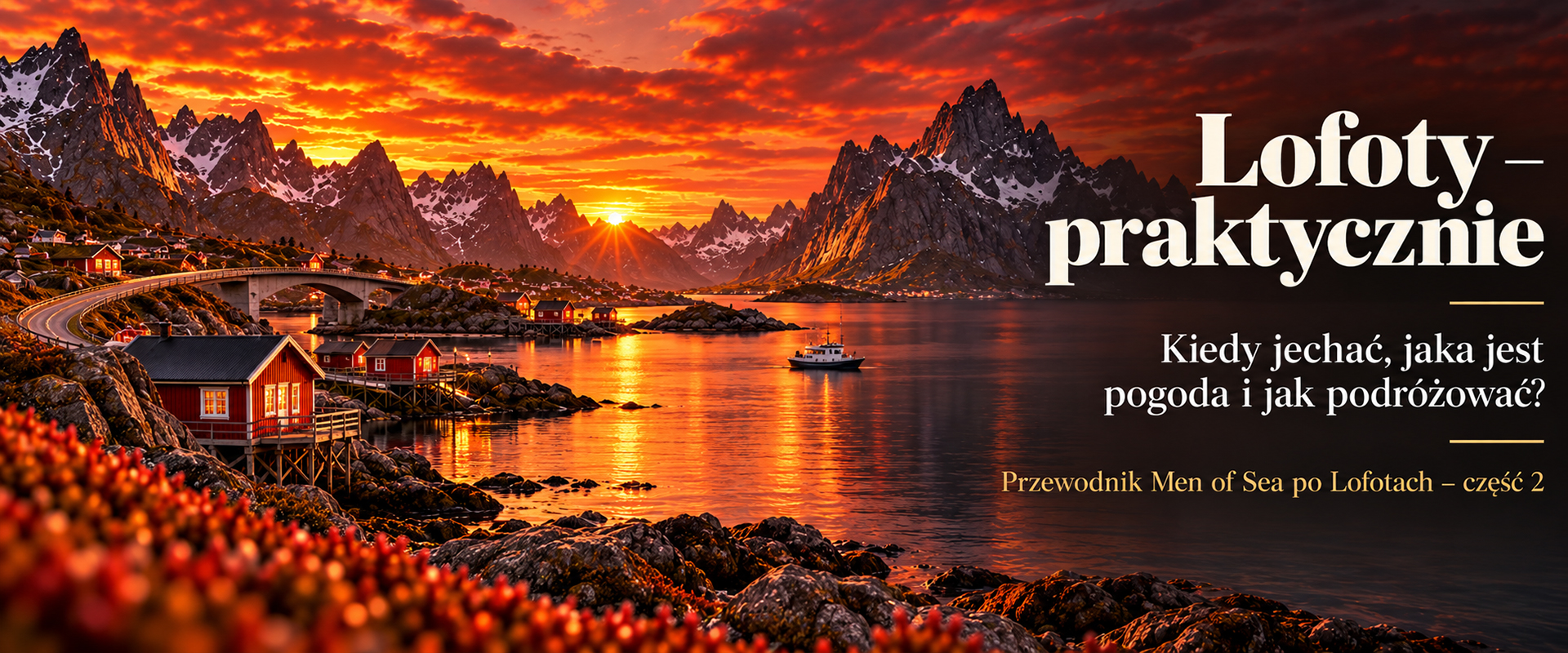
Lofoten Practical Guide – When to Visit, Weather, How to Travel and How to Prepare
Lofoten Practical Guide – When to Visit, Weather, How to Travel and How to Prepare
Men of Sea Guide to Lofoten – Part 2
We have been travelling around Lofoten and Northern Norway for more than a decade, by car, on foot and from the sea. During our successive expeditions, we have learned one thing above all: in Lofoten, the season changes not only the landscape but also the way you travel.
The same hiking trail, road, harbour or bay may be easily accessible in July, demanding in October and practically inaccessible in the middle of winter.
That is why the question “What is the best time to visit Lofoten?” does not have one answer that works for everyone.
There are, however, several very clear answers depending on whether your priorities are hiking, photography, the Northern Lights, the Midnight Sun, winter fishing or simply exploring the archipelago comfortably by car.
What is the best time to visit Lofoten? The short answer
If this is your first trip and your main priorities are hiking and easy travel around the islands, the most versatile period is from June to early September. From approximately 28 May to 14 July, Lofoten experiences the Midnight Sun, meaning that daylight continues throughout the night.
If you are interested in photography, the Northern Lights and fewer tourists, September and October are particularly interesting.
The Northern Lights can generally be seen from late August until around mid-April. From our experience, every month from September through March can offer excellent Aurora displays. Longer winter nights do not automatically mean better chances: shorter nights in early autumn are often balanced by better weather, while longer winter nights may come with more cloud, snow and storms.
If you want to see Lofoten covered in snow, photograph the Aurora and still have an increasing amount of daylight, February and March are particularly interesting.
In December and early January, the sun remains below the horizon. However, this does not mean complete darkness throughout the day. Around midday there are still several hours of blue Arctic twilight.
January also brings a greater chance of seeing nacreous clouds, which for us can be an even more remarkable sight than the Northern Lights.
Lofoten month by month
The temperatures below are approximate values for Svolvær and are intended for trip planning rather than as a forecast for the entire archipelago. Local conditions can vary significantly between the coast, mountains and individual islands.
| Month | Approx. average temperature | Approx. daylight in mid-month | Hiking | Northern Lights | Character of the trip |
|---|---|---|---|---|---|
| January | –1.5°C | approx. 2 h | winter conditions | very good | snow, blue light, skrei |
| February | –1.9°C | approx. 7 h | winter conditions | very good | snow + increasing daylight |
| March | –1.2°C | approx. 11 h | still winter | very good | one of the more interesting winter months |
| April | 1.8°C | approx. 15 h | depends on altitude | until mid-month | transition season |
| May | 5.5°C | approx. 20 h | more trails becoming accessible | practically none | long days, fewer visitors |
| June | 8.7°C | 24 h | very good | none | Midnight Sun |
| July | 11.8°C | almost 24 h | very good | none | peak season |
| August | 11.5°C | approx. 17 h | very good | from late month | still summer, darkness returns |
| September | 9°C | approx. 13 h | usually good | yes | photography, Aurora, fewer visitors |
| October | 5°C | approx. 9 h | weather dependent | yes | very changeable conditions |
| November | 2.2°C | approx. 4 h | often winter-like | yes | short days, storms, early winter |
| December | approx. 0°C | sun below horizon | winter conditions | yes | polar night period, blue light |
The Midnight Sun occurs approximately between 28 May and 14 July, although exact visibility depends on location and whether mountains block the horizon.
The period when the sun does not rise above the horizon is approximately 7 December to 5 January.
Lofoten in January, February and March
Winter in Lofoten is considerably milder than its latitude might suggest. Typical daytime temperatures are often somewhere between approximately –5°C and +5°C, although colder periods certainly occur. The main challenge is therefore usually not extreme cold. It is the combination of wind, moisture, ice, snow, limited visibility and rapidly changing weather.
January is a good month for travellers looking for a true winter atmosphere and long nights.
February brings significantly more daylight.
March is one of the most versatile winter months: the days are already long, snow is still common, the skrei season is underway and nights remain dark enough for the Northern Lights. In the past, we organised yacht expeditions around Lofoten in February and March. Based on that experience, we eventually stopped running these particular trips.
There were simply too many periods of poor weather and precipitation, hiking options were severely restricted and important roads were occasionally closed. The expeditions were still an adventure, but we increasingly felt that the conditions prevented us from showing participants the full character and beauty of the archipelago.
That first-hand experience is one of the reasons we now choose our Lofoten seasons very carefully.
Lofoten in April and May
April and May form one of the most unpredictable transition periods. At sea level, conditions may already feel like spring, while the mountains can still be in full winter conditions. In May, daylight becomes extremely long and the Midnight Sun period begins towards the end of the month.
There are fewer visitors than in July, but you should not automatically assume that every high-altitude hiking trail will already be in summer conditions. For travellers who do not want winter conditions but also do not need the full summer season, the second half of May can be an interesting compromise.
Lofoten in June, July and August
This is the easiest period logistically. Days are extremely long, most hiking trails are usually accessible, more seasonal transport operates and the tourism infrastructure is working at full capacity. At the same time, June through August is the high season.
From our observations, booking accommodation well in advance is often necessary, especially if you want to stay in a specific village or location. July is statistically the warmest month, but a “warm summer day” in Lofoten can still mean temperatures below 10°C, rain and strong wind.
Summer temperatures can range from around 8°C during cool periods to rare warm episodes approaching 30°C. You should therefore not pack for Lofoten as though you were going on a conventional summer holiday.
Lofoten is far better suited to travellers who expect an active trip in changeable conditions.
Lofoten in September
September is one of the most versatile months for people interested in photography and active travel. The days are still long enough for hiking and travelling around the islands, while darkness has returned sufficiently for Northern Lights viewing. In our experience, the end of August marks the beginning of the period when the sky becomes dark enough for Aurora observations.
Seeing the Northern Lights while temperatures are still relatively mild can itself be a surprising experience, because many people associate the Aurora exclusively with snow and deep winter. Visitor numbers are lower than in July. The weather becomes wetter and more dynamic, but snow at sea level is still not the norm.
If someone asks us for a good balance between hiking, photography, Northern Lights and relatively easy logistics, September is one of the first months we consider.
Lofoten in October – our experience
October is one of the months when we most often organise our Lofoten expeditions. As a result, we know not only the climate statistics but, more importantly, what October weather means in practice.
October has three major advantages: dark nights, fewer tourists and very interesting light.
It also has one major drawback: you can no longer plan the trip as rigidly as you might in summer.
The average temperature in Svolvær is around 5°C, but the wind is often more important than the temperature itself. A day at 7°C with strong wind and rain can feel considerably more demanding than a dry day close to freezing.
Can you hike in Lofoten in October?
Yes. October does not automatically mean the end of the hiking season.
It does mean that: you choose the trail according to current conditions, not according to an itinerary prepared several months earlier.
After several days of rain, rocks and soil on steep trails can become extremely slippery. After a cold night, ice may appear, while the first snow can settle on higher sections.
During our expeditions, we therefore do not treat any specific hike as a compulsory item on the programme. We first check the weather, temperature, wind and current trail conditions, and only then choose where to go. This is one of the situations where mobility becomes a major advantage.
By car, you can quickly move to another part of the islands.
By yacht, you can sometimes change the entire operating area of the expedition.
Lofoten weather – what should you really expect?
Lofoten has a maritime climate. The ocean moderates extreme temperatures, but it also brings moisture and contributes to very rapid changes in weather. In practice, you may experience sunshine, rain, hail, snow and strong wind on the same day.
We recommend preparing for rapidly changing weather throughout the year and carrying waterproof and windproof layers even in summer. Precipitation is one of the things that is difficult to predict far in advance. It occurs frequently and can have a major impact on travel plans.
What does 7°C with 15 m/s wind actually feel like?
15 m/s is approximately 54 km/h. At this temperature and wind speed, the perceived temperature can be considerably lower. Add rain, and the main problem becomes heat loss caused by wet clothing and wind exposure.
That is why in Lofoten waterproofing and wind protection are often more important than simply wearing a very thick jacket.
Why does “rain all day” not always mean constant rain?
The mountains divide the archipelago into small local weather zones. Clouds can become trapped on one side of a mountain ridge while breaks appear on the other. That does not mean weather forecasts are useless. Quite the opposite.
You simply need to look beyond a single rain icon.
We pay particular attention to: wind direction and strength, cloud cover, hourly precipitation and the movement of weather fronts.
For basic forecasting, Yr / MET Norway are very useful. For visualising wind, cloud cover and frontal systems, Windy can also be helpful.
How to get to Lofoten
There is no single “Lofoten Airport”. The most practical gateways are Bodø, Leknes, Svolvær and Harstad/Narvik Airport Evenes.
Bodø to Moskenes by ferry
This is one of the most logical routes for travellers planning to start in southern Lofoten. The direct Bodø–Moskenes ferry takes approximately 3.5 hours and carries both foot passengers and vehicles. This is particularly convenient for travellers who begin their journey in Bodø, rent a car there and then take the vehicle onto the ferry. It is also possible to spend one or two days exploring the main attractions around Bodø, including the famous Saltstraumen, known for its exceptionally powerful tidal currents.
Bodø Airport serves a large number of air connections, and another advantage is the compact local logistics. The airport lies only around one kilometre from the city centre, while the ferry terminal and express-boat harbour are only a short drive away.
During the summer season, it is advisable to book the ferry in advance. Under the current rules, passengers travelling on the Bodø–Værøy–Røst–Moskenes route also need to be registered with their name, nationality and date of birth.
Bodø to Leknes or Svolvær by air
If you want to avoid the ferry crossing, you can fly onward from Bodø to Leknes or Svolvær. Leknes is a convenient gateway for central and western Lofoten. Svolvær is a better base for the eastern part of the archipelago and for travelling towards Raftsundet.
Car rental is also relatively easy to arrange there.
Harstad/Narvik Airport Evenes
Evenes is a very practical option for travellers flying from Oslo or internationally and planning to begin in eastern Lofoten. The drive from Evenes to Svolvær takes approximately 2.5 hours, depending on conditions.
Buses also operate from the airport towards Lofoten.
Tromsø to Lofoten
Tromsø is a different type of starting point. If Lofoten is your only destination and you have limited time, Bodø or Evenes will usually be more efficient. If, however, Lofoten forms part of a longer Northern Norway trip, Tromsø becomes much more interesting.
You can combine the journey with Senja, Kvaløya or other areas of Northern Norway. We would treat the drive from Tromsø to Lofoten as part of the journey itself rather than merely as a transfer. The route is long and, in winter, can be demanding.
Bodø or Tromsø – which is better for Lofoten?
| Bodø | Tromsø | |
|---|---|---|
| Access to western Lofoten | very convenient ferry to Moskenes | long overland drive |
| Flights to Leknes/Svolvær | yes | depends on seasonal schedules |
| 3–5 day trip | more practical | usually less efficient |
| 7–10 day trip | very good | very good as part of a larger route |
| Car rental | easy locally | ideal for a broader Northern Norway road trip |
| Journey itself | mainly a transfer | can become part of the trip |
| Best for | Lofoten as the main destination | Lofoten + Northern Norway |
If you have only 3–5 days and Lofoten is your main destination, we would normally choose Bodø, Svolvær or Evenes.
If you have 7–10 days or more and want to explore other parts of Northern Norway as well, Tromsø becomes much more attractive.
Lofoten by car – do you need a rental car?
A car is not absolutely essential. But in most cases, it is the most convenient way to travel around Lofoten.
The Norwegian Scenic Route Lofoten covers approximately 230 km between Å and Raftsundet, with side roads to places including Nusfjord, Henningsvær, Unstad, Uttakleiv and Eggum. The main route can be driven without using ferries.
A car becomes especially useful if you want to:
- respond quickly to changing weather,
- drive east or west in search of clearer skies,
- start hikes early in the morning,
- photograph the Northern Lights at night,
- carry hiking and photography equipment.
From our own experience, we generally recommend renting a car. It gives you freedom, lets you reach trailheads and viewpoints quickly, provides a place to leave equipment you do not need on a hike and can even become a temporary shelter during heavy rain.
Driving in Lofoten
Roads are often narrow. The E10 is the main artery through the islands, but you share it with local residents, buses, cyclists, campervans and pedestrians. Choose stopping places carefully. Never stop in a way that blocks traffic or creates a safety hazard. Parking capacity is also limited in some popular areas.
In winter, road conditions can change rapidly. Within a single day, the E10 may be dry, icy, snow-covered or covered in slush. Exposed bridges can occasionally be closed during very strong winds.
Weather forecasts and road warnings should therefore be checked regularly.
Car rental in Lofoten
At Leknes and Svolvær airports you can find companies such as Avis, Hertz, Europcar and Sixt. Bodø offers an even wider choice, including Avis, Budget, Hertz, Europcar, Sixt and Enterprise/Alamo/National.
How much does it cost to rent a car in Lofoten?
Car rental is one of the most seasonal travel costs. Data for Svolvær Airport shows average prices of around USD 52 per day in October and USD 117 per day in July. At the exchange rate used for the original article, this corresponded to approximately NOK 490 and NOK 1,110 per day.
Actual offers can be considerably higher, especially for SUVs, short bookings, additional drivers or full insurance. For Leknes, May tends to be among the cheaper months, while July is one of the most expensive.
In practice, we would therefore budget several hundred to more than NOK 1,000 per day, with considerably higher prices possible during peak season or for larger cars.
Can you visit Lofoten without a car?
Yes. But you need to accept less flexibility. The main 300 Lofotekspressen bus route connects Å, Leknes, Svolvær and Narvik. There are also routes between Svolvær and Leknes, Å and Leknes, as well as local connections to places including Henningsvær, Unstad, Uttakleiv, Reine and Hamnøy.
Places along the E10 are relatively easy to reach, while connections away from the main road are much less frequent. For travellers relying heavily on public transport, the Travel Pass Nordland can be useful. As of September 2026, it costs NOK 1,990 and allows seven days of unlimited travel on buses and express boats within Nordland.
How many days do you need in Lofoten?
| Time | What it realistically allows |
|---|---|
| 3 days | a quick introduction to one part of the archipelago, with little margin for bad weather |
| 5 days | several activities plus 1–2 days of greater flexibility |
| 7 days | a good amount of time to explore several parts of Lofoten at a calmer pace |
| 10 days | excellent for hiking, photography, sea activities and a large weather buffer |
The main risk with a short visit is not a lack of things to do. It is bad weather. With only three days, one storm or one day of low cloud can eliminate a third of your entire programme. With seven or ten days, it becomes much easier to adapt hiking, sailing and photography plans to actual conditions.
What to pack for Lofoten
The most important rule is to dress in layers. Our basic recommendations are:
| Category | What we recommend |
|---|---|
| Base layer | merino wool or quick-drying underwear |
| Mid-layer | fleece or wool |
| Jacket | waterproof and windproof shell |
| Trousers | hiking trousers + waterproof outer layer |
| Footwear | waterproof hiking boots |
| Head and hands | hat and gloves, even outside winter |
| Autumn/winter | microspikes when conditions require them |
| Photography | spare batteries, rain protection |
| Electronics | power bank |
| Hiking | offline map, headlamp |
| Midnight Sun | sleeping mask |
In winter, we particularly recommend: wool base layers, fleece or wool insulation, waterproof outer layers, warm footwear and anti-slip traction devices.
Northern Lights in Lofoten – when can you see them?
The Northern Lights can generally be seen from late August until around mid-April.
Four things matter most: darkness, clear skies, solar activity and an open horizon. In Lofoten, you do not need to wait for KP 5 or KP 6. The archipelago lies beneath the auroral oval, and even KP 1–2 can be enough for visible Aurora activity.
In practice, cloud cover is often more important than the KP index. When planning Northern Lights photography or observation, we therefore look at cloud maps first.
If you want to understand Aurora forecasting in more detail, see our guide: HOW TO FORECAST THE NORTHERN LIGHTS IN NORTHERN NORWAY
and our separate guide to: THE BEST APPS AND WEBSITES FOR NORTHERN LIGHTS FORECASTING IN NORTHERN NORWAY
What can you do in Lofoten in each season?
| Activity | Winter | Spring | Summer | Autumn |
|---|---|---|---|---|
| Hiking | limited / winter conditions | changeable | best season | weather dependent |
| Northern Lights | very good | until mid-April | none | from late August |
| Midnight Sun | no | from late May | until mid-July | no |
| Sailing | possible, more demanding | yes | yes | yes |
| Kayaking | locally available | yes | best season | weather dependent |
| Surfing | yes | yes | yes | very good |
| Fishing | skrei | skrei into spring | regular | regular |
| Museums | some restricted hours | more reopen | full offer | some shorten opening periods |
| Photography | snow, blue hour, Aurora | long days | Midnight Sun | Aurora, dynamic light |
| Birdwatching | limited | migration | best season | fewer birds |
Car or yacht – which is better in Lofoten?
A car and a yacht solve two very different travel problems.
| Car | Yacht | Combination | |
|---|---|---|---|
| Access to E10 | excellent | no | excellent |
| Access to bays and fjords | limited | very good | very good |
| Hiking | very convenient | depends on landing point | greatest flexibility |
| Accommodation | booked separately | moves with you | very flexible |
| Reaction to weather | fast along roads | fast between maritime areas | greatest flexibility |
| Photography | many roadside locations | sea-level perspective | widest possibilities |
| Cost | comparable | comparable | higher |
| Comfort for everyone | high | depends on sea conditions | depends on programme |
We do not believe that a yacht is always the better option. If someone wants to drive through the main villages and complete several classic hikes, a car is an excellent solution.
A yacht offers something different: your accommodation base moves with you.
You do not need to return to the same hotel every day. In that respect, a yacht can be extremely convenient.
A well-organised sailing trip may also be more cost-effective than independent travel by car once you add the cost of accommodation and food, particularly restaurant meals.
On our 7- and 10-day Lofoten expeditions, we combine sailing, going ashore, hiking and photography. If the weather prevents us from sailing, we often rent a car instead. Flexibility is part of the programme.
How expensive is Lofoten?
The cost of a Lofoten trip depends heavily on the season.
To illustrate the difference, accommodation data for Svolvær shows average holiday-apartment prices of around USD 117 per night in November and USD 336 in July, which at the exchange rate used in the original article corresponded to roughly NOK 1,100–3,200.
This is not a price list for all of Lofoten. It simply illustrates how large the seasonal difference can be. Car rental shows a similar pattern.
Example prices – September 2026
| Expense | Example price |
|---|---|
| Travel Pass Nordland, 7 days | NOK 1,990 |
| Haukland parking | NOK 20/hour |
| Uttakleiv, passenger car | NOK 60 per started 3 h, max. NOK 300/24 h |
| Anita’s Seafood – fish burger | NOK 199 |
| Anita’s Seafood – fish soup | NOK 279 |
| Vind Brasserie – main course | approx. NOK 295–410 |
| Børsen Spiseri – halibut | NOK 495 |
| Børsen Spiseri – stockfish | NOK 545 |
| Cappuccino at Karoline/Nusfjord | NOK 65–75 |
Fuel prices are considerably more volatile. For example, the Norwegian average price of 95-octane petrol on 21 September 2026 was around NOK 29.63 per litre, while only one month earlier it had been much closer to NOK 21. Fuel prices should therefore always be checked shortly before travelling.
What should you eat in Lofoten?
Cod is the most important local product. During winter, skrei returns to Vestfjorden, while tørrfisk — stockfish or air-dried cod — is one of the products most closely associated with the history and development of the archipelago.
It is also worth trying: fresh fish, fish soup, halibut, seafood and local Lofotlam lamb.
We do not want to create another arbitrary list of the “10 best restaurants in Lofoten”. Instead, these four places illustrate different styles and price levels.
Anita’s Seafood – Sakrisøy
Anita’s Seafood is a relatively informal seafood bar. Current menu examples include:
- classic cod burger – NOK 199,
- fish soup – NOK 279,
- lobster – NOK 399.
Gammelbua Restaurant – Reine
Gammelbua is a good example of a more traditional restaurant based on local ingredients and tørrfisk. It is also important to remember the seasonality of restaurants in Lofoten — Gammelbua operates from February to October.
Vind Brasserie – Henningsvær
Current menu examples include:
- fish soup – NOK 215 as a starter,
- larger fish soup – NOK 295,
- halibut – NOK 410.
Børsen Spiseri – Svolvær
Børsen Spiseri is strongly connected with local culinary traditions. Current menu examples include:
- tørrfisk – NOK 545,
- halibut – NOK 495.
And if you travel by yacht with fishing equipment, fresh, delicious fish can become part of the menu almost every day.
The most common mistakes when planning a Lofoten trip
The first mistake is an itinerary that is too ambitious. One hundred kilometres in Lofoten is not the same as one hundred kilometres on a motorway. Roads are narrow, stops are frequent, the weather is changeable and summer traffic adds further delays.
The second mistake is scheduling every day almost hour by hour. For an active trip, it is sensible to leave at least one day as a weather buffer.
The third mistake is assuming that every popular hiking trail is accessible all year.
The fourth is packing too lightly. Even in summer, rain and strong wind can change the character of a day very quickly.
The fifth is underestimating costs, particularly car rental, accommodation and restaurant meals.
And finally: do not try to “beat” the weather. In Lofoten, it is usually better to change the plan than to force the plan to happen.
So, when is the best time to visit Lofoten?
If your main priorities are hiking, long days and the easiest logistics, choose June to August.
If you want to combine hiking with the Northern Lights, September is particularly good.
If your priorities are photography, the Aurora, fewer tourists and dynamic light, October is very interesting — as long as you accept greater weather uncertainty.
If you want winter landscapes, Northern Lights and steadily increasing daylight, February or March are strong options.
If you want to experience the Midnight Sun, plan your trip between late May and mid-July.
For a first-time visitor, the most universal compromise is usually: the second half of June, August or the first half of September.
For us, however, Lofoten becomes particularly interesting when conditions are less predictable. That is one of the reasons we return so often in autumn.
FAQ – Lofoten Travel Planning
When is the best time to visit Lofoten?
For most travellers, the best compromise is from June to early September. If your priorities are Northern Lights and photography, September or October may be better, while February and March are excellent for winter landscapes.
What is the best month to visit Lofoten?
There is no single best month for every traveller. July offers the easiest logistics and summer conditions, September combines hiking and Northern Lights, while March combines snow, increasing daylight and Aurora viewing.
Is October a good time to visit Lofoten?
Yes, particularly for photography and the Northern Lights. However, you need to accept rain, strong winds and the possibility of the first snow or ice.
What is the weather like in Lofoten?
The climate is maritime and highly changeable. Temperatures are relatively mild for the latitude, but strong wind, precipitation and rapidly changing conditions are common.
Does it rain a lot in Lofoten?
Yes. Autumn is particularly wet, and October is statistically one of the wetter months in Svolvær.
When can you see the Northern Lights in Lofoten?
Usually from late August until around mid-April, provided that the sky is dark and sufficiently clear.
When is the Midnight Sun in Lofoten?
Approximately from 28 May to 14 July.
How do you get to Lofoten?
For southern Lofoten, one of the most convenient options is to fly to Bodø and take the ferry to Moskenes. Other options include flying from Bodø to Leknes or Svolvær, or flying to Evenes and continuing by car or bus.
Is Bodø or Tromsø better for Lofoten?
Bodø is generally more practical when Lofoten is the main destination of a short trip. Tromsø makes more sense when Lofoten is part of a longer journey through Northern Norway.
Do you need a car in Lofoten?
No, but a car greatly increases flexibility. Public buses serve many places, particularly along the E10, but connections away from the main road are less frequent.
Can you explore Lofoten by bus?
Yes. Route 300 connects Å, Leknes, Svolvær and Narvik, while several local routes serve smaller villages and destinations.
How much does it cost to rent a car in Lofoten?
Prices vary strongly by season. Summer rates can be more than twice as high as autumn prices, so booking well in advance is advisable.
Are 5 days enough for Lofoten?
Yes, but you should focus on a limited part of the archipelago and keep some flexibility for bad weather.
Are 7 days enough for Lofoten?
Yes. Seven days gives you enough time to combine several areas, hiking, photography and sea-based activities without rushing every day.
Are 10 days too long for Lofoten?
No. For an active trip, ten days gives you an excellent weather buffer and allows you to explore the islands at a much calmer pace.
Is Lofoten expensive?
Yes, particularly for accommodation, car rental and restaurants during summer. Preparing some of your own meals can reduce the overall cost significantly.
Can you hike in Lofoten in autumn?
Yes, but you need to choose routes according to current conditions. Wet rock, mud, ice and snow can significantly increase difficulty.
Is Lofoten worth visiting in winter?
Yes, particularly if your priorities are Northern Lights, snow, photography or the skrei season. You should, however, be prepared for shorter days and more difficult road conditions.
Is it worth seeing Lofoten from the sea?
Yes. A yacht or boat provides a perspective that is impossible to experience from the E10, allows access to fjords and bays, and lets you move your base together with your route.
MEN OF SEA GUIDE SERIES TO LOFOTEN
A. Part 1 – Lofoten – the Most Beautiful Places and Attractions. What Is Worth Seeing by Car and from the Sea?
B. Part 2 – Lofoten Practical Guide – When to Visit, What the Weather Is Like, How to Travel and How to Prepare for Your Trip?
SEE ALSO
YACHT EXPEDITIONS IN LOFOTEN
ORCAS and HUMPBACK WHALES in Norway – Where, When and How to See Them?
How to Forecast the NORTHERN LIGHTS in Northern NORWAY
Å – the End at the Beginning
NUSFJORD – UNESCO Heritage
EAGLES in Northern Norway
TROLLFJORDEN – a Spectacularly Narrow Fjord
About the Author of This Guide
Marek Rajtar is the founder of Men of Sea, a skipper, photographer and organiser of expeditions in the Arctic and Northern Norway.
For more than a decade, he has been leading yacht expeditions across Svalbard, the Lofoten Islands and Northern Norway, exploring these regions both from the sea and during hikes and land-based expeditions. He has led numerous expeditions and trips around Svalbard, in the waters of Northern Norway and among the islands of Lofoten. His achievements include several records, new routes in the High North that he discovered himself, and a number of awards. He is also the author of many publications that have appeared in various media outlets.
His experience includes sailing in Arctic conditions, expedition route planning, landscape and wildlife photography, and observing wildlife in its natural environment. As a result, Men of Sea guides are not based solely on online sources — they are enriched with knowledge and observations gained during real expeditions.
When writing about places such as Svalbard, Lofoten or Northern Norway, Marek Rajtar draws on experience gathered over successive seasons spent in the North, with particular attention to weather conditions, access from the sea, safety, photography and the practical aspects of travelling in these regions.
Marek Rajtar
Captain • Photographer • Expedition Organiser
Men of Sea
Men of Sea