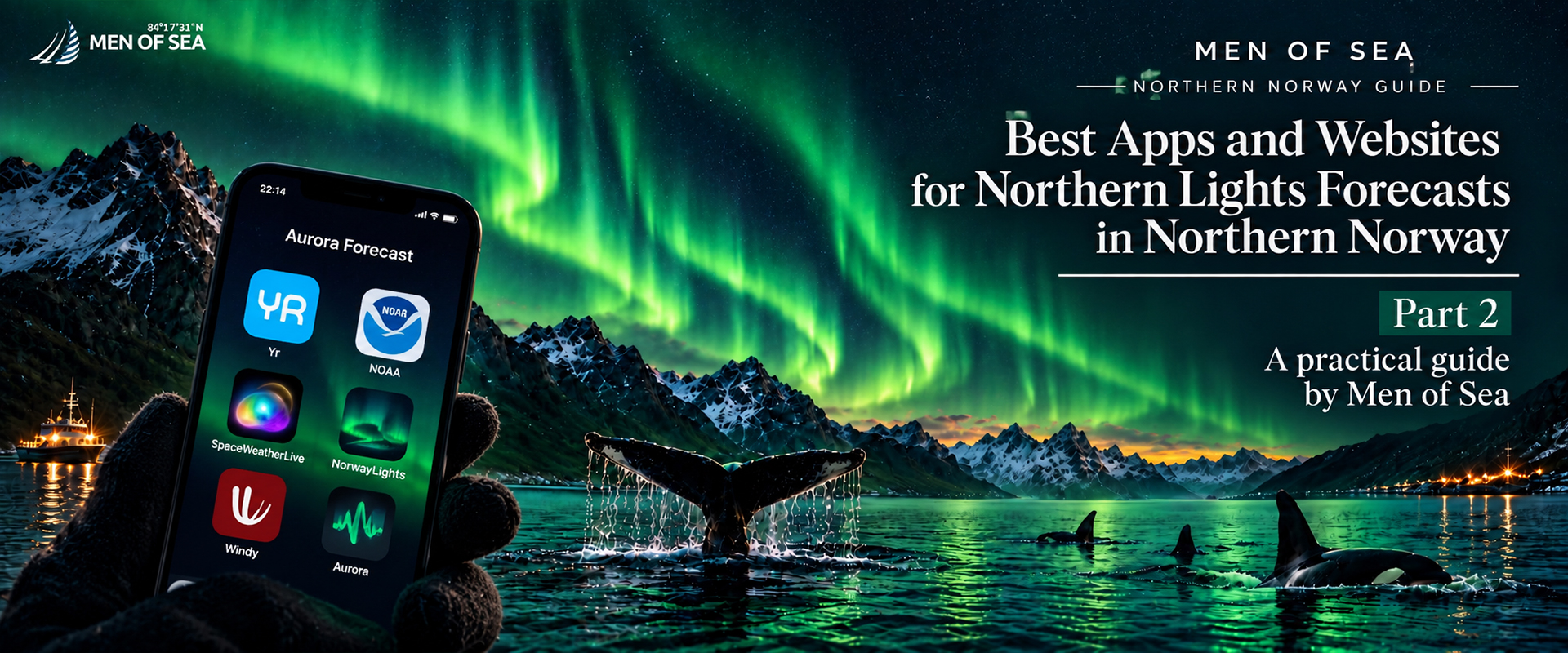
BEST APPS AND WEBSITES FOR NORTHERN LIGHTS FORECASTS IN NORTHERN NORWAY.
BEST APPS AND WEBSITES FOR NORTHERN LIGHTS FORECASTS IN NORTHERN NORWAY
After Part 1 of our Northern Norway Guide – HOW TO FORECAST THE NORTHERN LIGHTS IN NORTHERN NORWAY? – we want to share more practical information about forecasting the Aurora Borealis.
How to check the Northern Lights forecast in Tromsø, Kvænangen and Spildra?
People travelling to Tromsø or Northern Norway in winter quickly discover dozens of apps promising to answer one question: Will I see the Northern Lights tonight?
The problem is that no app can answer this with 100% certainty. Successful aurora hunting requires combining several types of information: local weather, cloud cover, solar wind data, Bz, Bt, Kp and the current position of the auroral oval.
That is why during our Northern Lights and Whales expeditions we never rely on a single app.
We use several sources at the same time. Each one serves a different purpose.
1. Yr – the most important weather app in Norway
If we had to choose one app worth having while travelling in Northern Norway, it would be Yr. The Yr app – or the website yr.no – is excellent for short-term local weather forecasting. And during Aurora Borealis hunting, the weather is crucial, because at least partly clear skies are one of the basic conditions for a successful Northern Lights observation.
How do we use Yr in practice?
It helps to understand some basic meteorology and to know how low-pressure systems, high-pressure systems and weather fronts behave. This makes it easier to judge how stable a forecast may be and how conditions are likely to change. For example, high-pressure systems are usually more stable and predictable than dynamic low-pressure systems. In winter, certain wind directions can bring colder and clearer air, while an approaching front may bring more or less cloud. This knowledge is especially useful for guides planning multi-day expeditions.
But if you do not have this meteorological background, simply check the cloud cover in your area. If the sky looks clear, plan your aurora hunt. If clouds are present, try to assess how dense they are and whether there may be breaks in the cloud cover. Even a short period of clearer sky can be enough to see an impressive Northern Lights display. You can also use Yr to compare nearby locations.
This is important because high mountains and fjords can create very local weather patterns. One fjord may be completely covered by clouds while another, only a short distance away, may have much clearer skies because of different terrain and mountain barriers. Yr also has its own aurora forecast section.
It provides an outlook for up to three days ahead, while its short-term aurora nowcast covers approximately 30–90 minutes. You can also enable notifications for increased aurora activity in a selected location.
What do we use Yr for?
Mainly for: cloud cover, temperature, wind, precipitation and the local Northern Lights forecast. During our expeditions, we are particularly interested in what is happening above Spildra and Kvænangen, rather than the general forecast for the entire Tromsø region. In the Arctic, a distance of several dozen kilometres can mean completely different weather.
The biggest advantage of Yr
For a regular traveller, Yr is very easy to use. You do not need to understand Bz or Bt.
You can quickly check: Will the sky clear, and does the app indicate aurora activity?
2. NOAA Space Weather Prediction Center – professional data
If we really want to understand what is happening with the Northern Lights, it is worth using data from the NOAA Space Weather Prediction Center. It is one of the main professional sources of space-weather information.
One of the most useful tools for aurora hunters is the Aurora 30-Minute Forecast. It shows the predicted position and intensity of the auroral oval over a short time horizon. This kind of nowcast is much more useful in the evening than a distant Kp forecast several days in advance.
NOAA is particularly useful when we want to answer the question: What is happening now, and what may happen in the next few dozen minutes?
3. SpaceWeatherLive – one of the best places to check Bz, Bt and solar wind
For people who want to go one level deeper, SpaceWeatherLive is one of the most useful services.
It is easier to use than NOAA and allows you to monitor several important parameters in one place: Kp index, solar wind speed, solar wind density, Bt, Bz, auroral oval and Hemispheric Power.
This is where we look when we want to understand not only: “Does the app show aurora?” but also: “Why is aurora activity increasing or decreasing?”
What do we check on SpaceWeatherLive?
First: Bz. If Bz is negative and remains negative for some time, this is a favourable sign. Then we look at: Bt, solar wind speed and density.
Finally, we check the current auroral oval and Kp.
The service also shows the estimated travel time of the solar wind from the measurement point upstream of Earth to our planet, based on its current speed. SpaceWeatherLive is therefore especially useful for people who want to learn how to forecast the Northern Lights, rather than simply receive a basic “go” or “wait” message.
4. NorwayLights – a simple app for travellers in Norway
NorwayLights is designed specifically for people looking for the Northern Lights in Norway. Visit Norway describes it as a website and app providing Northern Lights forecasts and information for the main Norwegian aurora destinations.
It provides a forecast for three days, and for the current day it also shows hourly information. One of its most convenient features is a simple recommendation: go, try or wait.
This recommendation combines weather information with solar-wind activity.
Who is it for?
It is aimed at people who do not want to analyse NOAA charts or IMF parameters. If someone is visiting Tromsø for a few days and wants a quick indication of whether it may be worth going aurora hunting in the evening, NorwayLights can be convenient.
However, based on our own experience, we do not consider it reliable enough to use on its own. We have seen situations where a very optimistic forecast was followed by no visible aurora, and the opposite situation, where a low-probability forecast was followed by an excellent Northern Lights display.
5. Windy – not an aurora app, but very important for clouds
Windy is primarily a weather forecasting app, not a Northern Lights app. And that is exactly why it can be so useful. Its major advantage is its weather maps. During aurora hunting, we are particularly interested in: clouds.
Not only total cloud cover, but also:
- low clouds,
- medium clouds,
- high clouds,
- the direction in which they are moving.
We use Windy together with Yr because Windy gives us additional information about different cloud layers. Dense low and medium clouds are usually the biggest obstacle when observing the Northern Lights. Higher, thinner cloud layers may be less problematic.
Windy also provides longer-range forecasts. However, in Northern Norway, forecasts beyond about three days should be treated cautiously.
For more experienced users, Windy is still very useful for identifying broader weather trends and helping guides plan Northern Lights outings.
Why is it worth using several sources?
A common mistake looks like this: Someone opens an app, sees: Kp 5 – great aurora! and assumes that a spectacular display will begin within an hour. But outside, the sky is completely covered by clouds. Or the opposite happens.
The app shows low activity. Kp is 1. The traveller stays in the hotel. Meanwhile, a beautiful aurora is glowing above Kvænangen.
That is why during our expeditions we try to answer two separate questions:
Is the aurora active? and: Will we be able to see it?
The first question is about space weather. The second is about the weather above us.
Our practical Northern Lights hunting setup
You can follow a very simple sequence.
First: Yr or Windy
We check: Will there be clouds, and when are breaks in the cloud cover expected?
If the whole evening is forecast to be completely overcast, excellent solar parameters will not help much.
Then: SpaceWeatherLive
We look at: Bz, Bt, solar wind speed and density. This gives a much better picture of the current potential than Kp alone.
Then: the Auroral Oval
We check whether the active oval is over Northern Norway. In Tromsø and Kvænangen, we are often already located within the natural auroral zone.
Finally: Kp
Kp is useful, but in Northern Norway it should not be the first parameter you look at.
Which app should a beginner use?
If someone is visiting Tromsø for the first time and does not want to study space weather:
Yr + NorwayLights.
This is enough to provide a useful basic overview. Yr will answer the most important weather questions. NorwayLights provides an easy-to-understand aurora assessment.
What should more advanced users use?
If you want to hunt the Northern Lights more consciously: Yr + Windy + SpaceWeatherLive + NOAA.
Together, these provide almost the full picture: local weather, cloud movement, solar wind data, Bz and Bt, and the current auroral oval.
Can an app tell you exactly when the Northern Lights will start?
No. If an app says: “Aurora starts at 22:35” you should not treat this as an exact prediction. The Northern Lights are a dynamic natural phenomenon.
Solar-wind data can provide very useful short-term information, but the behaviour of the magnetosphere and the aurora itself remains variable.
That is why nowcasts are much more valuable than attempts to predict an exact starting time several days in advance. Yr states that its aurora nowcast covers approximately 30–90 minutes ahead.
And one more important point: Do not blindly trust a single “Aurora probability” percentage.
Many apps display numbers such as: 12%, 48%, 87%. The problem is that these percentages may represent different things in different apps.
You should not automatically interpret them as: “I have an 87% chance of seeing the Northern Lights.”
It is always worth checking how the particular app defines this value.
During our expeditions, we are more interested in: what is actually happening in the data and in the sky
than in one attractive-looking percentage.
Why is Northern Norway different?
In Poland, Germany or southern Norway, a high Kp value may be very important because the auroral oval has to expand much farther south. In Tromsø and Kvænangen, the situation is different.
We are already located in one of the best regions in the world relative to the typical position of the auroral oval.
That is why: low Kp does not mean there will be no Northern Lights. This is extremely important to understand.
Spildra – an advantage no app can show
Apps are extremely useful. But in the end, one more thing matters: where you are.
During our Northern Lights and Whales expeditions, our base is the small island of Spildra in Kvænangen.
There is very little artificial light. Around us we have high mountains, open sea and wide fjord views. We do not have to drive for hours out of Tromsø every evening to escape city lights.
Sometimes all we need to do is step off the yacht. If the apps suddenly show a break in the clouds and improving conditions, we can react almost immediately. That is an advantage no Kp value can replace.
An app cannot replace looking at the sky
This is probably the most important advice. You can have several apps open at the same time, but sometimes the best thing to do is simply: go outside.
The Northern Lights can appear quickly, suddenly increase in intensity, last for a few minutes or continue for hours. They may look much better than the app suggested.
That is why we use technology during our expeditions, but we do not allow it to replace the simplest tool: our own eyes.
We have been sailing in remote parts of the world for many years and are able to assess the weather not only with apps, but also by observing the sky, cloud types, pressure and temperature.
This experience makes it easier for us to plan expeditions where Northern Lights hunting is one of the key elements.
FAQ – Northern Lights apps in Norway
What is the best Northern Lights app in Norway?
There is no single best app. For most people, a very useful combination is:
Yr for local weather and cloud cover, and NorwayLights for a simple aurora forecast.
More advanced users should also use NOAA and SpaceWeatherLive.
Does Yr show a Northern Lights forecast?
Yes. Yr provides an Aurora Borealis forecast for up to three days and a short-term nowcast approximately 30–90 minutes ahead. You can also enable aurora activity notifications.
Is NorwayLights a good app?
It is convenient for tourists travelling in Norway. It offers a three-day forecast and simple recommendations such as: go, try or wait. However, based on our own experience, we would not rely on it as the only source.
Where can I check Bz and Bt?
A very convenient service is SpaceWeatherLive. It shows real-time Bz, Bt, solar wind speed and density, as well as the auroral oval.
Where can I check the current auroral oval?
One of the best sources is the NOAA Space Weather Prediction Center, including its short-term auroral oval forecast.
Is Kp enough?
No. In Tromsø and Kvænangen, Kp should be only one of several parameters. Cloud cover, the current auroral oval, Bz and other solar-wind parameters are equally important, and often more important.
Is it worth using several apps?
Yes. One app may be excellent for weather, while another may be better for space weather. Combining several sources provides a much better picture than relying on one “aurora probability” percentage.
Men of Sea Northern Norway Guide
A. Part 1 – How to Forecast the Northern Lights in Northern Norway
B. Part 2 – Best Apps and Websites for Northern Lights Forecasts in Northern Norway
C. Part 3 – Tromsø: What to See and How to Plan Your Stay – Top Attractions and Practical Information
D. Part 4 – Tromsø by car – the best road trips, scenic drives and hikes around Tromso
E. Part 5 – Orcas and Humpback Whales in Norway – Where, When and How to See Them.
See also
Humpback Whales – the Singing Whales
Orcas – Intelligent and Family-Oriented
Kvænangen – Whales, Mountains, Sámi Culture and Glaciers
Snorkelling with Orcas and Humpback Whales
About the Author of This Guide
Marek Rajtar is the founder of Men of Sea, a skipper, photographer and organiser of expeditions in the Arctic and Northern Norway.
For more than a decade, he has been leading yacht expeditions across Svalbard, the Lofoten Islands and Northern Norway, exploring these regions both from the sea and during hikes and land-based expeditions. He has led numerous expeditions and trips around Svalbard, in the waters of Northern Norway and among the islands of Lofoten. His achievements include several records, new routes in the High North that he discovered himself, and a number of awards. He is also the author of many publications that have appeared in various media outlets.
His experience includes sailing in Arctic conditions, expedition route planning, landscape and wildlife photography, and observing wildlife in its natural environment. As a result, Men of Sea guides are not based solely on online sources — they are enriched with knowledge and observations gained during real expeditions.
When writing about places such as Svalbard, Lofoten or Northern Norway, Marek Rajtar draws on experience gathered over successive seasons spent in the North, with particular attention to weather conditions, access from the sea, safety, photography and the practical aspects of travelling in these regions.
Marek Rajtar
Captain • Photographer • Expedition Organiser
Men of Sea