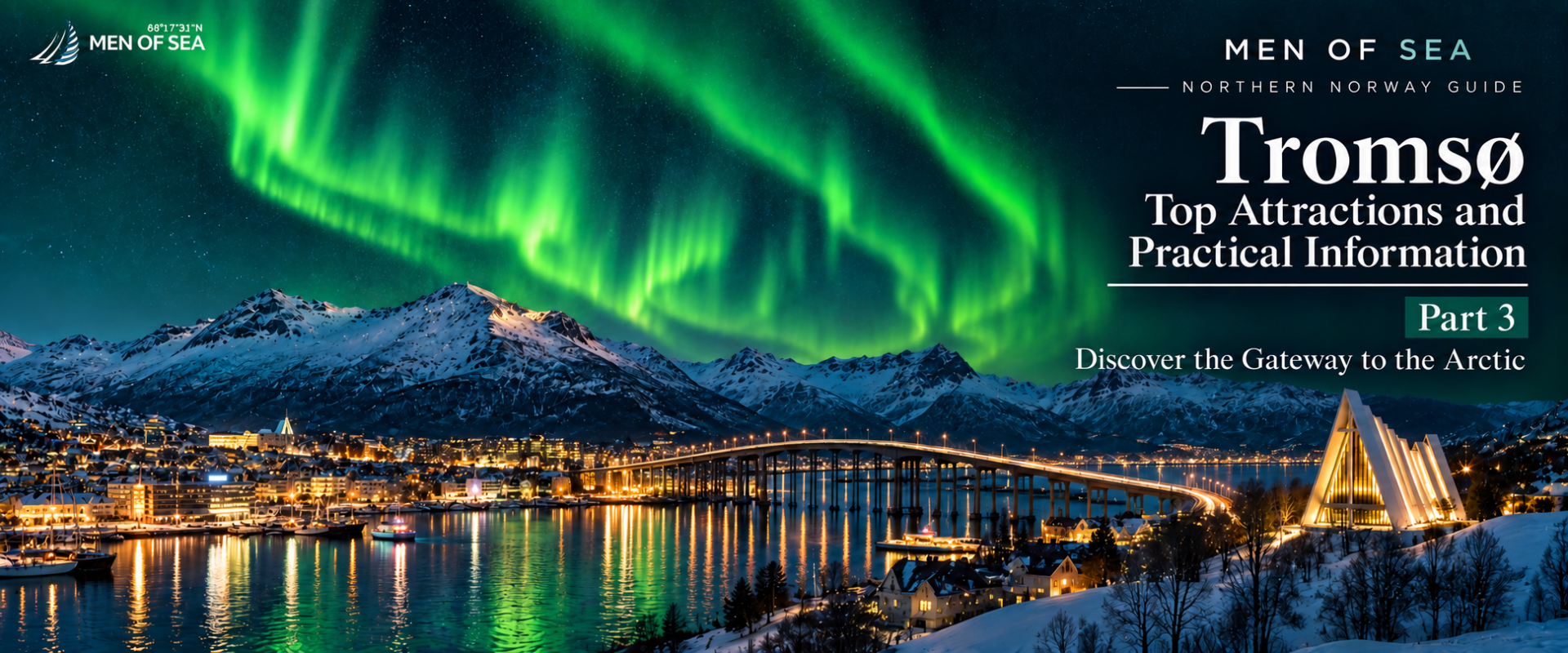
TROMSØ – WHAT TO SEE AND HOW TO PLAN YOUR STAY? TOP ATTRACTIONS AND PRACTICAL INFORMATION.
TROMSØ – WHAT TO SEE AND HOW TO PLAN YOUR STAY? TOP ATTRACTIONS AND PRACTICAL INFORMATION
Men of Sea Northern Norway Guide – Part 3
Tromsø is often the first introduction to Northern Norway for many travellers. This relatively small city, located well above the Arctic Circle, is at the same time an important harbour, a university centre and one of the most popular bases for Northern Lights trips, whale watching, fjord tours and Arctic adventures.
For participants joining our Northern Lights and Whales expeditions, Tromsø is also the natural gateway farther north, towards Kvænangen and Spildra.
However, Tromsø should not be treated only as an airport or transfer point. If you can spend one or two extra days in the city, you will find interesting museums, Arctic architecture, excellent viewpoints and a wide choice of day trips.
In this part of our Men of Sea Northern Norway Guide, we explain what to see in Tromsø, how to get around, where to look for the Northern Lights, how much the main attractions cost and how to plan accommodation and airport transport.
Tromsø – a city you can explore on foot
Tromsø city centre is compact, and most of the main attractions can be reached on foot. The natural axis of the centre is Storgata, Tromsø’s main street. Around it you will find shops, restaurants, cafés, traditional wooden buildings, the harbour and Stortorget, the city’s main square. It is also worth walking down towards the waterfront.
From here you get some of the best views of Tromsø Bridge, the Arctic Cathedral and the mountains on the other side of the strait.
If you only have a few hours, a walk through the centre, along the harbour and Storgata is a very good introduction to Tromsø.
Tromsø Bridge and the Arctic Cathedral
One of our favourite walks is the route from central Tromsø across Tromsø Bridge to Tromsdalen. The bridge is about one kilometre long, and crossing it on foot takes roughly 20 minutes.
From the bridge you can enjoy excellent views of the city centre, the harbour, Tromsøya island and the surrounding mountains.
On the other side stands one of the city’s main landmarks: Ishavskatedralen, the Arctic Cathedral. This distinctive church, built in 1965, has become one of the most recognisable buildings in Northern Norway. It is worth seeing not only from the outside. In 2026, standard admission costs 90 NOK, while children under 12 enter free of charge.
The Arctic Cathedral is also a convenient stop on the way towards Fjellheisen.
Fjellheisen and Fløya – the best view over Tromsø
If we had to choose just one viewpoint in Tromsø, it would be the area around Fjellheisen and Fløya. The lower cable-car station is located in Tromsdalen.
From the city centre you can walk there via Tromsø Bridge and the Arctic Cathedral, or take bus number 26.
The walk from the centre to the lower station takes around 45 minutes. It is a particularly pleasant route because you can combine crossing the bridge with a visit to the Arctic Cathedral.
Fjellheisen takes passengers up to Storsteinen, where you can enjoy a panoramic view over Tromsø, Tromsøya, the fjords and the surrounding mountains.
In 2026, a return ticket for an adult costs 645 NOK, while a one-way ticket costs 415 NOK. If the weather is good, you can also walk up instead of taking the cable car.
A popular route is the Sherpatrappa – the Sherpa Steps, leading high above Tromsdalen. From there, you can continue hiking towards Fløya.
For people who enjoy mountain walking, this is a much more rewarding option, but in winter you must take into account snow, ice, strong winds, limited daylight and rapidly changing weather.
Fjellheisen is also a popular place for watching the Northern Lights. In winter, you may see the Aurora Borealis over Tromsø from above, although the city lights create more light pollution than locations outside the city.
Prestvannet – where to see the Northern Lights without leaving Tromsø
If you do not want to travel far outside the city, Prestvannet is worth considering. This small lake is located on the higher part of Tromsøya and is surrounded by walking paths.
The area has a long history connected with Northern Lights observations and aurora research in Tromsø. Prestvannet is often mentioned as one of the traditional places for watching the Aurora Borealis in the city.
Of course, it is not completely dark – you are still within Tromsø. However, once you move away from the main roads, there is considerably less artificial light than in the city centre. With clear skies and active aurora, Prestvannet can be a very good place for an evening walk.
If you want genuinely dark skies, however, it is better to travel outside the city. That is one of the reasons why our Northern Lights and Whales expeditions are based on Spildra in Kvænangen, where light pollution is dramatically lower.
Polaria – seals and the Arctic in the centre of Tromsø
One of Tromsø’s most popular attractions is Polaria. It is not simply a seal aquarium, but an Arctic educational centre and aquarium.
Among the fish on display you can see species such as Atlantic wolffish – which, in our opinion, is one of the tastiest fish found in Northern Norway, even if its appearance may not be particularly inviting.
Polaria also features seals, aquariums with species from northern seas, exhibitions about the polar environment and films about the Arctic. It is one of only a few places in Europe where you can see bearded seals at close range. Daily feeding and training sessions are also organised.
Polaria is especially worth visiting in poor weather or when travelling with children. The current adult ticket price is approximately 395 NOK.
Planetarium and Northern Lights show
Another place worth visiting is the Science Centre of Northern Norway – Nordnorsk Vitensenter. It is home to Norway’s largest planetarium.
For anyone interested in the aurora, the Extreme Auroras show is particularly interesting. It presents the Aurora Borealis using 360° fulldome technology and explains the phenomenon from scientific, historical and cultural perspectives. The show takes place regardless of whether there is aurora outside, a snowstorm or complete cloud cover.
You can learn a great deal about the Northern Lights, but when booking your ticket remember to check the language of the show. In addition to Norwegian, presentations are available in English and German.
Admission to the Science Centre also includes the planetarium. In 2026, adult admission costs 150 NOK.
In our opinion, this is an excellent activity before your first real Northern Lights hunt.
Polar Museum – the history of Arctic people and expeditions
If you are interested in the history of polar expeditions, visit Polarmuseet – the Polar Museum. The museum covers topics such as trapping, hunting, the lives of people in the far north and the history of Arctic expeditions, including journeys associated with Roald Amundsen and Fridtjof Nansen. It is located in the historic harbour area and fits very naturally into a walk through the northern part of central Tromsø.
In 2026, an adult ticket costs 130 NOK, while admission is free for visitors under 18.
Tromsø Cathedral and the wooden architecture of the city centre
In the very centre of Tromsø, it is also worth seeing Tromsø Cathedral. Do not confuse it with the Arctic Cathedral on the other side of the bridge. Tromsø Cathedral stands on Storgata and is one of the characteristic landmarks of the historic centre.
While walking around the city, pay attention to Tromsø’s preserved wooden architecture.
For centuries, Tromsø developed as a trading port and a base for journeys into the far north, so its history has always been closely connected with the sea and the Arctic.
Telegrafbukta
If you have more time, it is worth travelling or walking to the southern end of Tromsøya to Telegrafbukta. It is a popular coastal recreation area with views over the fjord and surrounding mountains. From here you can see Kvaløya, one of the most beautiful islands around Tromsø.
Telegrafbukta is also an interesting location for photography at sunrise or sunset and, in suitable conditions, for Northern Lights observation. In winter, be careful on icy paths.
How to get around Tromsø
The most important public transport app is currently Svipper. It allows you to plan journeys, check real-time departures and buy tickets for buses and express passenger boats in the Troms region.
From February 2026, a standard single ticket for one zone costs 50 NOK, while an off-peak ticket in Tromsø is available for 30 NOK. It is worth installing Svipper before arriving.
Google Maps and Apple Maps are also useful for planning walking routes and locating individual attractions.
For hiking routes, we also recommend two apps: Mapy.com and Norgeskart.
Do Uber and Bolt operate in Tromsø?
Uber operates in Tromsø.
The company currently lists Tromsø among its supported cities and allows rides to be booked in the app, including in advance.
The situation with Bolt is different. Its current list of Norwegian cities includes places such as Oslo, Bergen, Trondheim, Stavanger and Ålesund, but Tromsø is not currently listed.
Traditional taxi companies also operate in the city, including Tromsø Taxi and Din Taxi.
How to get from Tromsø Airport to the city centre
Tromsø Langnes Airport is located very close to the city. The drive to the centre usually takes around 10 minutes. The cheapest option is a local bus departing from the airport.
The bus stop is located behind the underground parking area on the lower level of the airport. Tickets can be purchased in the Svipper app, from a ticket machine at the stop or from the driver.
If you choose a taxi, the estimated fare to the city centre is around 350 NOK during the day, about 400 NOK in the evening and around 450 NOK late at night.
Prices depend on time, operator and tariff, so it is worth asking for the approximate fare before starting the journey.
Where to stay in Tromsø
If you are staying for one or two nights, central Tromsø is usually the most practical option. From there, you can walk to most restaurants, the harbour, Polaria, the Polar Museum and many of the meeting points for organised tours.
Hotels should be booked as early as possible, particularly between autumn and March. The Northern Lights season creates very high demand for accommodation. Apartments can also sometimes be found through local forums and community groups.
One important point: if you try to book at the last minute, you may find that no suitable rooms are available. We recommend securing accommodation well in advance.
Prices vary considerably by date. In popular winter periods, a good room in central Tromsø can realistically cost around 1,500–3,000 NOK per night, and during peak dates even more.
Restaurants in Tromsø – what should you try?
Tromsø has a very good food scene for a city of its size. It is worth trying: cod, halibut, stockfish, seafood, king crab, reindeer and dishes inspired by Northern Norwegian cuisine.
If you are looking for food based on local products, consider Mathallen Tromsø. Fiskekompaniet specialises in fish and seafood.
Bardus Bistro is a popular Norwegian-style bistro. In the historic harbour district you will also find Full Steam Tromsø.
A couple of years ago, they served what we considered an excellent reindeer stew. The chef has since changed, so we are waiting before giving it the same full recommendation again.
If you are looking for a traditional pub with a large selection of local beers, visit Ølhallen.
Before visiting restaurants and pubs, however, remember one thing: the prices are very much… Norwegian.
During the winter season, good restaurants are worth booking in advance.
What day trips can you book from Tromsø?
Tromsø has a huge selection of day tours and activities.
Prices vary depending on operator, date and season, so the amounts below should be treated as approximate prices for the 2026/27 season.
- Northern Lights tour by bus: from around 1,285 NOK; Northern Lights cruises from around 1,090 NOK. If the weather around Tromsø is poor, a tour towards the Finnish border may sometimes be worth considering. Mountains can block cloud systems, meaning that conditions farther inland may be much clearer.
- Whale watching: around 1,990 NOK for a full-day trip. Remember that boats may travel a long distance both ways towards Kvænangen, and the actual time spent watching whales may sometimes be less than an hour. It is also worth checking the weather yourself before departure, especially wind and wave conditions. Even if the vessel sails, rough conditions can make the journey unpleasant for anyone prone to seasickness.
- Dog sledding: usually around 2,990–3,950 NOK, depending on the programme and operator. These trips have often been offered as an optional activity during our Northern Lights and Whales expeditions and have received very positive feedback from our participants.
- Reindeer and Sámi culture: around 2,195 NOK for an evening programme including sledding, reindeer feeding and Northern Lights hunting.
- Fjord tour / Kvaløya / Sommarøy: around 990–1,750 NOK, depending on duration and type of transport. Fjord cruises start from around 1,150 NOK.
Most of these trips start and finish in central Tromsø, so getting to the meeting point is usually easy. It is worth booking in advance, as activities such as dog sledding often sell out quickly.
Is it worth renting a car in Tromsø?
If you only plan to explore central Tromsø, the Arctic Cathedral and Fjellheisen, you do not need a car.cIf you want to explore Kvaløya, Sommarøy, Ersfjordbotn or other places outside the city independently, however, a rental car gives you much more freedom.
In winter, keep in mind that driving in Northern Norway may involve: snow, ice, strong winds, poor visibility and sudden weather changes. Free parking is also difficult to find in Tromsø, and paid parking can be expensive.
For drivers without experience in northern winter conditions, an organised excursion may be the better option.
In the next part of our Northern Norway Guide, we explain what is worth seeing if you have a car.
If your main goal is independent Northern Lights hunting, a car becomes one of the most useful parts of the trip.
What to pack for Tromsø in winter
Layered clothing is the most important thing. Because Tromsø is located by the sea, extreme cold is not always the biggest issue.
Wind, humidity and spending long periods standing still while watching the Northern Lights can make you feel much colder. Frequent snowfall or wet snow should also be expected.
Good footwear with grippy soles is very important. Waterproofing your boots and even bringing a small boot dryer can be useful.
In winter, Tromsø’s pavements are often icy. Small anti-slip cleats or microspikes can sometimes be more useful than adding another thick jacket.
How many days should you spend in Tromsø?
For the city centre itself, one full day is enough.
If you want to visit museums, hike or take the cable car towards Fløya, visit the planetarium and take a day trip outside the city, allow two or three days.
If your main goal is the Northern Lights, remember one key rule: the more nights you have, the better your chances of suitable conditions.
One night may be completely overcast. With several nights available, you have much more flexibility to react to changing weather.
Tromsø or Kvænangen – where is better for the Northern Lights?
Tromsø is an excellent starting point. It has an airport, hotels, restaurants, attractions and a huge range of organised excursions. But it also has the lights of a relatively large city.
That is why during our Northern Lights and Whales expeditions, we travel farther north to Kvænangen.
Our base is the small island of Spildra. There is very little artificial light. Around us are mountains, fjords and the open sea, while during the day we head out in search of orcas and humpback whales.
In the evening, we do not necessarily need to organise a multi-hour Northern Lights hunt.
If conditions improve, often all we need to do is: step outside and look at the sky.
That is why we see Tromsø as an excellent gateway to Northern Norway. But for us, the real Arctic adventure begins a little farther north.
FAQ – Tromsø
What are the best things to see in Tromsø in one day?
A good plan is to walk along Storgata and the harbour, cross Tromsø Bridge, visit the Arctic Cathedral and take the Fjellheisen cable car. If you still have time, visit Polaria or the Polar Museum.
Where is the best viewpoint in Tromsø?
The best-known viewpoint is Storsteinen, next to the upper Fjellheisen station. You can also continue hiking towards Fløya.
Where can you see the Northern Lights in Tromsø?
The aurora can sometimes be seen even from the city centre, but places with less artificial light are better. Prestvannet is one option. The best conditions are generally found outside the city.
Does Uber operate in Tromsø?
Yes. Uber currently operates in Tromsø.
Which app should I use for buses in Tromsø?
Svipper. It is used to plan journeys and buy tickets for buses and express passenger boats throughout the Troms region.
How much is a taxi from Tromsø Airport to the city centre?
Expect approximately 325–350 NOK during the day, around 400 NOK in the evening and around 450 NOK late at night, although fares vary by operator and time.
How much does Fjellheisen cost?
In 2026, an adult return ticket costs 645 NOK.
Men of Sea Northern Norway Guide
A. Part 1 – How to Forecast the Northern Lights in Northern Norway
B. Part 2 – Best Apps and Websites for Northern Lights Forecasts in Northern Norway
C. Part 3 – Tromsø: What to See and How to Plan Your Stay – Top Attractions and Practical Information
D. Part 4 – Tromsø by car – the best road trips, scenic drives and hikes around Tromso
E. Part 5 – Orcas and Humpback Whales in Norway – Where, When and How to See Them.
See also
Humpback Whales – the Singing Whales
Orcas – Intelligent and Family-Oriented
Kvænangen – Whales, Mountains, Sámi Culture and Glaciers
Snorkelling with Orcas and Humpback Whales
About the Author of This Guide
Marek Rajtar is the founder of Men of Sea, a skipper, photographer and organiser of expeditions in the Arctic and Northern Norway.
For more than a decade, he has been leading yacht expeditions across Svalbard, the Lofoten Islands and Northern Norway, exploring these regions both from the sea and during hikes and land-based expeditions. He has led numerous expeditions and trips around Svalbard, in the waters of Northern Norway and among the islands of Lofoten. His achievements include several records, new routes in the High North that he discovered himself, and a number of awards. He is also the author of many publications that have appeared in various media outlets.
His experience includes sailing in Arctic conditions, expedition route planning, landscape and wildlife photography, and observing wildlife in its natural environment. As a result, Men of Sea guides are not based solely on online sources — they are enriched with knowledge and observations gained during real expeditions.
When writing about places such as Svalbard, Lofoten or Northern Norway, Marek Rajtar draws on experience gathered over successive seasons spent in the North, with particular attention to weather conditions, access from the sea, safety, photography and the practical aspects of travelling in these regions.
Marek Rajtar
Captain • Photographer • Expedition Organiser
Men of Sea