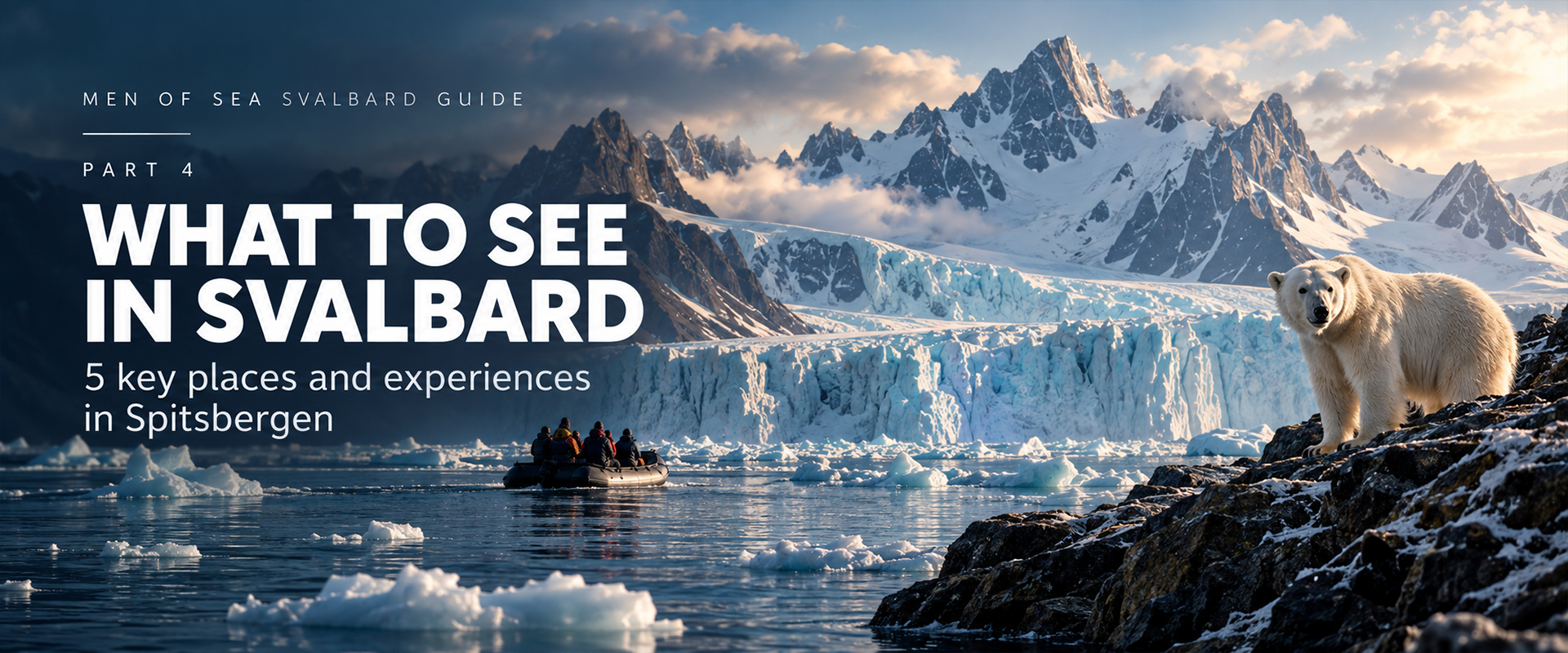
What to see in Svalbard. 5 key places and experiences in Spitsbergen.
What to See in Svalbard? 5 Must-See Places and Attractions in Spitsbergen
Men of Sea Svalbard Guide – Part 4: What to See in Svalbard?
Svalbard is one of the most extraordinary places in the entire Arctic. Glaciers flow directly into the sea, walruses and reindeer can be seen along the coast, whales and belugas appear in the fjords, and between the mountains and ice you can still find traces of polar explorers, mining history and historic expeditions.
If you are planning your first trip and wondering what to see in Svalbard, there is one important thing to remember: this is not a destination that can always be explored according to one fixed itinerary. Weather, sea ice and the presence of wildlife can change the plan from one day to the next. However, there are several places and experiences that show the different faces of Svalbard particularly well.
Here are our 5 must-see places and attractions in Spitsbergen.
1. Longyearbyen – the Starting Point for Most Svalbard Adventures
Longyearbyen is the largest settlement in Svalbard and, for most travellers, the first place they see after arriving in the archipelago. Although it has only a few thousand residents, it is the administrative, tourist and logistical centre of Svalbard.
It is worth walking through the small town centre, visiting the harbour and seeing the characteristic Arctic architecture, as well as the remains of former mining infrastructure. For many years, the development of Svalbard was closely connected with coal mining, and traces of this history are still clearly visible in the Longyearbyen landscape.
Svalbard Global Seed Vault
One of the most famous places near the town is the Svalbard Global Seed Vault. This secure storage facility, built inside a mountain, holds duplicate seed samples from gene banks around the world. It was designed to help safeguard global crop diversity in case of disasters, conflicts or the loss of local collections.
The interior is not normally open to tourists, but the distinctive entrance can be seen from outside.
What Is Worth Seeing in Longyearbyen?
The most interesting places include:
- Longyearbyen town centre,
- the harbour,
- Svalbard Museum,
- Svalbard Global Seed Vault,
- old mining installations and cableways,
- the old airport area and Adventdalen.
We also recommend three hikes in the surrounding area:
- A few-hour hike to the nearby Longyearbreen glacier.
- A hike to Mount Sarkofagen, with a beautiful panoramic view of the area.
- A shorter hike to the nearby Sverdruphamaren.
It is important to remember that travelling outside Longyearbyen without appropriate polar bear protection is dangerous, so these hikes should be done with a qualified guide.
Longyearbyen is worth treating not only as a transit point, but also as a good introduction to the history and character of Svalbard.
2. Pyramiden – an Abandoned Arctic Town
Pyramiden is one of the most unusual places in Spitsbergen. The former Soviet mining settlement functioned for decades almost like a self-contained town. Coal mining ended in the late 20th century and most residents left, but many of the buildings remain.
You can still see residential blocks, a school, sports facilities, the monumental cultural centre, a canteen, a hotel and one of the most distinctive Lenin statues in the Arctic. As a result, Pyramiden feels like a place frozen in time. It is not only a historical attraction.
The settlement lies on Billefjorden, surrounded by mountains and glaciers. The combination of Soviet architecture, history and Arctic landscape makes Pyramiden one of the most photogenic places in Svalbard. When travelling by sea, the entrance to Billefjorden itself is also a major attraction and one of the most beautiful parts of Isfjorden.
Pyramiden cannot be reached overland from Longyearbyen. You need either a day boat trip or a longer organised expedition that includes it in the itinerary.
3. Svalbard Glaciers – Meeting the Living Ice of the Arctic
You cannot truly experience Svalbard without seeing its glaciers. They cover a vast part of the archipelago and are one of the defining elements of the landscape. Particularly spectacular are tidewater glaciers, whose fronts form huge walls of ice where the glacier reaches the sea.
From the deck of a yacht, you may see:
- blue crevasses,
- icebergs drifting through the fjord,
- fractured ice,
- waterfalls flowing down glacier surfaces,
- and sometimes glacier calving.
Borebreen and Borebukta
One interesting place relatively close to Longyearbyen is Borebukta and the Borebreen glacier. It is a good example of a place where a glacier landscape and wildlife observations can be combined during the same expedition.
Monacobreen
On longer expeditions, it is possible to travel farther north to places such as Monacobreen. It is one of the most spectacular glaciers in northern Spitsbergen and one of the places where the true scale of the Arctic landscape becomes particularly clear.
What Is Glacier Calving?
One of the most spectacular natural processes is glacier calving. This occurs when part of the glacier front breaks away and falls into the sea with a huge roar.
The detached ice becomes an iceberg and may continue drifting through the fjord for many days. It is not something that can be scheduled for a particular hour, which is exactly why witnessing it is so memorable.
The most impressive marine-terminating glaciers are generally observed from a yacht or ship.
4. Svalbard Wildlife – Walruses, Whales, Belugas and Polar Bears
One of the greatest attractions of Svalbard is the opportunity to observe wild animals in their natural environment. This is not a zoo or a safari park. Animals appear where conditions are best for them at that particular moment. That is why every wildlife encounter is unpredictable.
Walruses: Walruses can be seen on beaches, small islands and sea ice. Sometimes they rest in large groups, while at other times individual animals can be seen swimming near the coast or a yacht.
Svalbard reindeer: The Svalbard reindeer is unique to this archipelago. It can even be seen close to Longyearbyen, but some of the most beautiful encounters happen during tundra hikes.
Arctic foxes: The Arctic fox occurs throughout Svalbard. In summer, it is often seen around bird cliffs, where food is abundant.
Whales and belugas: Many species of whales occur in Svalbard waters. These include humpback whales, fin whales and the characteristically Arctic beluga whales, which often travel in groups along the coast and through fjords. Watching white belugas against dark Arctic water and glaciers is one of the most characteristic wildlife experiences in Svalbard.
Polar bears: The symbol of the archipelago remains, of course, the polar bear. However, a polar bear sighting is never guaranteed. Polar bears move freely across a huge area of the archipelago and can cover long distances. It is precisely this unpredictability that makes an encounter with a polar bear so special.
The best wildlife encounter is always one where the animal continues to behave naturally and does not change its behaviour because of human presence.
5. Ny-Ålesund and Wild North-West Spitsbergen
Ny-Ålesund is one of the most unusual settlements in the world. Located on Kongsfjorden, it is now primarily an international scientific research centre. At the same time, it has an important place in the history of Arctic exploration. In the 1920s, several aerial expeditions towards the North Pole departed from here. Today, you can still see the mooring mast used during the Norge and Italia airship expeditions, as well as a monument to Roald Amundsen.
Ny-Ålesund, however, is only the beginning of what this region has to offer.
Kongsfjorden
Kongsfjorden is one of the most scenic fjords in western Spitsbergen. It is surrounded by mountains and glaciers, and its location makes it a good area for observing Arctic wildlife.
Magdalenefjorden
Farther north lies Magdalenefjorden. High mountains, glaciers and the narrow fjord create one of the classic landscapes of Spitsbergen.
North-West Spitsbergen
The farther north you travel, the more the character of the expedition changes. There is usually more ice, fewer signs of modern civilisation and a stronger feeling of being in the real Arctic. For us, north-western Spitsbergen is one of the best regions for a first encounter with wild Svalbard.
What Can You See in Svalbard During One Expedition?
You do not have to choose between history, glaciers and wildlife. One of the biggest advantages of travelling around Svalbard by yacht is the possibility of seeing several completely different faces of the Arctic during a single expedition.
One day you may walk through abandoned Pyramiden. The next day you may stand in front of the towering face of a glacier. A few hours later, you may encounter walruses, belugas or whales.
And somewhere along the way, a polar bear may appear. There is no single perfect itinerary.
In Svalbard, weather, ice and wildlife always have the final word. That is why a good expedition should have a detailed plan, but also the flexibility to change it.
This is what makes every journey around Svalbard different.
Can You Explore Svalbard on Your Own?
In practice, only to a limited extent. Without a properly equipped guide, most visitors should remain within Longyearbyen itself. Longyearbyen has a unique atmosphere and is certainly worth exploring, but for travellers who want to experience the real Arctic, it is not enough on its own. We think around two days in Longyearbyen can be spent very well.
The second option is to stay in Longyearbyen and book day trips by boat or fast motorboat.
This gives you a much better chance of seeing the surrounding fjords, wildlife and glaciers.
However, we recommend booking at least a multi-day yacht or ship expedition, which gives you a much better opportunity to experience the most important attractions of Svalbard.
FAQ – What to See in Svalbard?
What are the main attractions in Svalbard?
The main attractions include Longyearbyen, Pyramiden, glaciers, Arctic wildlife, Ny-Ålesund and north-western Spitsbergen.
What should you see on your first trip to Svalbard?
On a first visit, it is worth combining Longyearbyen with an expedition outside town to see glaciers, fjords, wildlife and at least one historic place such as Pyramiden or Ny-Ålesund.
Is Pyramiden worth visiting?
Yes. Pyramiden combines the unusual history of a former Soviet mining settlement with a beautiful location on Billefjorden.
Where can you see the best glaciers in Svalbard?
Spectacular glaciers can be seen in many parts of Spitsbergen. Interesting locations include Borebreen, Monacobreen and the glaciers of Kongsfjorden and north-western Spitsbergen.
Can you see polar bears in Svalbard?
Yes, but sightings are never guaranteed.
Polar bears are wild animals that move across a vast area of the archipelago.
What wildlife can you see in Svalbard?
You may see walruses, Svalbard reindeer, Arctic foxes, seals, whales, belugas, many species of seabirds and polar bears.
Is Ny-Ålesund worth visiting?
Yes. Ny-Ålesund is interesting both for its polar exploration history and for its location in one of the most beautiful regions of western Spitsbergen.
How many days do you need in Svalbard?
A few days are enough to experience Longyearbyen and the nearest surroundings, but to see a wider variety of fjords, glaciers and wildlife, it is worth allowing at least around one week.
Is it better to explore Svalbard by land or by sea?
Both have advantages.
Travelling by yacht allows you to reach remote fjords, glaciers and areas without roads, and to adjust the route according to weather, sea ice and wildlife.
Men of Sea Svalbard Guide Series
MEN OF SEA SVALBARD GUIDE SERIES
A. Part 1 – How to Get to Svalbard
B. Part 2 – What to Pack for Svalbard
C. Part 3 – When Is the Best Time to Visit Svalbard?
D. Part 4 – What to see in Svalbard. 5 key places and experiences in Spitsbergen.
E. Part 5 – Polar Bears in Svalbard – Where They Live, How to See Them and How to Observe Them Safely
LOOK ALSO AT:
Glacier Trekking in Svalbard
Zodiac Landings in Svalbard
Photography in Svalbard
Svalbard Yacht Expeditions
Svalbard Wildlife
About the Author of This Guide
Marek Rajtar is the founder of Men of Sea, a skipper, photographer and organiser of expeditions in the Arctic and Northern Norway.
For more than a decade, he has been leading yacht expeditions across Svalbard, the Lofoten Islands and Northern Norway, exploring these regions both from the sea and during hikes and land-based expeditions. He has led numerous expeditions and trips around Svalbard, in the waters of Northern Norway and among the islands of Lofoten. His achievements include several records, new routes in the High North that he discovered himself, and a number of awards. He is also the author of many publications that have appeared in various media outlets.
His experience includes sailing in Arctic conditions, expedition route planning, landscape and wildlife photography, and observing wildlife in its natural environment. As a result, Men of Sea guides are not based solely on online sources — they are enriched with knowledge and observations gained during real expeditions.
When writing about places such as Svalbard, Lofoten or Northern Norway, Marek Rajtar draws on experience gathered over successive seasons spent in the North, with particular attention to weather conditions, access from the sea, safety, photography and the practical aspects of travelling in these regions.
Marek Rajtar
Captain • Photographer • Expedition Organiser
Men of Sea