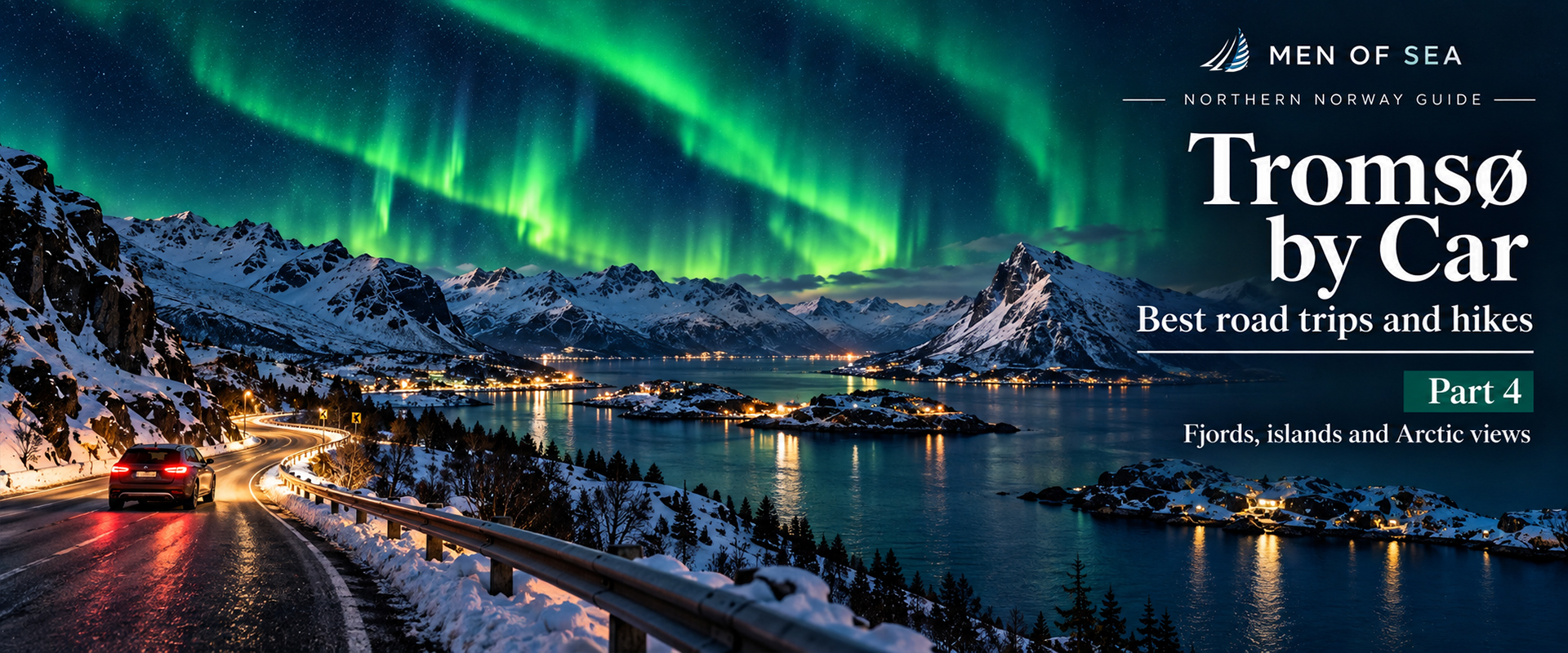
TROMSØ BY CAR – THE BEST ROAD TRIPS, SCENIC DRIVES AND HIKES AROUND TROMSØ.
TROMSØ BY CAR – THE BEST ROAD TRIPS, SCENIC DRIVES AND HIKES AROUND TROMSØ. Tromso road trips.
Men of Sea Northern Norway Guide – Part 4
Tromsø is an excellent base not only for exploring the city itself. Some of the most spectacular landscapes in Northern Norway begin almost immediately after you cross the bridge towards Kvaløya.
Within less than an hour, you can find yourself beside a wide Arctic fjord, on an empty white-sand beach, beneath steep mountain walls, at the historic site where the battleship Tirpitz was sunk, or at the trailhead of one of the best short hikes near Tromsø.
Having a car gives you enormous freedom in this region. Many of the best places around Tromsø are difficult to reach efficiently by public transport. In winter, a car also allows you to react to changing weather and drive towards clearer skies when hunting the Northern Lights.
In Part 4 of our Men of Sea Northern Norway Guide, we show you some of the best road trips from Tromsø, short scenic hikes, practical winter-driving advice and the places we think are most worth visiting depending on the weather and season.
Is it worth renting a car in Tromsø? Tromso road trips
If you only plan to visit central Tromsø, Fjellheisen and the Arctic Cathedral, you probably do not need a car. In fact, parking in the city can sometimes be more of a problem than a benefit.
But if you want to explore Kvaløya, Sommarøy, Ersfjordbotn, Grøtfjord, Tromvik, Håkøya or even drive towards Finland, renting a car becomes one of the best ways to discover Northern Norway.
Kvaløya begins just outside Tromsø and gives you access to fjords, beaches, mountain valleys and numerous hiking routes.
The drive from Tromsø to Sommarøy takes about an hour, and the road itself is part of the experience: it passes through mountain landscapes, along fjords and across wide Arctic valleys. Ersfjord, Kattfjordeidet, Sommarøy and Hillesøy among popular scenic stops west of the city.
Rental prices vary strongly by date and season. As a rough guide, basic cars may start at around 600–800 NOK per day, but winter, Northern Lights season and weekends can be considerably more expensive.
When booking a rental car, check:
- insurance and the excess,
- mileage limits,
- winter tyre specification,
- whether driving into Finland is permitted,
- whether cross-border travel has to be declared in advance,
- additional fees.
If you are planning to drive to Kilpisjärvi, confirm the cross-border rules before collecting the vehicle.
What kind of car do you need in winter?
You do not automatically need a large SUV.
The most important things are good winter tyres, appropriate speed and winter-driving experience.
Studded tyres are very common in Northern Norway and can provide excellent grip in icy conditions, but they are not legally mandatory in all winter situations. The official rule is that the driver must ensure sufficient grip for the actual conditions. In Troms and Finnmark, studded tyres are normally permitted from 16 October to 30 April, and outside that period when conditions require them.
Four-wheel drive can help when starting on snow or getting out of a snowy parking area, but it does not change the laws of physics: 4WD does not shorten your braking distance on ice.
A well-driven compact car on excellent winter tyres may be safer than a heavy SUV driven too fast.
Driving around Tromsø in winter. Tromso road trips
Winter is the most demanding time of year for driving. Roads may be covered with: packed snow, ice, slush or fresh snow.
You may also encounter strong winds, drifting snow and rapid changes in visibility.
Before every longer drive, we recommend checking: Yr for weather,, Vegvesen Trafikk / 175.no for road conditions and closures, and Varsom for avalanche conditions if you are planning a mountain hike.
Road closures and temporary restrictions are not unusual in Northern Norway, and official traffic information for Norwegian roads is available through Vegvesen Trafikk and 175.no. (Statens vegvesen)
If you have never driven on winter roads before, remember one thing: white, icy roads are normal winter conditions in Northern Norway.
Summer driving is much easier, although many roads remain narrow and winding. You should still watch out for cyclists, wildlife and tourists stopping in unsuitable places.
Our top places to visit around Tromsø by car
1. Brosmetinden – one of the most spectacular road trips from Tromsø
If we had to choose one particularly rewarding trip from Tromsø, Brosmetinden would be high on the list. The drive itself is part of the attraction. You head west across Kvaløya, passing fjords, steep mountains, small settlements and increasingly open views towards the Atlantic. If you see a safe lay-by or viewpoint along the road, it is worth stopping for photographs. Reindeer are also sometimes seen close to the road, so if you encounter them, stop safely and let them cross. The final part of the road heads towards Tromvik and Rekvik.
Brosmetinden rises to about 525 metres above sea level and is considered one of the relatively accessible summit walks on the outer coast of Kvaløya. The popular hike is relatively short, around 4 km, and is often completed in about 1–2 hours depending on conditions and route choice.
From the upper sections you get views of: the open Atlantic, Vengsøya, the mountains of Kvaløya and steep slopes dropping towards the sea.
Keep well away from cliff edges, especially in strong winds. In summer and early autumn, this is a good hike for people with average fitness. In winter, it becomes a completely different outing. Snow depth, ice and avalanche conditions must be assessed before setting off. With deep snow, snowshoes can be extremely useful.
2. Sommarøy and Hillesøy – islands you should not miss
The drive from Tromsø to Sommarøy and Hillesøy is one of the most scenic road trips in the region. The route crosses Kvaløya through mountain valleys, beside fjords and through small settlements, before reaching the dramatic bridges and islands of the outer coast.
Sommarøy is known for: white beaches, turquoise water, small islands, bridges and open-sea views. The scenery can almost feel more like an Arctic archipelago than mainland Norway. Hillesøy lies just beyond Sommarøy and is connected by a small bridge. It feels even more exposed to the ocean and gives a strong sense of reaching the edge of the road.
In summer, this is a wonderful area for sunsets and the Midnight Sun. In winter, the same landscape becomes much more raw, windy and dramatic. From the eastern side of the islands you can see Håja, the distinctive mountain island that inspired architect Jan Inge Hovig when designing Tromsø’s Arctic Cathedral.
It is also worth stopping at Sommarøy Arctic Hotel for coffee, lunch or a break during the drive.
3. Ørnfløya – a short hike with a huge view over Sommarøy
If you are already driving towards Sommarøy, combine the road trip with a hike up Ørnfløya. This is one of those hikes where the amount of scenery is much greater than the effort required. The trail begins near Brensholmen, shortly before Sommarøy.
From the top you can look across: Sommarøy, Hillesøy, Brensholmen, Senja, Håja and the open Norwegian Sea.
It is a particularly good photography location. In summer, it is excellent for the Midnight Sun. In winter, in suitable conditions, it can also be a beautiful short hike above the snow-covered archipelago. Snowshoes may help in deep snow, while microspikes can be useful on hard-packed snow or ice.
A very good one-day combination is: Tromsø → Kattfjordeidet → Ørnfløya → Sommarøy → Hillesøy.
4. Hillesøytoppen – panoramic views over the archipelago
Another hike worth combining with Sommarøy is Hillesøytoppen. The summit is around 210 metres above sea level, but despite its modest height it offers wide views over the open sea and surrounding islands. Visit Tromsø describes it as a popular and fairly easy summer hike, with the climb taking roughly an hour.
From the top you can see: Sommarøy, Håja, Hekkingen, Edøy, Tussøy, Senja and dozens of small islands. Sea eagles are also frequently seen in this coastal region.
If you do not have time to reach the summit, even a short climb can quickly improve the panorama. In good summer conditions, Ørnfløya + Hillesøytoppen makes an excellent pair of short hikes in one day.
In winter, the first section may be slippery and much more serious than it looks in summer. Ice, wind and snow can change the character of the route completely.
5. Nattmålsfjellet and Ersfjordbotn
This is one of the best combinations near Tromsø: short hike + spectacular fjord + relatively short drive from the city.
Nattmålsfjellet lies above Ersfjorden.
The popular route is around 4 km return with moderate elevation gain. From higher up, you can enjoy views towards: Ersfjorden, Kattfjordeidet, Kaldfjorden and the mountains of western Kvaløya.
You can approach from the Ersfjordbotn side or from Kattfjordeidet. Even if you do not hike, Ersfjordbotn itself is well worth a stop.
The fjord cuts deep between steep mountains and is one of the most characteristic landscapes on Kvaløya. Ersfjord is also regularly included in scenic fjord tours from Tromsø.
6. Håkøya – the site where Tirpitz was sunk
Håkøya is one of the most important World War II historical sites around Tromsø. The German battleship Tirpitz was sunk off Håkøya by British bombers in November 1944.
A memorial stands on the island, significant remains are still present in the area where the ship sank. The memorial was erected by Tromsø municipality in 1984. The site is worth visiting not only for its history.
Håkøya also offers attractive views towards Tromsøya, the fjord and the surrounding mountains. It can easily be combined with Ersfjordbotn or Sommarøy during a longer road trip.
7. Grøtfjord – a beach surrounded by mountains
Grøtfjord is a broad sandy beach framed by steep mountains. It is easy to reach by car and makes an excellent photography stop on the way towards Tromvik and Brosmetinden. There is a viewpoint before the village, and the beach itself can be reached from the lower area.
In summer, Grøtfjord is a beautiful Midnight Sun location. In autumn and winter, it can also be a very good place for the Northern Lights when the sky is clear.
Always use designated or clearly safe parking areas and avoid blocking local roads, driveways or access for residents.
8. Kattfjordeidet – scenic valley and hiking base
Kattfjordeidet is not a single attraction but a broad mountain valley crossed by the road towards Sommarøy. It is one of the best places to experience the character of western Kvaløya: high mountains, wide valleys, lakes and open Arctic landscapes.
During autumn and winter, it can also be a useful area for Northern Lights hunting because there are relatively few artificial lights. There are several stopping areas along the road, but always choose a place that is genuinely safe and off the carriageway.
Kattfjordeidet is also a starting area for several hikes, including approaches towards Nattmålsfjellet. Dog-sledding activities also operate in this broader area.
9. Kilpisjärvi – when the coast is covered by clouds
This is especially useful for travellers whose main goal is the Northern Lights. Weather around Tromsø can be extremely local.
Sometimes the coast is covered in cloud while the inland area on the other side of the mountains has clear skies. In that situation, one option is to follow the E8 towards Finland and Kilpisjärvi.
The drive is roughly 160–170 km and can take around 2.5 hours each way in good conditions. Kilpisjärvi lies near the Saana massif and close to the area where Norway, Finland and Sweden meet.
Why can this work for aurora hunting? The mountains separate the wetter coastal climate from the more continental inland climate. It is therefore possible to have clouds over Tromsø and clear skies farther inland.
But do not drive there automatically. First check: cloud cover along the entire route, wind, precipitation, road conditions and temperature.
In winter, the E8 can be icy and the inland temperature may be significantly lower than on the coast. Traffic can also be busy on aurora nights because many tour buses and minivans travel inland from Tromsø.
10. Senja – for a long day or preferably two days
If you have more time, consider Senja. The National Scenic Route Senja passes dramatic mountains, fjords, fishing villages and beaches.
Particularly interesting stops include: Bergsbotn, Tungeneset and Ersfjordstranda.
Depending on season and ferry schedules, one possible route from Tromsø is towards Brensholmen and then by ferry to Botnhamn. This is already a much longer trip. For relaxed sightseeing, allow at least one full day, and preferably two.
Driving around Tromsø by season
May–June: There may still be plenty of snow in the mountains, but the days are very long and road conditions usually become easier.
June–August: This is the easiest period for driving and hiking. The Midnight Sun gives enormous flexibility, although popular places can be busier.
September–October: One of the most interesting periods. There are fewer tourists, autumn colours become beautiful and the first good Northern Lights nights return. However, the first icy roads may also appear.
November–March: The most demanding driving season, but also an excellent period for Northern Lights travel. Be prepared for snow, ice, wind, darkness and rapid weather changes.
April: Longer daylight returns, but there may still be deep snow in the mountains. It is a very good period for winter activities, but April should not be treated like summer.
Winter hiking around Tromsø
The most important rule is simple: an easy summer hike may not be an easy winter hike. Snow, ice, wind, poor visibility and avalanche terrain can completely change the character of a route. Before heading into the mountains, check the current conditions and Varsom.
Varsom publishes daily regional avalanche forecasts for Tromsø from 1 December to 31 May, while also stressing that the forecast is a planning tool rather than a guarantee of local conditions.
If you do not have winter mountain experience, choose simpler terrain or consider going with a local guide.
What to take on a hike
In summer and autumn, the basics are: good hiking boots, a windproof and waterproof jacket, a warm layer, food, water, an offline map and a charged phone. In winter, useful equipment often includes:
- snowshoesin deep snow,
- microspikeson hard snow and ice,
- trekking poles,
- headlamp,
- warm gloves,
- spare insulating layer,
- waterproof and windproof outer layer,
- thermos,
- power bank,
- offline map.
Snowshoes and other winter equipment can be rented in Tromsø. Local rental centres also offer warm clothing, boots, trekking poles, microspikes and avalanche equipment.
Northern Lights hunting by car – important safety rules
One of the most common mistakes during aurora hunting is stopping wherever the sky looks good. Roads around Tromsø are often: narrow, dark, winding and bordered by snowbanks.
Do not stop: on bends, on the carriageway, at narrow sections or anywhere that blocks visibility. Use proper parking areas, lay-bys and safe places completely off the road.
Finding a dark location is not enough. You also need somewhere where you can safely leave the traffic lane.
Our suggested road trip routes
Route 1 – Western Kvaløya
Tromsø → Ersfjordbotn → Nattmålsfjellet → Grøtfjord → Tromvik → Brosmetinden. Best for: fjords, mountains, hiking and Atlantic views.
Route 2 – Sommarøy and Hillesøy
Tromsø → Kattfjordeidet → Ørnfløya → Sommarøy → Hillesøy → Hillesøytoppen. Best for: islands, beaches, panoramas and short hikes.
Route 3 – History and scenery
Tromsø → Håkøya and Tirpitz Memorial → Ersfjordbotn → Kattfjordeidet → Sommarøy. Best for travellers who want to combine: history, scenery and a slower sightseeing day.
Route 4 – Northern Lights escape inland
If the coast is heavily clouded: Tromsø → Skibotn → Kilpisjärvi but only after checking weather and road conditions for the entire route.
Is it worth exploring Tromsø by car?
Absolutely. Tromsø is an excellent city, but driving outside the urban area reveals the true scale of Northern Norway. In a single day, you can travel from the city harbour to empty beaches, steep mountains, fishing villages and the open Atlantic coast.
The greatest advantage of having a car is flexibility. In the Arctic, the weather often decides the plan.
That is why being able to change your route in the morning—or even halfway through the day—can be more valuable than following an itinerary planned months in advance.
FAQ – Road trips from Tromsø
Do I need a 4×4 in Tromsø in winter?
Not always. Good winter tyres, appropriate speed and winter-driving experience matter more than four-wheel drive alone.
How much does it cost to rent a car in Tromsø?
Basic offers may start at around 600–800 NOK per day, but prices vary considerably depending on season, demand and vehicle type.
Can I drive a rental car from Norway to Finland?
Usually yes, but you must check the specific rental agreement and whether cross-border travel has to be declared in advance.
Is Brosmetinden an easy hike?
In summer, it is relatively short and accessible, but parts of the route are close to steep terrain and cliffs. In winter, deep snow, ice and wind can make it significantly more demanding.
What is the best short hike near Sommarøy?
Ørnfløya is probably the easiest option with an excellent view. If you have more time, add Hillesøytoppen.
Where should I go for a one-day road trip from Tromsø?
For a combination of scenery and hiking, western Kvaløya is an excellent choice: Ersfjordbotn, Grøtfjord, Tromvik and Brosmetinden.
Where should I drive if Tromsø is cloudy?
For Northern Lights hunting, check inland conditions towards Skibotn and Kilpisjärvi.
Do not drive inland blindly—check weather and road conditions for the full route first.
Men of Sea Northern Norway Guide
A. Part 1 – How to Forecast the Northern Lights in Northern Norway
B. Part 2 – Best Apps and Websites for Northern Lights Forecasts in Northern Norway
C. Part 3 – Tromsø: What to See and How to Plan Your Stay – Top Attractions and Practical Information
D. Part 4 – Tromsø by car – the best road trips, scenic drives and hikes around Tromso
E. Part 5 – Orcas and Humpback Whales in Norway – Where, When and How to See Them.
See also
Humpback Whales – the Singing Whales
Orcas – Intelligent and Family-Oriented
Kvænangen – Whales, Mountains, Sámi Culture and Glaciers
Snorkelling with Orcas and Humpback Whales
About the Author of This Guide
Marek Rajtar is the founder of Men of Sea, a skipper, photographer and organiser of expeditions in the Arctic and Northern Norway.
For more than a decade, he has been leading yacht expeditions across Svalbard, the Lofoten Islands and Northern Norway, exploring these regions both from the sea and during hikes and land-based expeditions. He has led numerous expeditions and trips around Svalbard, in the waters of Northern Norway and among the islands of Lofoten. His achievements include several records, new routes in the High North that he discovered himself, and a number of awards. He is also the author of many publications that have appeared in various media outlets.
His experience includes sailing in Arctic conditions, expedition route planning, landscape and wildlife photography, and observing wildlife in its natural environment. As a result, Men of Sea guides are not based solely on online sources — they are enriched with knowledge and observations gained during real expeditions.
When writing about places such as Svalbard, Lofoten or Northern Norway, Marek Rajtar draws on experience gathered over successive seasons spent in the North, with particular attention to weather conditions, access from the sea, safety, photography and the practical aspects of travelling in these regions.
Marek Rajtar
Captain • Photographer • Expedition Organiser
Men of Sea