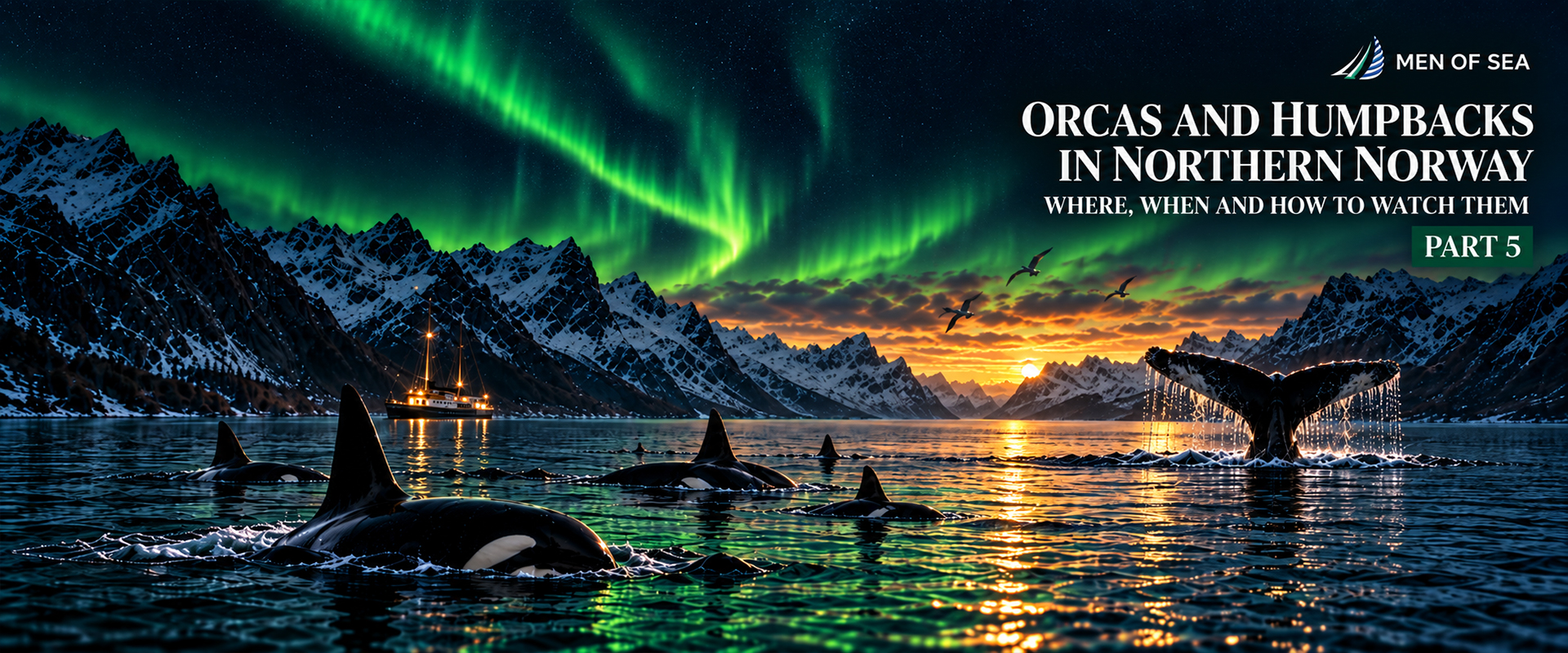
Orcas and Humpback Whales in Norway – Where, When and How to See Them.
Orcas and Humpback Whales in Norway – Where, When and How to See Them
Northern Norway Guide – Part 5
There are places you travel to in the hope of seeing a whale. And then there are places where, for a few winter weeks, an entire ecosystem begins to revolve around enormous schools of herring — attracting orcas, humpback whales and other cetaceans.
One of those places is Northern Norway, and in particular the Kvænangen fjord system north of Tromsø.
This is where we spend our winter expeditions with Men of Sea. We do not come here for a few hours simply to tick a whale tail off a list. We live in this environment for an entire week. We watch where the herring move, listen to orcas through a hydrophone, photograph whales in Arctic light and, above all, give ourselves time.
Because when it comes to whales, time changes everything.
In short: where and when can you see orcas and humpback whales in Norway?
The best period for winter whale watching in Northern Norway is usually November, December and January, although the first animals may appear as early as late October. In recent years, one of the most important areas for winter concentrations of orcas and humpback whales has been Kvænangen, including the waters around Spildra and Jøkelfjorden.
However, whales follow the herring. Their exact location can therefore change not only from one season to another, but even within a matter of days.
Why do orcas and humpback whales come to Northern Norway in winter?
The answer can be reduced to one word: herring. Norwegian spring-spawning herring form enormous winter concentrations. When hundreds of thousands of tonnes of fish gather within a relatively confined system of fjords, they create an extraordinary feeding ground for marine predators. The orcas follow the herring. The humpback whales follow the herring. Fin whales and other cetaceans may also appear.
For a visitor, the result can look like an explosion of life: seabirds gathering at the surface, a dense ball of herring below them, pods of orcas surrounding the fish — and seconds later, a huge humpback whale emerging from below.
Behind this spectacular sight, however, lies a very specific ecological process.
Herring – the real reason behind the great winter migration
Norwegian spring-spawning herring are one of the most important food resources in the north-eastern Atlantic. Their wintering grounds are not fixed. For several consecutive years, a large part of the population may use the same fjord system and then suddenly shift to another area. The Norwegian Institute of Marine Research, Havforskningsinstituttet, has pointed out that these changes can occur when new, strong year classes of herring enter the population. And that is exactly why the map of whale watching in Norway is not fixed either.
In December 2024, scientists estimated that approximately 821,000 tonnes of herring were present in Kvænangen. Particularly high concentrations were recorded around Reisafjorden and Jøkelfjorden. In December 2025, the situation looked different. The total herring biomass in Kvænangen was estimated at around 290,000 tonnes, with especially high concentrations recorded east and south of Spildra.
For us, this demonstrates one of the most important lessons in whale watching: we do not search for one fixed point on a map. We search for the herring.
And when the herring begin to form huge concentrations, that is where we start looking for orcas and humpback whales.
How has the whale-watching map of Northern Norway changed?
The popularity of the phrase “whale watching Tromsø” may give the impression that orcas have always gathered close to Tromsø. They have not.
During the 1990s, major winter concentrations of herring were located much farther south, in the Tysfjord–Ofotfjord–Vestfjord system. Orcas followed the fish, and this area became one of the first major centres for killer whale safaris in Norway. Later, the situation began to change.
During the 2016/17 winter season, significant quantities of herring were still wintering around Kvaløya, just west of Tromsø. In the winter of 2017/18, a major shift occurred. Large quantities of herring appeared approximately 100 kilometres farther north-east in Kvænangen.
Humpback whales responded in much the same way. Photo-identification studies showed a clear shift in their winter feeding grounds from Kvaløya to Kvænangen.
This is one of the most important things to understand when planning a whale-watching trip: “Whale watching Tromsø” does not necessarily mean that the whales are close to Tromsø. Tromsø is often simply the starting point of the excursion. The whales may be several hours away.
Where are the best places to see orcas and humpback whales in Northern Norway?
Tromsø
Tromsø remains the main tourism hub in Northern Norway and the departure point for many whale-watching tours. In recent years, however, the most important winter feeding areas have generally been located farther north, particularly around Skjervøy and within the Kvænangen fjord system.
Skjervøy
Skjervøy has become one of Europe’s best-known winter whale-watching locations. Its major advantage is accessibility by road. Visitors can travel from Tromsø to Skjervøy and then begin their boat trip much closer to the areas where whales are feeding. Local RIB whale safaris, for example, often spend approximately three hours on the water. However, Skjervøy should not be considered a guaranteed “address for orcas”.
The herring may move deeper into Kvænangen or into neighbouring waters, and the whales may follow them.
Kvænangen
Kvænangen is currently one of the most important fjord systems for wintering herring in Northern Norway. The Norwegian Institute of Marine Research has confirmed that since the 2017/18 season, a substantial part of the herring population has used this system as a wintering area.
As the herring moved into Kvænangen, concentrations of orcas and humpback whales followed.
Spildra
Spildra is a small island located within the Kvænangen fjord system — and this is where we base our expeditions. From the perspective of recent research, its location is particularly interesting. During the December 2025 survey, high concentrations of herring were recorded east and south of Spildra.
This does not mean the whales will always be found in exactly the same place. It does, however, illustrate why Spildra is such a useful base for exploring the wider Kvænangen system.
Jøkelfjord
A year earlier, during the December 2024 survey, some of the largest herring concentrations were recorded in Jøkelfjorden. This is an excellent example of how dynamic the system is.
One winter, herring may concentrate more strongly in Jøkelfjorden. The following year, major schools may be found closer to Spildra.
Burfjord and Burfjorden
Burfjord lies deeper inside the Kvænangen fjord system and provides a convenient base for several local operators.
Based on our own observations from recent seasons, Burfjorden has become one of the areas where we frequently encounter significant numbers of whales.
When is the best time to see whales in Norway?
For orcas and humpback whales associated with winter herring concentrations, the main period is generally from late October or early November through January. The safest way to define the core whale-watching season is:
November to January, with good encounters sometimes beginning during the second half of October, as happened in 2025. Studies of humpback whales have shown that the highest number of observations generally occurs between November and January. In practice, there are important differences between the months.
November still provides relatively long periods of usable daylight and excellent conditions for whale photography.
December is polar night, but polar night does not mean complete darkness. For several hours around midday, Northern Norway can be filled with extraordinary blue, pink and purple Arctic twilight.
January can still provide excellent whale encounters, although the herring may begin to move again and conditions can change more rapidly.
How many orcas and humpback whales can you see in Norway?
It is worth avoiding marketing claims such as “thousands of orcas in one fjord”. The science tells a more interesting story: the scale of the phenomenon is enormous, but the number of animals present in any particular location changes constantly.
Between 2010 and 2019, scientists identified 866 individual humpback whales visiting Northern Norway by photographing and comparing the unique patterns on their tail flukes. The 2015/16 season alone produced 408 identified individuals. For orcas, long-term photo-identification data included 1,236 individually recognised animals.
Models also revealed large differences between seasons — approximately 1,061 orcas using the study area in 2015 compared with around 513 in 2018. These are historical estimates for particular study areas.
So the responsible answer is simple: nobody can truthfully say that there are exactly 300, 500 or 1,000 orcas in Kvænangen today.
How do orcas hunt herring?
Norwegian orcas are famous for a highly coordinated hunting technique known as carousel feeding. A family group or pod works together to force the herring into a dense school. The fish tighten into a compact ball, after which the orcas can attack in sequence, sometimes stunning herring with powerful tail strikes.
Studies of herring-feeding killer whales in Norway using cameras and multi-sensor tags have documented both carousel feeding and feeding associated with commercial fishing activity. It is not chaotic hunting. It is highly coordinated group behaviour in which different animals can take different roles.
Bait balls – when the sea suddenly comes alive
A bait ball is a tightly packed mass of small fish formed when prey are concentrated under pressure from predators. The herring gather more and more tightly. Orcas appear around them. Seabirds circle overhead. And then the humpback whales may arrive.
Humpback whales are baleen whales. They do not catch individual fish with teeth. Instead, a humpback can accelerate towards a school of herring and open its enormous mouth, taking in a huge volume of water and fish at the same time. It then forces the water back through its baleen plates, trapping the prey inside.
This technique, known as lunge feeding, is one of the characteristic feeding strategies of humpback whales. On many occasions we have watched herring literally leap out of the water while trying to escape the closing mouth of a humpback whale.
Humpbacks are also capable of bubble-net feeding, using bubbles to help concentrate prey.
What behaviour can you see during whale watching in Norway?
One of the most spectacular behaviours is breaching — when a whale launches much or all of its body out of the water.
Spyhopping is when an orca or whale rises vertically and lifts its head above the surface, apparently observing what is happening around it.
You may also see tail slapping, pectoral-fin slapping, quiet resting at the surface known as logging, and the characteristic lifting of a humpback whale’s fluke before a deeper dive.
But some of the most fascinating behaviours are less dramatic. A family of orcas travelling together. A calf staying close to its mother. A sudden change of direction across the entire pod. Several orcas disappearing beneath the surface at the same time. And then, minutes later, the surface suddenly erupts with activity as the hunt begins.
Hydrophone – what does the world of orcas sound like underwater?
One of the tools we use during Men of Sea expeditions is a hydrophone — essentially a very sensitive underwater microphone. Orcas live in a world where sound plays a fundamental role.
They use clicks, including echolocation clicks, to navigate and detect objects and prey. They also produce whistles and distinctive pulsed calls used in social communication.
During our expeditions, when conditions allow, we lower a hydrophone into the water. Sometimes we first see black dorsal fins passing several dozen metres from the yacht.
And then the sounds of the sea come through the speaker. Clicks. Whistles. Changing sequences of calls. Suddenly an animal that moments earlier was simply a black silhouette at the surface becomes part of a much more complex world.
Of course, we cannot promise to hear orcas every time we deploy the hydrophone. Orcas do not vocalise constantly, some frequencies fall outside the range of human hearing, and underwater acoustic conditions also vary.
Whale-watching tours and orca safaris in Northern Norway
Whale watching from Tromsø – what does a day trip look like?
The simplest logistical option is to stay in Tromsø and join a one-day whale-watching tour. However, it is important to understand that today’s whale watching from Tromsø often means spending several hours travelling from Tromsø to the area where the animals are actually feeding. For example, current tours connecting Tromsø with Skjervøy may involve approximately 2.5–3 hours of travelling by boat, followed by around 1.5 hours searching for and observing whales. The complete trip may last around 8–9 hours.
Another operator using a high-speed catamaran lists approximately 2 hours 45 minutes in each direction, with around 2.5 hours in the whale-watching area. This does not mean that such trips are a bad choice. For someone spending only two or three days in Tromsø, a day trip may be the most practical solution.
But the ratio of travel time to whale-watching time is worth considering: several hours travelling — a few hours or less with the whales — and several hours travelling back.
Weather is another important factor. When the wind is strong and the sea is rough, passengers may feel the motion of the vessel considerably, and seasickness can become a real issue. The stretch around the Lyngen Alps can be particularly demanding in difficult conditions.
Skjervøy – driving or taking a bus from Tromsø and joining a RIB tour
Another popular option is to travel from Tromsø to Skjervøy by road and begin the whale-watching trip there. The major advantage is a much shorter journey by sea.
Local RIB operators usually take small groups. Some trips accommodate a maximum of around 12 people and spend approximately three hours on the water. The trade-off is logistics. The road transfer from Tromsø to Skjervøy can take around four hours each way. Some full-day programmes begin at around 5 a.m. and finish after 5 p.m.
You can also drive yourself, but the route is long and tiring, and winter driving conditions can often be challenging.
RIB or large whale-watching boat?
There is no single answer that suits everyone. A RIB is fast, carries a small group and places you close to the surface of the water. In good weather, it can be a fantastic way to experience orca watching in Norway. At the same time, in November, December and January you are operating at approximately 70°N. On an open boat, you are exposed to wind, freezing temperatures, moisture and sea spray. In larger waves, the ride can become physically demanding, and passengers remain outside in heavy flotation suits for several hours.
A larger vessel is generally more stable and usually provides a heated saloon, toilets and shelter from the weather. On the other hand, these vessels may carry dozens or even more than one hundred passengers. We therefore do not describe a RIB as the “bad” choice and a large vessel as the “good” one.
They are simply very different whale-watching experiences.
Multi-day whale-watching expedition – why does it change everything?
This is the type of whale watching we value most. A few hours may be enough to see a whale. Several days allow you to begin observing how whales behave.
If the sea is too rough on the first day, we have more days. If the herring move several miles, we can change area. If we encounter a resting pod of orcas one day, we may observe the same animals hunting on another. If the light is poor for photography one morning, the conditions may be completely different the following day.
Several companies offer multi-day whale expeditions in Northern Norway, and these trips can be found online. They often sell out well in advance, so early booking is advisable.
Why does Men of Sea organise its 7-day whale expedition from Spildra?
For us, the answer is simple: we want to start each morning where we begin looking for whales — not several hours away from them.
Our base is Spildra in Kvænangen. For seven days we live aboard our expedition yacht Azimuth. During the day we head out in search of whales. In the evening, we return to the small harbour at Dunvik, where we have had a regular berth for many years. The next morning we can head towards whichever part of the fjord currently holds the herring and the whales.
Our Men of Sea model is a seven-day stay in the winter feeding grounds, with the possibility of using a hydrophone, photographing animals from a relatively low position above the water and adapting the daily plan to the current location of the whales. With more than 10 years of Arctic sailing and expedition experience, combined with close relationships with local residents and fishermen, we have access to current local information about where it may be worth searching for whales.
That matters enormously. Because the most important question in the morning is not: “Where were the whales yesterday?” It is: “Where is the herring today?”
Azimuth – a yacht that becomes our home in the winter world of whales
The difference between a yacht and a RIB is not simply the size of the vessel. Azimuth is simultaneously our means of transport, observation platform and home. We can spend time outside watching the animals, return to the heated interior, have something warm to drink, eat, dry photographic equipment and then go back on deck when the situation changes.
That matters when spending several days in an Arctic climate. We do not want to leave the whales after 20 minutes simply because everyone has become too cold. We want the possibility of long, patient observation.
Whale watching and Norwegian regulations
Norwegian regulations prohibit whale-watching activity conducted in a way that disturbs the natural behaviour of whales and other cetaceans. Whale-watching vessels must also maintain at least 0.2 nautical miles — 370 metres — from an actively fishing vessel, a seine operation or fixed fishing gear.
In 2026, the Norwegian Directorate of Fisheries highlighted examples of inappropriate behaviour such as chasing whales, cutting across their course, driving into a pod, separating a mother and calf, approaching whales at high speed and surrounding animals with multiple vessels. These principles should be an integral part of responsible whale watching, not an obstacle to it.
Whale photography expeditions – why finding the whale is only the beginning
You can find a humpback whale and still take a poor photograph. Or you can anticipate where it is likely to surface after its next dive, position the yacht at the right angle to the light, look for a clean background and still leave the animal plenty of space. That is a huge difference.
During our photography expeditions, we do not think only: Where is the whale? We also think: Where will it be in a moment — and what will be behind it in the frame?
We are experienced wildlife photographers, and we know that successful whale photography depends on far more than equipment. The position of the yacht, the direction of the light, the background and the ability to anticipate animal behaviour can be just as important as the camera itself. Years of observing orcas and humpback whales often allow us to recognise their direction of travel, pace of movement and the likely area of the next surfacing. This helps us position the yacht so that photographers have the best possible conditions without chasing the animals or interfering with their natural behaviour.
Everything matters: the position of the sun, the direction in which the orcas are travelling, the line of the mountains in the background, reflections on the fjord, sea state, distance and which side of the yacht offers the clearest view. Sometimes moving only a short distance or changing the angle of the yacht can transform a photograph from a black silhouette against a grey background into an orca surfacing against snow-covered mountains and a colourful Arctic sky.
Another major advantage of photographing from Azimuth is the low shooting perspective. From the deck we are relatively close to the surface of the water. Instead of photographing the animal from high above, we can work at almost sea level. This perspective makes photographs feel more natural and dynamic, while the orca or humpback stands out more strongly from the background. With the right positioning, a single frame can combine the animal, the surface of the fjord, the mountains and the extraordinary Arctic light.
Winter brings very limited daylight to Northern Norway. During the polar night, the sun does not rise above the horizon, yet the middle of the day is not necessarily dark. Instead, for several hours we experience the characteristic soft light of the Arctic twilight.
When the sky is not completely overcast, conditions can resemble a prolonged golden hour — the kind of light photographers usually associate with sunrise or sunset. Here, however, it can last much longer. The sky takes on shades of pink, orange and violet.
Snow-covered slopes reflect pastel colours, the surface of the fjord begins to glow with warm light, and the black silhouettes of orcas contrast beautifully with their surroundings. Even an otherwise ordinary humpback surfacing can become an exceptional photograph in these conditions. Paradoxically, the short winter day is not necessarily a disadvantage.
For photographers, it can become one of the great advantages of a winter whale expedition in Northern Norway. Technically, the conditions can be challenging.
When photographing fast-moving orcas, shutter speeds of around 1/1000–1/2000 sec are often useful, and it is generally better to increase ISO than risk motion blur. With a slowly surfacing humpback whale, slower shutter speeds may be possible. A focal-length range of approximately 100–400 mm is highly versatile, although lens speed becomes particularly important in the low Arctic light.
Whales and orcas may also approach the yacht closely, so in our experience maximum aperture can sometimes be more useful than extreme focal length. It is therefore always worth having a shorter lens ready as well.
More than seeing a whale – observing behaviour instead of a brief encounter
The biggest difference between a few-hour whale safari and a week-long expedition is not simply the total amount of time spent on the water. It is the opportunity for longer, repeated observation of groups of animals behaving in different situations.
On a short whale-watching trip, simply finding orcas or humpback whales may already be considered a success. On a multi-day expedition, you can go much further. With time, you begin noticing differences between individual animals, how a pod travels, relationships between adults and calves, and recurring patterns of behaviour.
After several days of observation, it becomes easier to recognise the moment when calm travelling begins to turn into active feeding. Speed changes. Direction changes. Surfacing patterns change. More seabirds may gather. Herring may become visible close to the surface. The behaviour of the orcas becomes increasingly coordinated.
The same is true of humpback whales. Over time, you begin to recognise their surfacing and diving rhythm.
After several breaths at the surface, a humpback may prepare for a deeper dive, increasing the likelihood that it will raise its fluke above the water.
An experienced observer will sometimes hear the powerful blow first, locate the whale from the plume of condensation and only then see its body.
A week-long expedition also gives us the chance to observe many different kinds of behaviour: travelling, resting, feeding, social interactions, relationships between individuals and responses to other animals.
Not every encounter is spectacular. But longer observations reveal that whale behaviour is about much more than a breach or a tail disappearing beneath the surface.
Multi-day whale watching also increases the chance of witnessing less predictable behaviour: bait balls, breaching, spyhopping, tail slapping or an orca choosing to approach the yacht at close range.
That is why the goal of our expedition is not simply to “see a whale”. It is to spend enough time around these animals to begin understanding what they are doing.
We do not simply want to show our guests an orca or humpback whale.
We want to create the conditions for meaningful observation — to see how the animals travel, feed, communicate and function as part of the wider Arctic ecosystem.
We cannot guarantee that a humpback whale will breach. We cannot guarantee a bait ball. And we cannot promise that an orca will decide to approach the yacht. What we can do is increase the opportunities for remarkable encounters through time, experience, local knowledge, careful observation of conditions and flexible planning throughout the expedition.
FAQ – Orcas and Whales in Norway
Where is the best place to see orcas in Norway?
In recent years, the Kvænangen fjord system and the waters around Skjervøy have been among the most important winter areas. Their exact distribution changes with the herring.
When can you see orcas in Northern Norway?
The most predictable period associated with winter herring concentrations is generally November through January.
Are there orcas close to Tromsø?
Usually not in the same concentrations seen farther north. Many tours marketed as “whale watching Tromsø” begin in Tromsø but travel considerably farther north to reach the whales.
Where can you see humpback whales in Norway in winter?
In recent seasons, Kvænangen and neighbouring waters have been particularly important winter feeding areas.
Is Skjervøy still a good place for whale watching?
Yes, but the whales can move considerable distances from the harbour as they follow the herring.
Is Spildra a good base for whale watching?
Yes. Interestingly, the December 2025 IMR survey recorded high concentrations of herring east and south of Spildra.
Are whale sightings guaranteed?
No. No responsible whale-watching operator can guarantee encounters with wild animals.
How long does a whale-watching tour from Tromsø take?
Typical excursions take most of the day — often approximately 8–12 hours depending on the tour format and type of transport.
Is a RIB or a large whale-watching boat better?
A RIB is faster and more intimate but exposes passengers more directly to cold, wind and sea conditions. A larger vessel offers greater comfort but usually carries many more passengers.
Is a multi-day whale expedition worth it?
For people interested in behaviour, photography and flexibility, several days offer a major advantage over relying on a single weather window.
What is a bait ball?
A bait ball is a dense concentration of small fish that forms, among other reasons, under pressure from predators.
What is spyhopping?
Spyhopping is behaviour in which an orca or whale rises vertically and lifts its head above the water, apparently to observe its surroundings.
Can you hear orcas?
Yes. A hydrophone can detect some of their clicks, whistles and pulsed calls, although orcas do not vocalise continuously. At times, we can even hear some of their sounds while standing on the yacht’s deck.
What other whale species can be seen in Northern Norway?
In addition to orcas and humpback whales, visitors may encounter fin whales, sperm whales and, occasionally, other cetacean species.
Why does the number of whales change from year to year?
One of the most important factors is the distribution of prey, particularly herring. Research on orcas confirms that their winter distribution responds to the changing distribution of their food.
Men of Sea Northern Norway Guide
A. Part 1 – How to Forecast the Northern Lights in Northern Norway
B. Part 2 – Best Apps and Websites for Northern Lights Forecasts in Northern Norway
C. Part 3 – Tromsø: What to See and How to Plan Your Stay – Top Attractions and Practical Information
D. Part 4 – Tromsø by car – the best road trips, scenic drives and hikes around Tromso
E. Part 5 – Orcas and Humpback Whales in Norway – Where, When and How to See Them.
See also
Humpback Whales – the Singing Whales
Orcas – Intelligent and Family-Oriented
Kvænangen – Whales, Mountains, Sámi Culture and Glaciers
Snorkelling with Orcas and Humpback Whales
About the Author of This Guide
Marek Rajtar is the founder of Men of Sea, a skipper, photographer and organiser of expeditions in the Arctic and Northern Norway.
For more than a decade, he has been leading yacht expeditions across Svalbard, the Lofoten Islands and Northern Norway, exploring these regions both from the sea and during hikes and land-based expeditions. He has led numerous expeditions and trips around Svalbard, in the waters of Northern Norway and among the islands of Lofoten. His achievements include several records, new routes in the High North that he discovered himself, and a number of awards. He is also the author of many publications that have appeared in various media outlets.
His experience includes sailing in Arctic conditions, expedition route planning, landscape and wildlife photography, and observing wildlife in its natural environment. As a result, Men of Sea guides are not based solely on online sources — they are enriched with knowledge and observations gained during real expeditions.
When writing about places such as Svalbard, Lofoten or Northern Norway, Marek Rajtar draws on experience gathered over successive seasons spent in the North, with particular attention to weather conditions, access from the sea, safety, photography and the practical aspects of travelling in these regions.
Marek Rajtar
Captain • Photographer • Expedition Organiser
Men of Sea