GLACIERS
Glaciers – the True Heart of Svalbard
SVALBARD GLACIERS – HOW THEY FORM, WHERE THE MOST BEAUTIFUL ONES ARE AND WHY THEY ARE WORTH SEEING
Glaciers – the True Heart of Svalbard
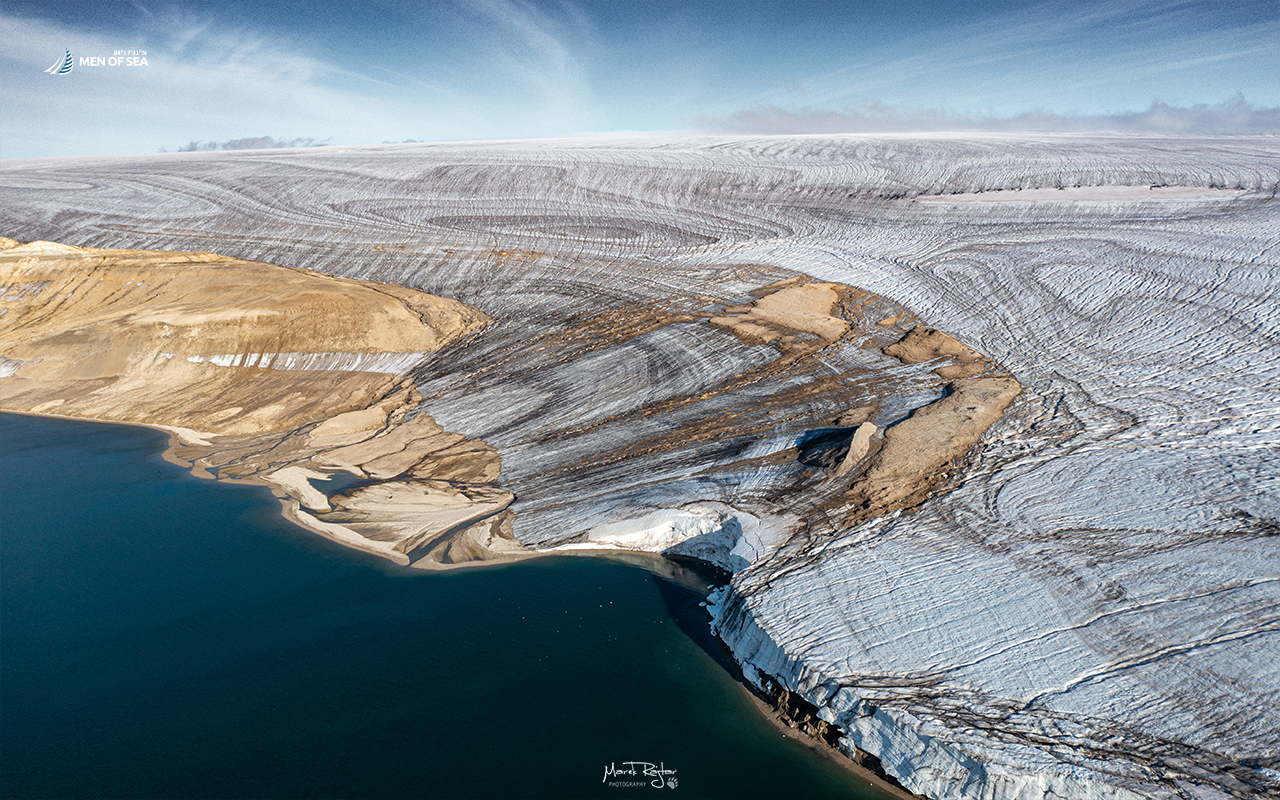
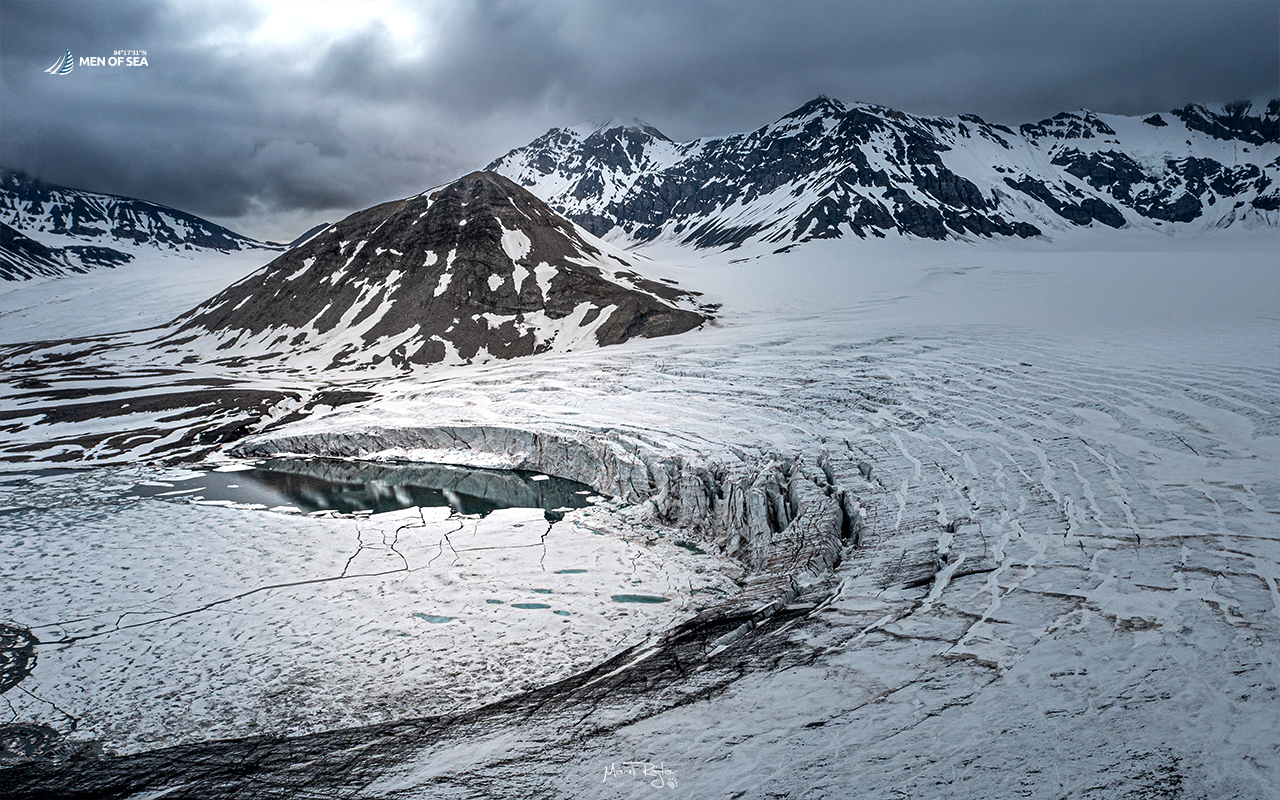
Glaciers are one of the most characteristic elements of the Svalbard landscape. They cover around 57–60% of the archipelago, and there are more than 2,100 glaciers across Svalbard – from small mountain glaciers to enormous ice caps covering thousands of square kilometres. The largest ice masses are found on Nordaustlandet, but extensive glaciers also occur on Edgeøya, Barentsøya, Kvitøya and Spitsbergen itself.
For us, glaciers are one of the main reasons we have been returning to the polar regions for many years. Their scale, raw beauty and constant change create a landscape that is difficult to experience anywhere else.
Key Facts about Svalbard Glaciers
Number of glaciers: more than 2,100
Svalbard land area covered by glaciers: around 57–60%
Largest ice cap: Austfonna on Nordaustlandet
Most characteristic types: ice caps, ice fields, valley glaciers, outlet glaciers and marine-terminating glaciers
Total coastline with marine-terminating glaciers: more than 900 km
Main process: snow accumulation, transformation into firn and ice, and glacier flow under gravity
Most spectacular phenomenon: glacier calving, when blocks of ice break away into the sea.
How Does a Glacier Form?
A glacier can form where, over many years, more snow falls than melts during the warmer season. Fresh snow gradually undergoes transformation. First, it is compressed by the weight of new layers above it.
Over time: snow → firn → glacier ice. Firn is granular, partially transformed snow that has survived at least one melting season.
Under the pressure of successive layers, changes in temperature and recrystallisation, the grains become increasingly compact. Air bubbles are gradually squeezed out and very dense glacier ice is formed. When the ice mass becomes large enough, it begins to move slowly under its own weight. This is how an active glacier is born.
Does a Glacier Rebuild Itself Every Year?
Not literally. Every year, a glacier receives a new supply of snow, mainly during winter. At the same time, it loses mass through:
- surface melting,
- meltwater runoff,
- melting from the sea,
- calving,
- sublimation.
The difference between ice gained and ice lost is called the glacier mass balance. If accumulation exceeds losses, the glacier gains mass. If losses are greater, the glacier loses mass. In Svalbard, most glaciers have had a negative mass balance for many decades and are retreating.
Why Are Glaciers So Important?
Glaciers are much more than spectacular scenery. They are extremely important for both climate and ecosystems. Their bright surface reflects a significant proportion of solar radiation, influencing the Earth’s energy balance. They are also enormous stores of freshwater.
Svalbard glaciers transport into the fjords:
- freshwater,
- sediment,
- minerals,
- nutrients.
As a result, highly productive ecosystems can develop near glacier fronts. Water flowing from beneath a glacier can bring nutrients and zooplankton up from deeper parts of the fjord, attracting fish, seabirds, seals and other Arctic animals.
What Types of Glaciers Are Found in Svalbard?
Svalbard is an excellent place to observe many different glacier forms.
Ice caps: The largest ice masses in Svalbard are ice caps. They cover vast areas of land and usually form broad domes from which ice flows in different directions. The best-known examples are found on Nordaustlandet: Austfonna and Vestfonna. Austfonna is the largest ice cap in Svalbard and one of the largest outside Greenland and Antarctica. Its area is around 8,500 km².
Ice fields: Ice fields resemble ice caps, but their movement is more strongly controlled by the underlying terrain. Individual mountain peaks called nunataks often rise above the ice. Such landscapes are particularly characteristic of north-western Spitsbergen.
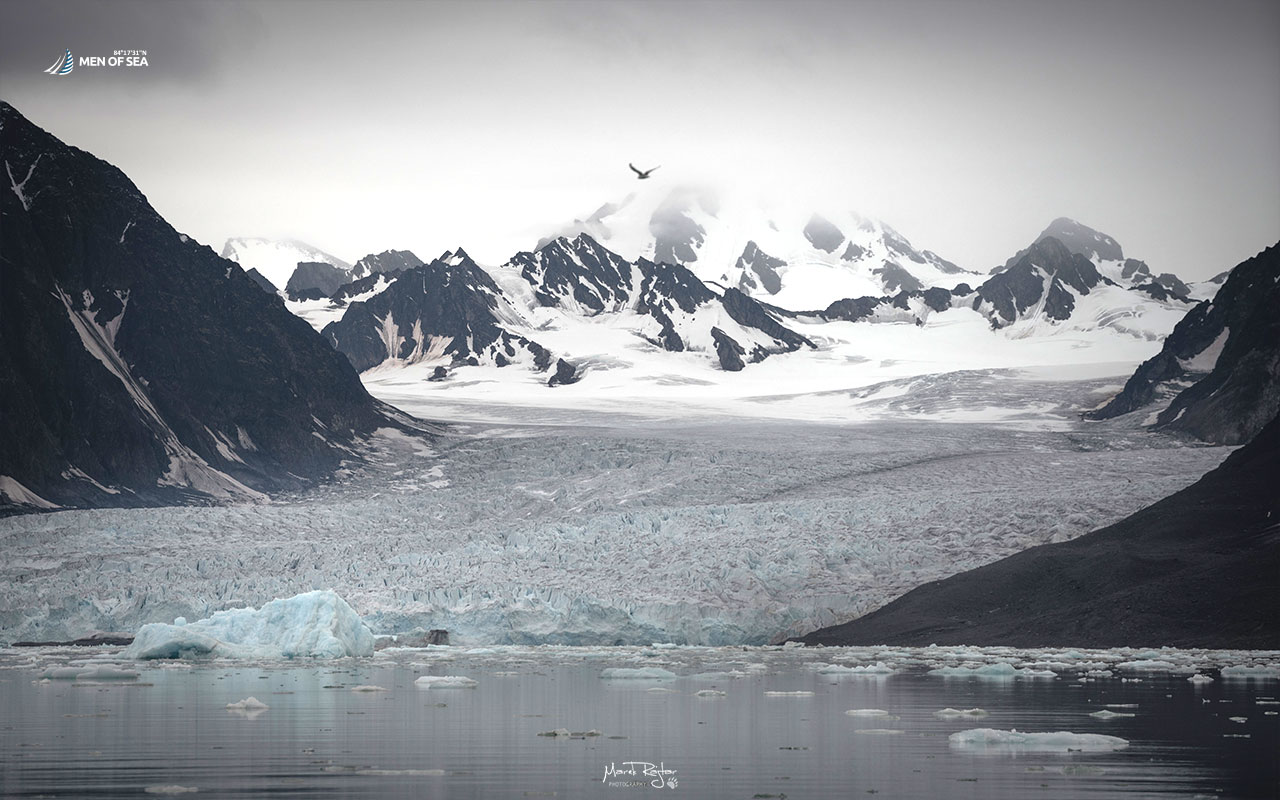
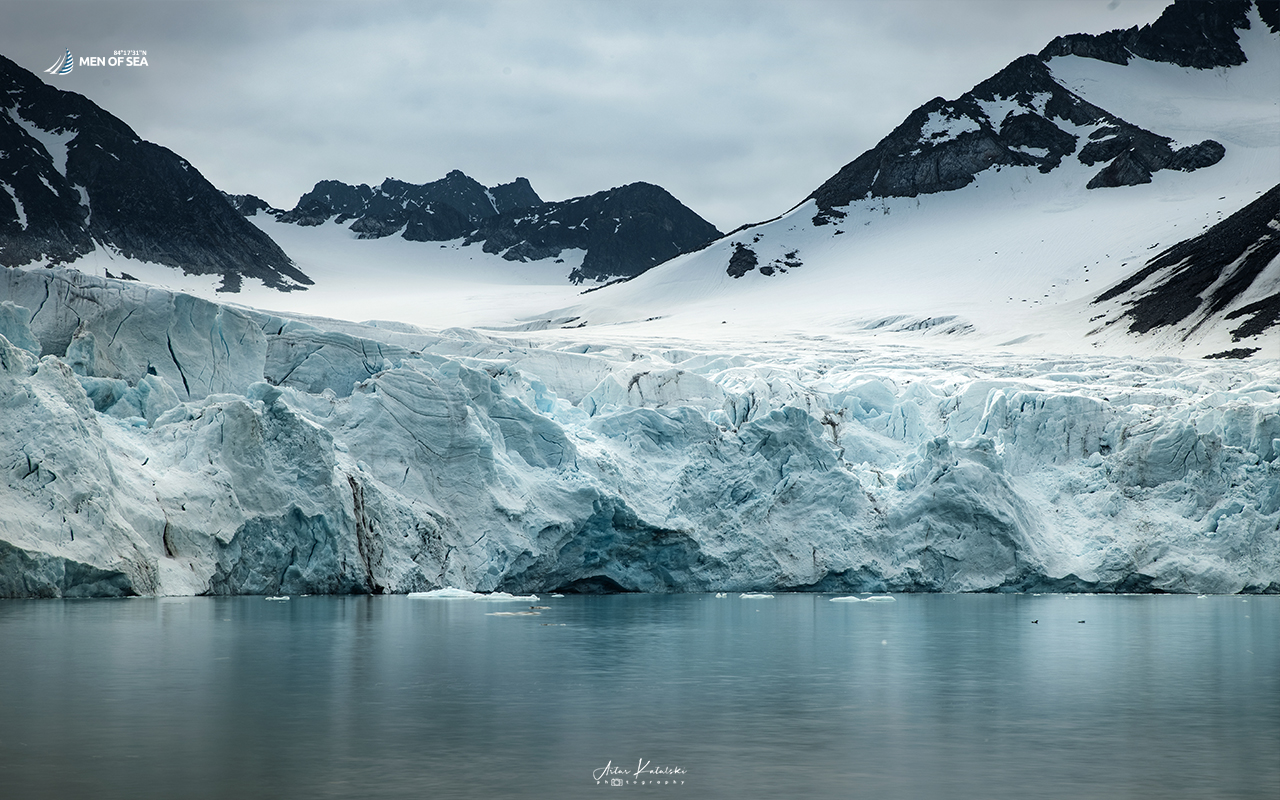
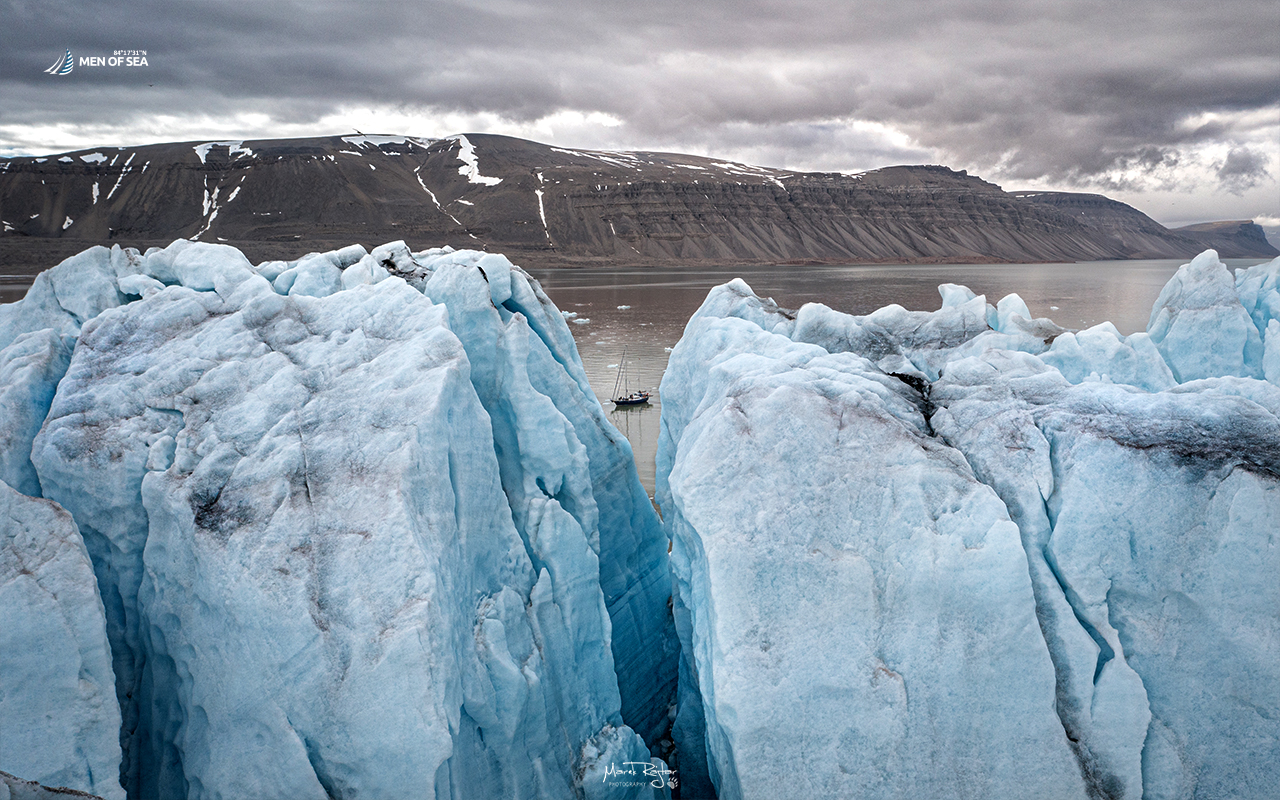
Valley glaciers: These are among the most recognisable glacier types. Ice flows through mountain valleys much like a river. Valley glaciers may terminate on land or directly in the sea. Many of the latter create spectacular vertical glacier fronts visible from a yacht.
Outlet glaciers: Outlet glaciers drain ice from a larger ice cap or ice field. They can be compared to enormous “rivers of ice”. They often move faster than the surrounding ice masses and may terminate in the sea.
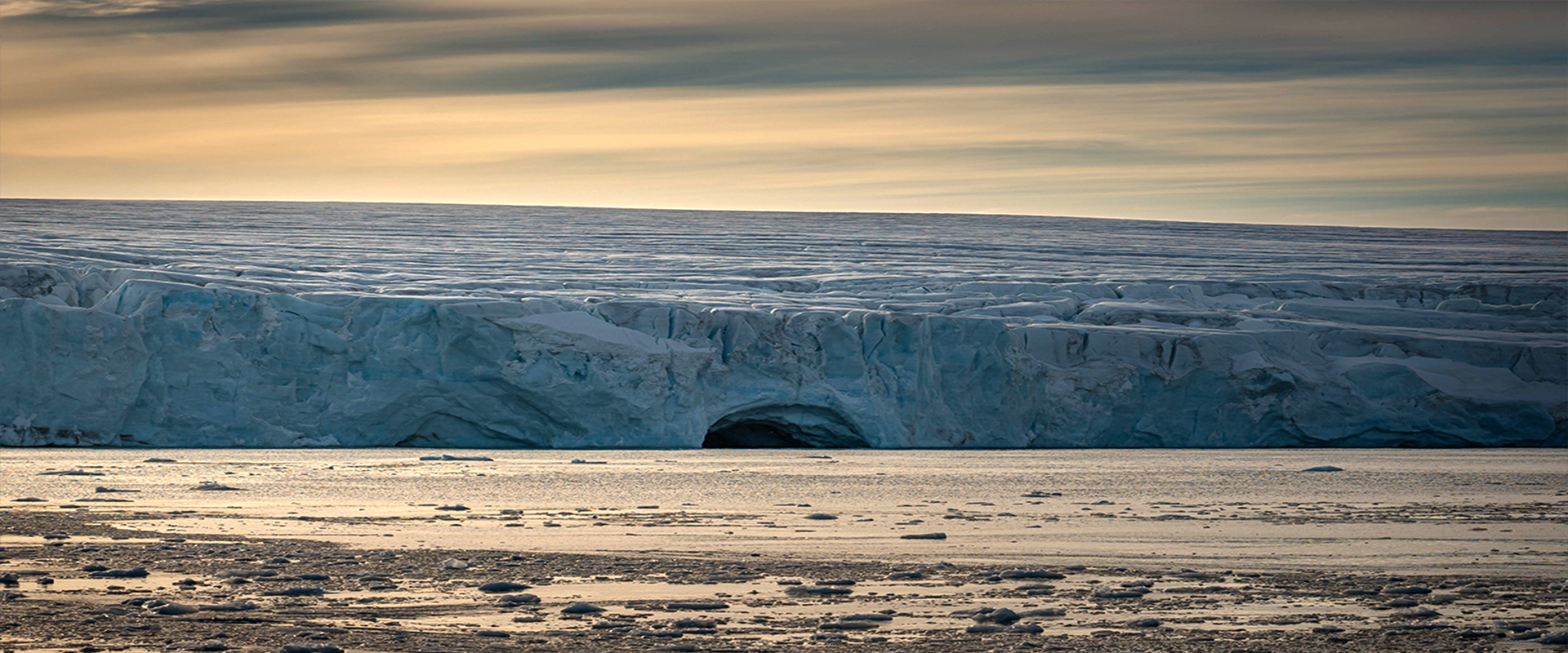
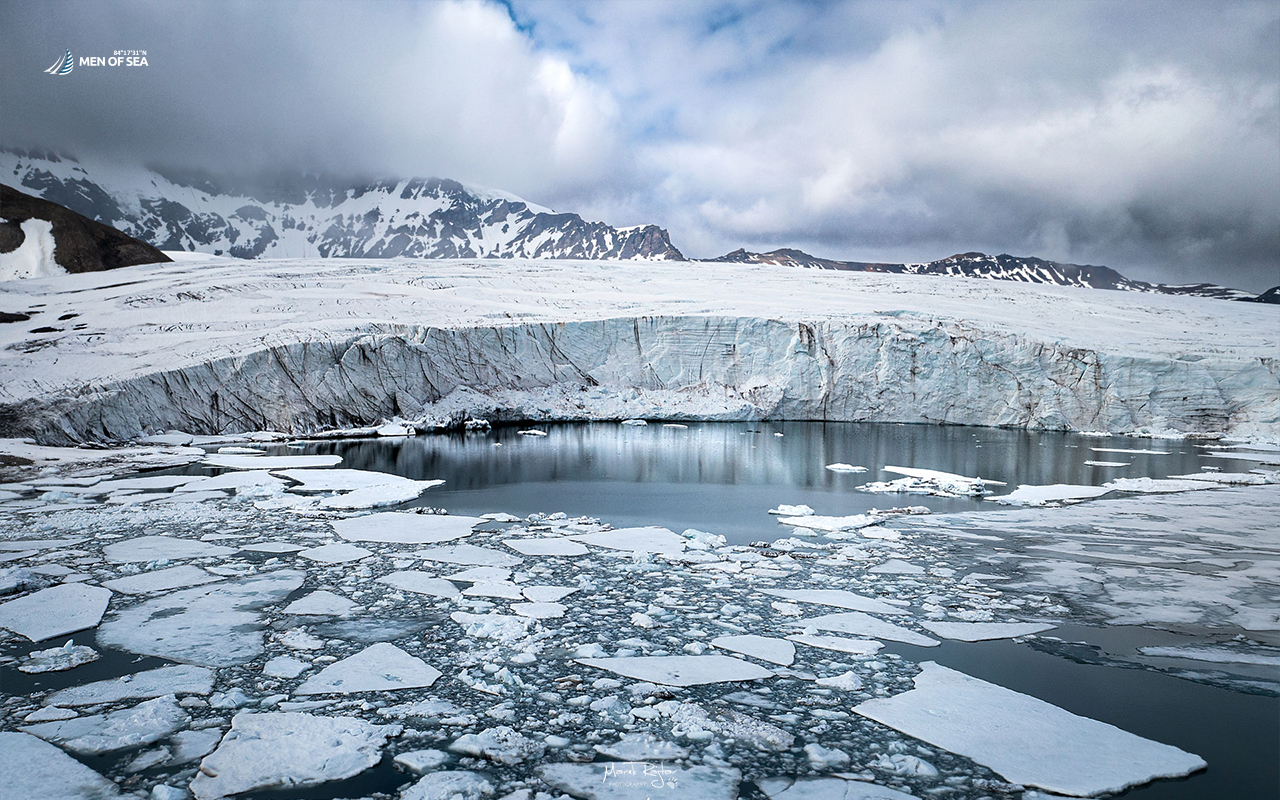
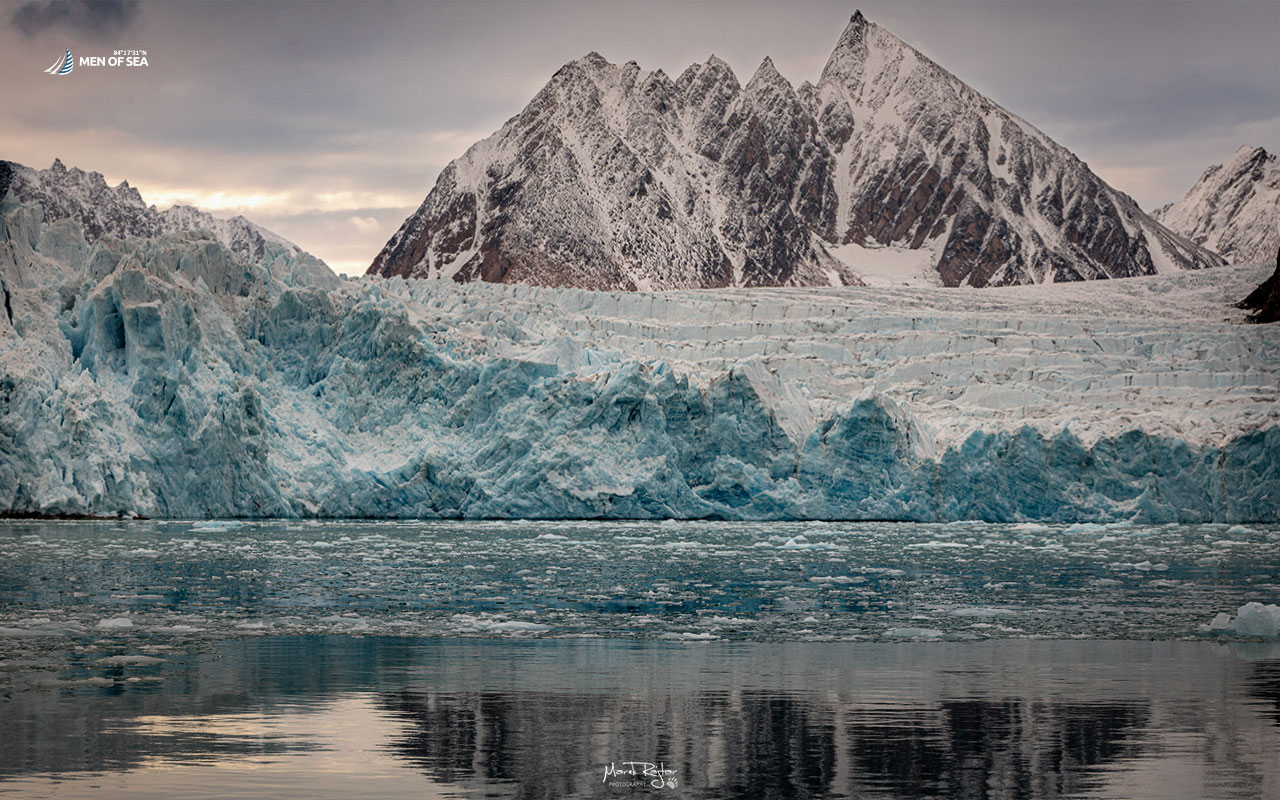
Marine-terminating glaciers: These are especially interesting from a traveller’s perspective. Their fronts extend directly into a fjord or the sea. In Svalbard, more than 900 km of coastline is associated with glaciers ending in the sea. This is where spectacular glacier calving occurs.
Are There Ice Shelves in Svalbard?
This is an important distinction. Typical ice shelves, the enormous floating ice platforms known mainly from Antarctica, are not a characteristic feature of Svalbard.
Most Svalbard glaciers are grounded on bedrock, although they may extend into the sea and form glacier fronts. Some glacier tongues may locally become buoyant, but not every marine-terminating glacier should be described as a classic ice shelf.
Austfonna – the Ice Giant of Svalbard
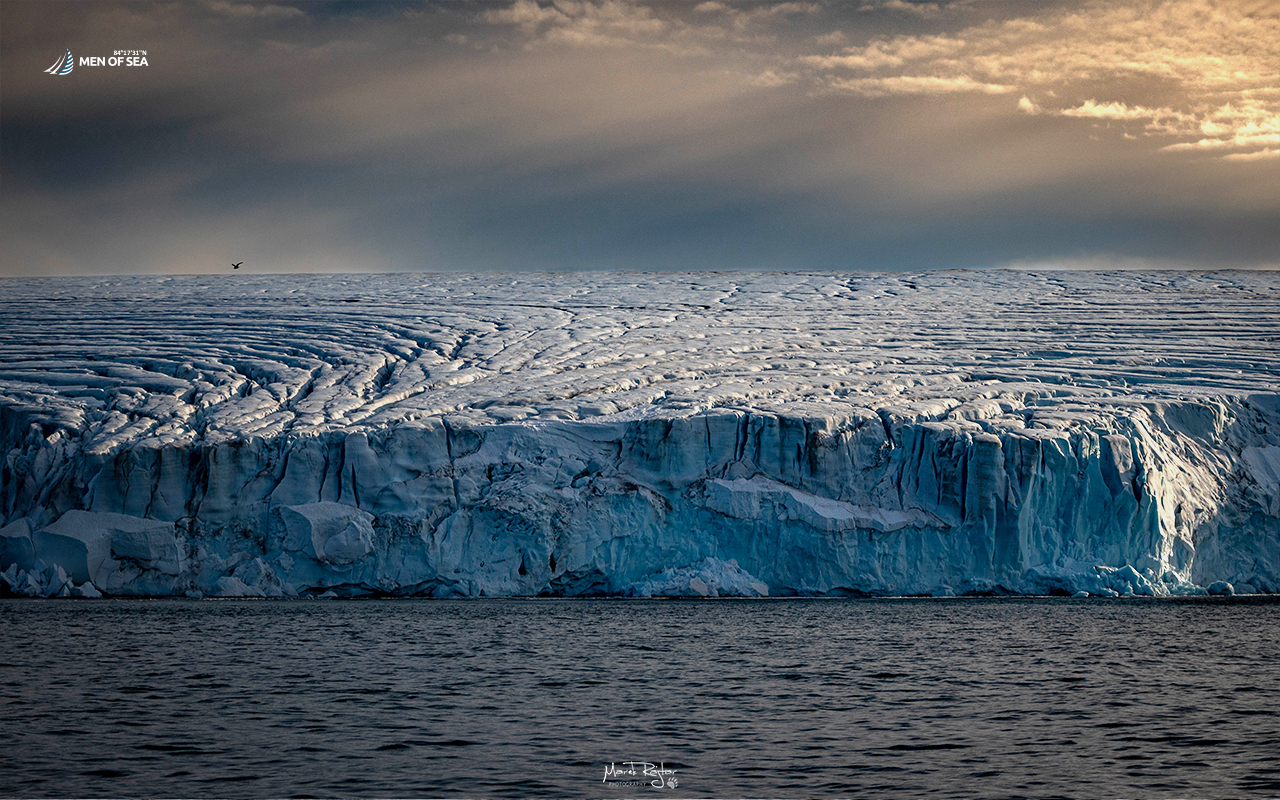
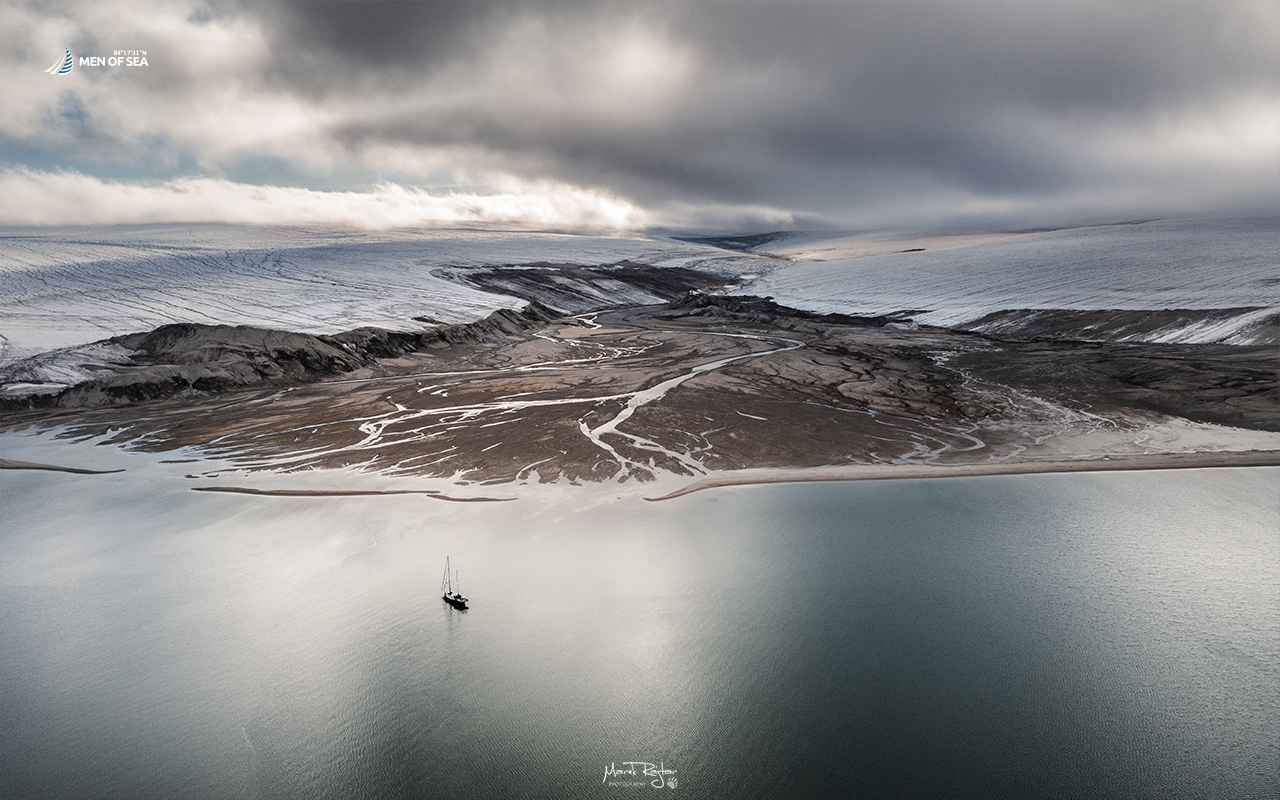
Austfonna on Nordaustlandet is the largest ice cap in the archipelago. It covers around 8,490 km². Its southern and eastern sections meet the sea along an enormous distance, creating one of the most monumental Arctic landscapes.
One of its most spectacular sections is Bråsvellbreen. It is a huge outlet glacier located in the southern part of Austfonna.
For us, Austfonna and Bråsvellbreen are among the most extraordinary glaciers in all of Svalbard.
What Is Glacier Calving?
Calving, or glacier calving, occurs when part of a glacier front breaks away and falls into the sea. It may be:
- a small piece of ice,
- a multi-ton block,
- a huge section of an entire ice wall.
It is often accompanied by a powerful roar. When the ice enters the water, it displaces a large volume of water and creates a wave.
For this reason, even in beautiful weather, boats should not approach an active glacier front too closely. The greatest danger may not come from the falling ice itself. It may be the wave created by the calving event.
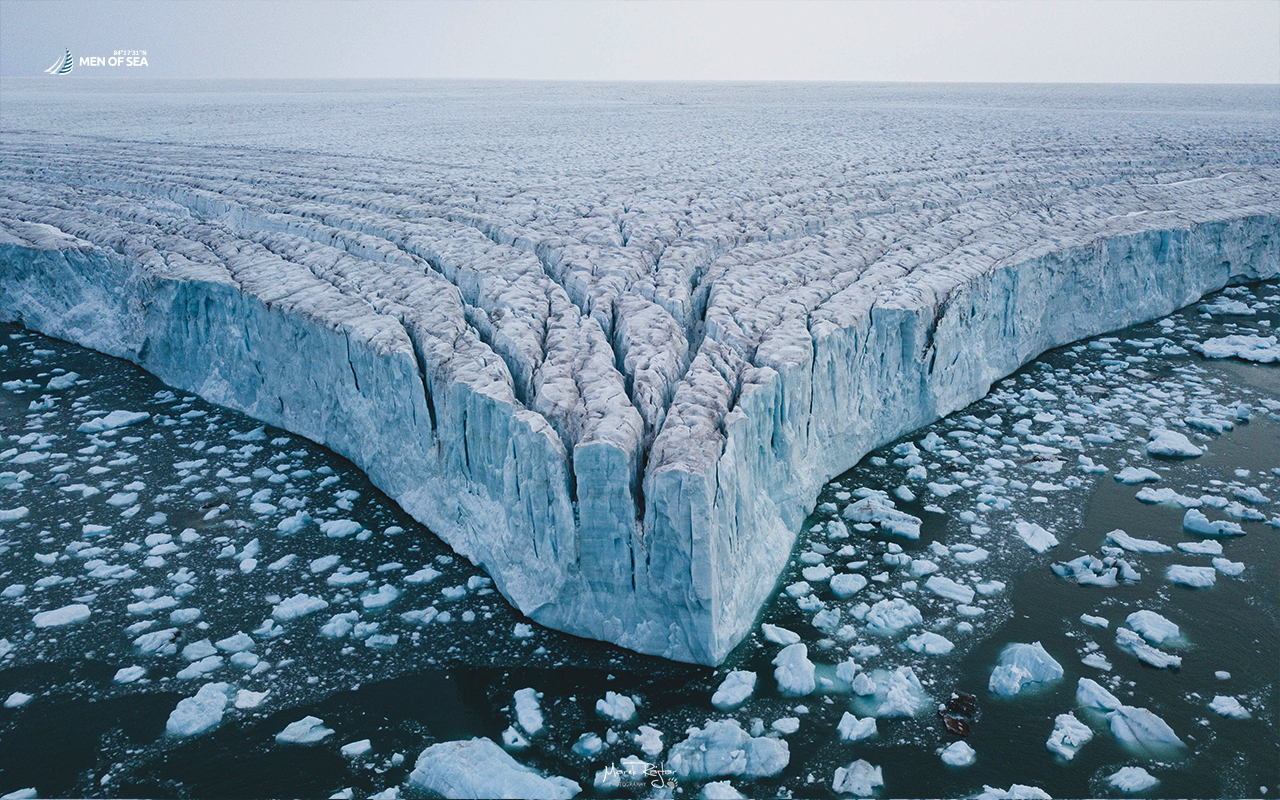
Why Is the Glacier Front So Heavily Crevassed?
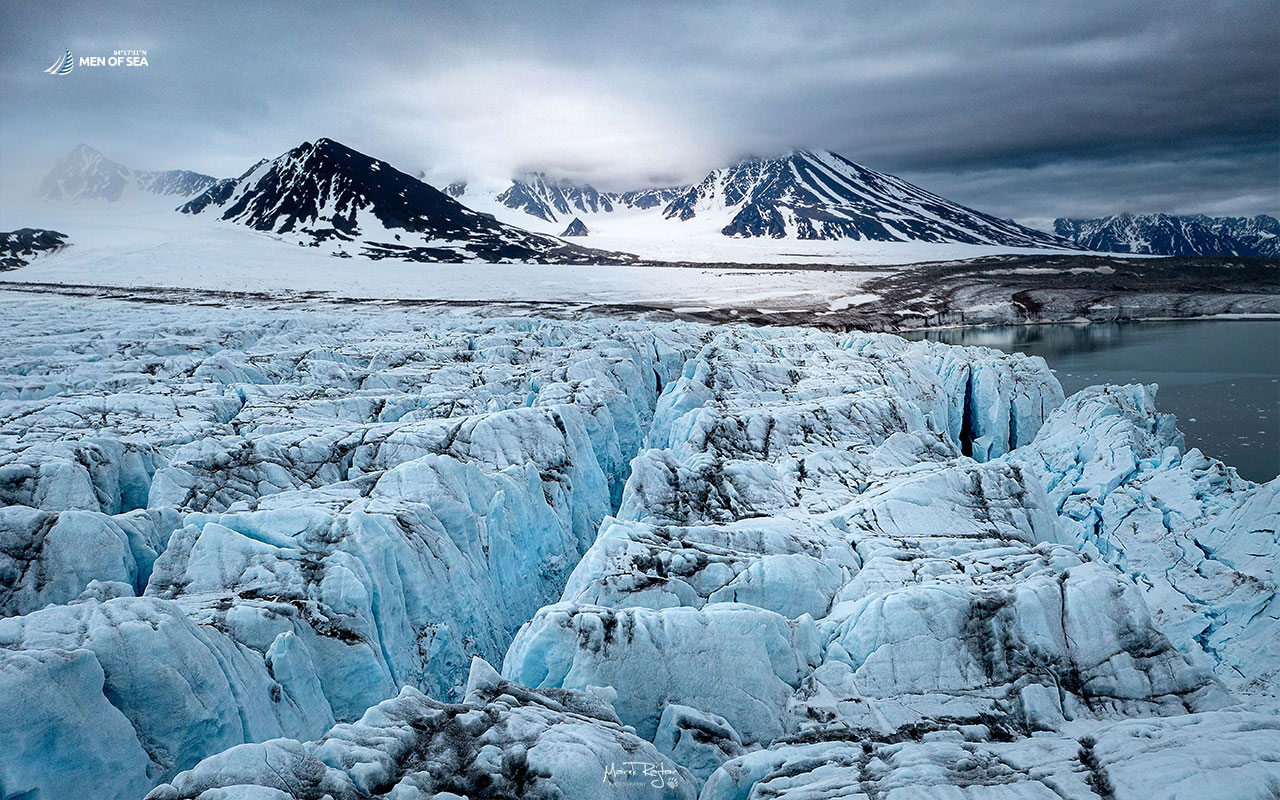
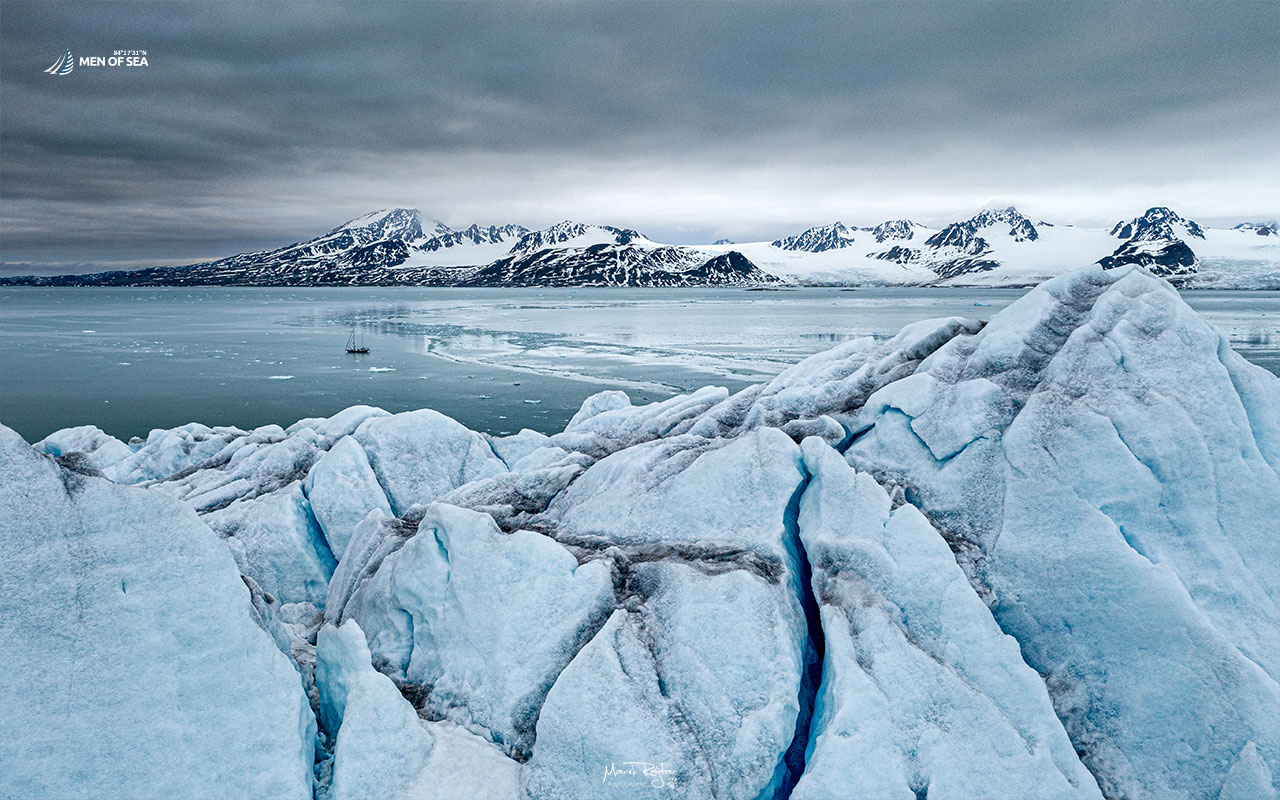
A glacier is constantly moving. Some parts flow faster, others more slowly. When the stress becomes too great, the ice fractures. This creates characteristic glacier crevasses.
They can be very deep and are often covered by a thin layer of snow. This is why entering a glacier independently without proper experience and equipment can be dangerous.
Why Is Glacier Ice Blue?
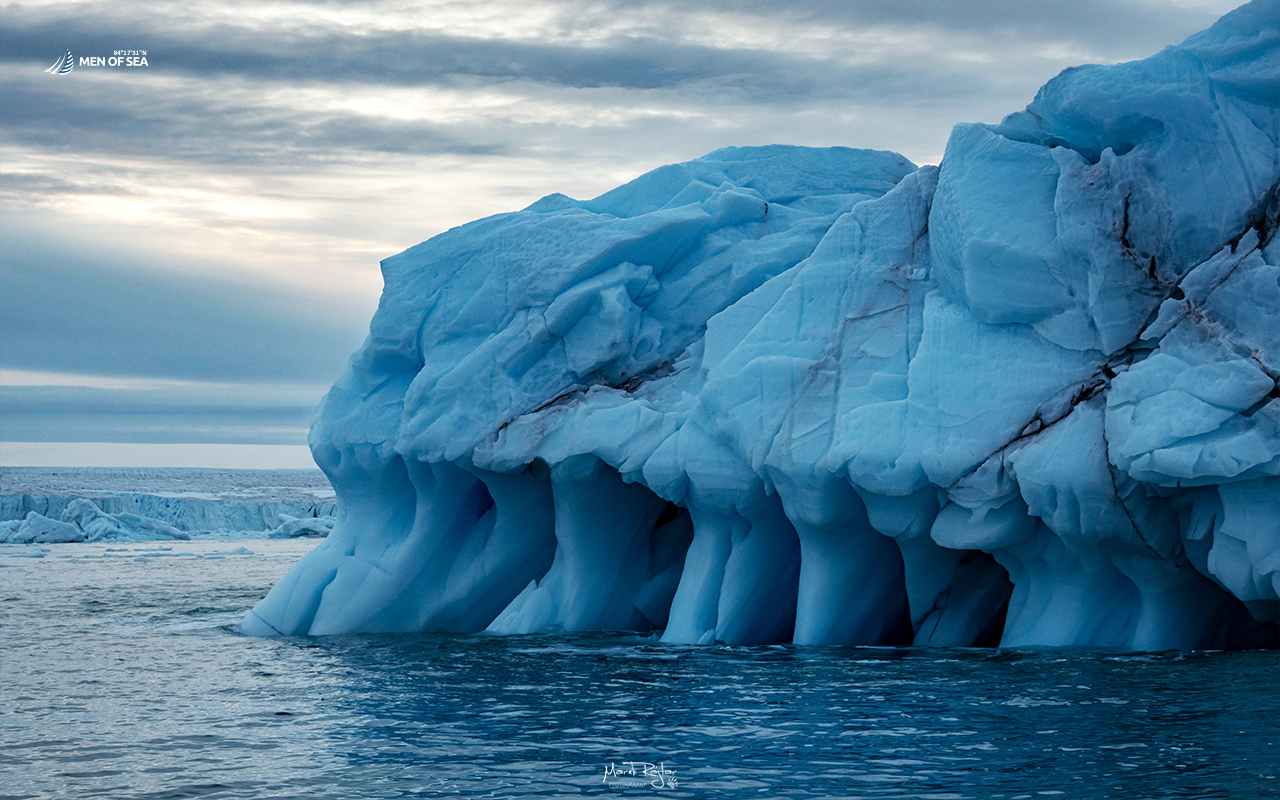
This is one of the questions we hear most often. Yes — glacier ice really can be intensely blue. This is not simply because it reflects blue light. In very dense ice, light travels through a greater thickness of material. The ice absorbs longer wavelengths more efficiently, especially red light, leaving more light from the blue part of the spectrum.
That is why thick, old and highly compressed sections of glacier ice can appear: turquoise, pale blue or very deep blue. Fresh snow, on the other hand, contains a lot of air and scatters almost all visible light, which is why it appears white.
Is Older Ice More Blue?
Often, yes, but not because age itself directly changes the colour. Older ice has usually been subjected to enormous pressure for longer. It contains fewer air bubbles and is more compact.
As a result, light can travel through a greater mass of ice and the blue colour becomes more pronounced. That is why freshly broken pieces from deeper inside a glacier can sometimes show an exceptionally intense blue colour.
What Are Icebergs?
An iceberg forms when a section of a glacier ending in the sea breaks away and begins to drift freely. Because ice is less dense than seawater, most of its mass remains below the water surface.
This means that the small part visible above the water may belong to a much larger block. For yachts sailing in the Arctic, this has very practical consequences. It is necessary to watch not only for large icebergs, but also smaller pieces known as growlers and bergy bits.
What Is a Glacier Surge?
Svalbard is also famous for surging glaciers. These are glaciers that may move very slowly for many years and then suddenly enter a period of rapid acceleration. During a surge, the ice can move many metres per day.
After some time, the glacier slows down again. A large number of Svalbard glaciers show this kind of behaviour, which makes the archipelago one of the world’s most important regions for the study of dynamic glaciers.
Glaciers and Svalbard Wildlife
The areas around glaciers are not biological deserts. Quite the opposite. Marine-terminating glaciers in particular can create highly productive areas.
We may encounter there:
- seals,
- seabirds,
- fish,
- sometimes belugas,
- and where seals are present, also polar bears.
Water flowing from beneath the glacier can carry nutrients and marine organisms towards the surface, creating local feeding hotspots.
When Is the Best Time to See Glaciers in Svalbard?
Glaciers can be seen throughout the year. However, from a traveller’s perspective, the greatest access is usually during summer – from June to September.
May: Many fjords still contain a lot of sea ice. The landscape remains very wintry, but some glaciers may be more difficult to reach.
June: The main marine season begins to open up. Melting snow and retreating sea ice make more and more fjords accessible.
July and August: These are the most versatile months. Yachts can reach a large number of glaciers, while conditions allow glacier viewing to be combined with trekking and shore landings.
September: Sea ice is usually at its lowest, which can make more remote areas of northern and eastern Svalbard accessible. At the same time, the days rapidly become shorter and the weather more autumnal.
Can You Walk on a Glacier in Svalbard?
Yes, but it should not be done independently without knowledge of glacier travel. Even an apparently flat surface may conceal:
- crevasses,
- snow bridges,
- meltwater streams,
- moulins,
- extremely slippery ice.
On easier routes, microspikes or crampons may be used, while more demanding terrain may require a rope, harness and full glacier equipment. The equipment should always be chosen according to the specific glacier and current conditions.
Glaciers during Men of Sea Expeditions
Glaciers are one of the most important elements of our expeditions. We try to experience them in several different ways. We observe them from the deck of the yacht. We sail into fjords ending in enormous walls of ice.
We make landings near glaciers and organise treks leading towards their moraines. If conditions and the character of the glacier allow it, we also organise glacier walks. The most spectacular moments are when, standing on the yacht, we hear a deep roar coming from inside the glacier and, a moment later, a huge part of the glacier front collapses into the sea.
It is one of those moments when you truly feel the power of the Arctic.
Can You Drink Glacier Water or Use Glacier Ice?
Glacier ice that looks clean does not necessarily have to be sterile. It may contain:
- mineral sediment,
- microorganisms,
- atmospheric pollutants,
- material from rocks and the glacier surface.
For this reason, it should not automatically be assumed that every piece of glacier ice is safe to consume. During our expeditions, we sometimes collect clean pieces of floating glacier ice from the sea as part of the Arctic experience, but we always treat this as a curiosity rather than a source of safe drinking water.
Are Svalbard Glaciers Retreating?
Yes. Most Svalbard glaciers are currently losing mass. The Norwegian Polar Institute indicates that this process has been continuing for decades and has accelerated in many areas in recent years.
For marine-terminating glaciers, the situation is particularly complex. Their condition is influenced by:
- air temperature,
- the amount of winter snowfall,
- ocean temperature,
- calving,
- underwater melting,
- the internal dynamics of the glacier.
For this reason, an individual glacier may sometimes behave differently from the overall regional trend. One recent example is Borebreen.
Why Are Glaciers So Special to Us?
We may return to the same fjord many times, but a glacier never looks exactly the same. Everything changes: the light, the ice, the colour of the water, the number of icebergs, the shape of the glacier front, the weather and the surrounding landscape. It is a living landscape.
Sometimes calm and almost motionless. At other times full of roaring sounds, cracks and collapsing blocks of ice. That is why glaciers are one of the most important symbols of Svalbard for us.
FAQ – SVALBARD GLACIERS
How many glaciers are there in Svalbard?
There are more than 2,100 glaciers in the archipelago, covering approximately 57–60% of its land area.
What is the largest glacier in Svalbard?
The largest ice cap is Austfonna on Nordaustlandet, covering approximately 8,500 km².
Do Svalbard glaciers reach the sea?
Yes. Many of them terminate directly in fjords and the sea. More than 900 km of Svalbard’s coastline is associated with marine-terminating glaciers.
Why is glacier ice blue?
Dense ice absorbs more of the red part of the light spectrum. When the ice is thick enough, more blue light reaches the observer, making the ice appear blue.
What is glacier calving?
It is the process in which pieces of the glacier front break away and fall into the sea. This is how icebergs are formed.
Is glacier calving dangerous?
Yes. Large blocks entering the water can create powerful waves, so an appropriate distance should always be maintained from an active glacier front.
When is the best time to see glaciers in Svalbard?
The greatest number of glaciers is usually accessible by sea from June to September. July and August offer the widest range of possibilities for combining glacier viewing with trekking and yacht expeditions.
Can you walk on glaciers in Svalbard?
Yes, but only with suitable knowledge and equipment. Glaciers may contain hidden crevasses and other hazards.
Are Svalbard glaciers disappearing?
Most glaciers are currently losing mass and retreating, although the rate of change varies between individual glaciers.
Is Austfonna the largest glacier in Europe?
It is better to describe it as the largest ice cap in Svalbard and one of the largest ice caps in the world outside Greenland and Antarctica, rather than using the ambiguous phrase “the largest glacier in Europe”.
READ ALSO:

Trips connected with GLACIERS
Across the Arctic Seas

12 dni
Animals of Svalbard Photo Safari #01
8 dni
Polar bears #01
10 dni
Spitsbergen in a week #01
8 dni
Polar bears #02
10 dni
Animals of Svalbard Photo Safari #02
8 dni
Polar bears #03
10 dni

Spitsbergen in a Nutshell
5 dni
Spitsbergen in a week #05
8 dni
To the Edge of the North #03
10 dni
Spitsbergen in a week #07
8 dni