BOCKFJORDEN
Crimson Sandstone and Warm Springs
Bockfjorden in Spitsbergen: An Extinct Volcano and Hot Springs in the Heart of the Arctic
Key Information at a Glance (TL;DR):
Location: Northern part of Spitsbergen (west of Woodfjorden).
Name Origin: Named after the German polar explorer Franz Karl von Bock.
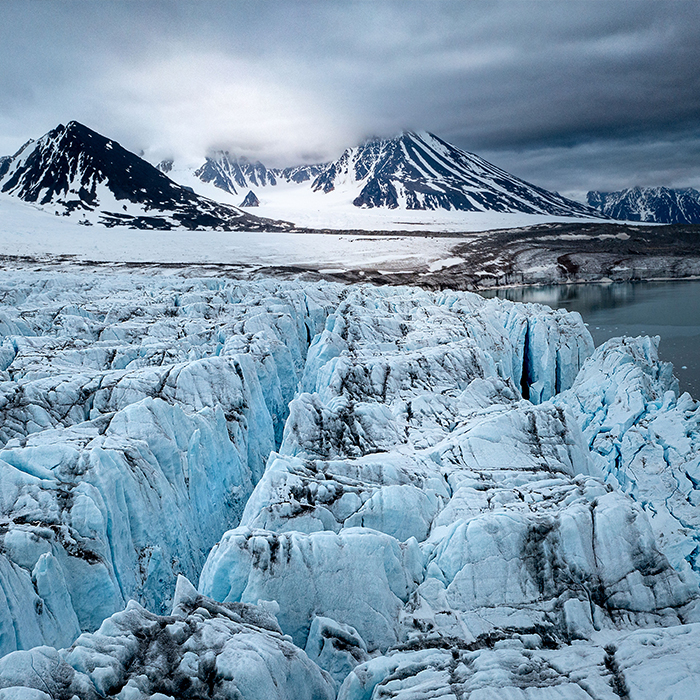
Landscape: Glaciers to the west, red sandstone mountains to the east, Sverrefjellet volcano to the south.
Geothermal Springs: Jotunkjeldene (approx. 20°C) and Trollkjeldene (approx. 28°C) with fragile carbonate terraces.
Wildlife: Middle Arctic tundra zone; unique thermophilic plants, reindeer, geese, and Svalbard rock ptarmigans.
Where is Bockfjorden and What Makes It Stand Out?
Bockfjorden is an extraordinary fjord located in the northern part of the island of Spitsbergen, just west of the famous Woodfjorden. It owes its name to the German polar explorer, Franz Karl von Bock, who made his mark in the history of exploring these lands.
What attracts researchers and travelers most to Bockfjorden is its incredible landscape diversity. It is a place full of geological contrasts. The western part of the fjord is dominated by raw glaciers, while the eastern shores are surrounded by picturesque mountains made of red sandstone. Meanwhile, to the south of the fjord rises Sverrefjellet—an extinct volcano, which is a true rarity in this region of the Arctic.
Jotunkjeldene and Trollkjeldene: Arctic Geothermal Springs
Past volcanic activity and the resulting tectonic faults in the bedrock led to the creation of one of Svalbard’s greatest phenomena—natural geothermal springs.
Jotunkjeldene:
-
Located at an altitude of 50 meters above sea level.
-
It consists of two main springs where groundwater is heated year-round to a temperature of at least 20°C.
-
The warm water flowing from the bedrock dissolves minerals, creating extensive, cascading carbonate deposits (tufa) that have gradually pushed aside the moraine clay.
-
Important for visitors: These terraces are extremely fragile. Walking on them is strictly prohibited to prevent the destruction of thousands of years of geological processes.
Trollkjeldene: About 8 kilometers south of Jotunkjeldene lies a second, even warmer system—Trollkjeldene. There are more outflow points here, and the water temperature can reach up to 28°C.
An Oasis of Life: Unique Flora and Fauna of Bockfjorden
The Bockfjorden region belongs to the Middle Arctic tundra zone, which means the local vegetation is much more thermophilic (heat-loving) than in the northern reaches of the archipelago. However, it is the area directly around the hot springs that represents a true botanical anomaly.
Within a radius of just one kilometer from Jotunkjeldene and Trollkjeldene, a specific microclimate exists. Several species of vascular plants, mosses, and algae grow there that are not found anywhere else in Svalbard. This wealth of vegetation naturally attracts numerous animals. Here, you can easily spot foraging Svalbard reindeer, flocks of geese, and the characteristic birds of the region—rock ptarmigans.
Frequently Asked Questions (FAQ)
Why is Bockfjorden so important to scientists?
Bockfjorden is a geological and biological laboratory unique on an Arctic scale. It combines the presence of an extinct volcano (Sverrefjellet), active geothermal springs, and endemic species of mosses and algae.
Can you bathe in the hot springs in Svalbard?
No. Springs like Jotunkjeldene are surrounded by fragile carbonate terraces of immense scientific and environmental value. Walking on them and bathing are prohibited to protect this unique environment.
What temperatures do the springs in Bockfjorden reach?
The water temperature in the springs remains constant throughout the year, ranging from about 20°C in Jotunkjeldene to as high as 28°C in the more southerly Trollkjeldene.