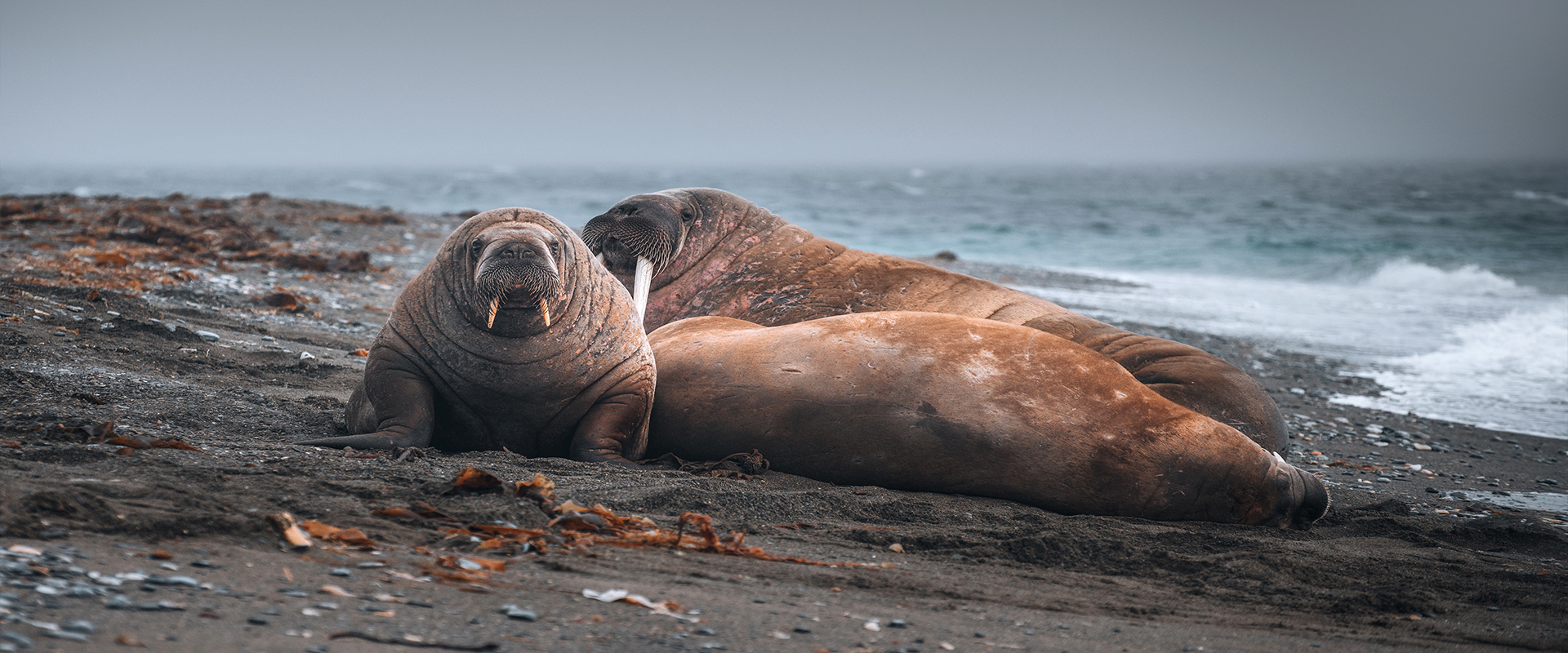
WALRUSES
One of the Great Symbols of the Arctic
Walruses in Svalbard – Where to See Them, How They Live and Why They Are an Arctic Icon
One of the Great Symbols of the Arctic
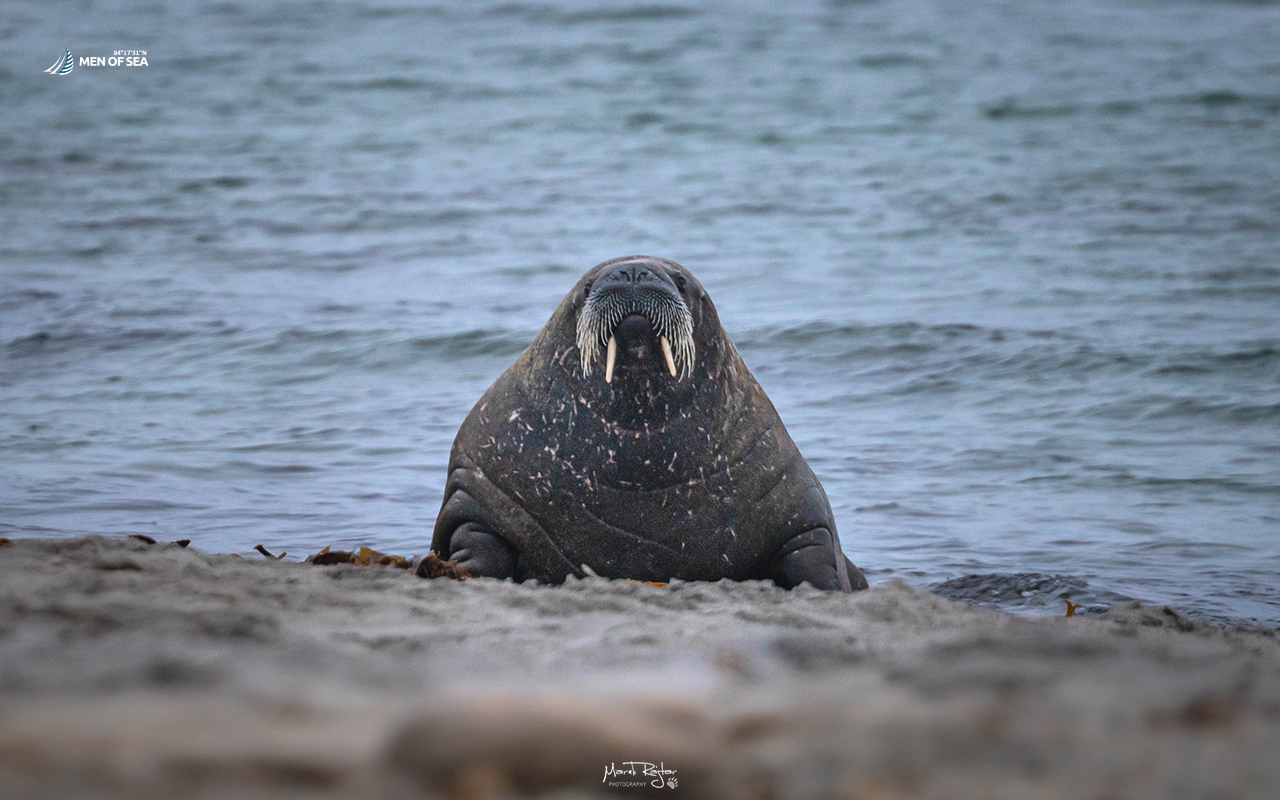
The Atlantic walrus is one of the most distinctive animals of the Arctic and one of the species most strongly associated with Svalbard. Its massive body, long tusks, hundreds of sensitive whiskers and unmistakable appearance make it one of the most fascinating marine mammals you can encounter in Spitsbergen.
Adult males can reach approximately 3–3.5 metres in length and weigh up to around 1,500 kg. Females are smaller, typically reaching about 2.5 metres and weighing around 900 kg. Walruses can live for more than 40 years.
On land they often look heavy and slow. In the water, however, they become surprisingly agile swimmers and divers.
How Are Walruses Adapted to Life in the Arctic?
Walruses have a thick layer of blubber that protects them from the cold and allows them to spend long periods in icy Arctic waters. Their bodies are massive but streamlined, and their large flippers allow them to move efficiently underwater.
Unlike true seals, walruses can rotate their hind flippers beneath their bodies, which helps them move on land. Their skin colour may also change.
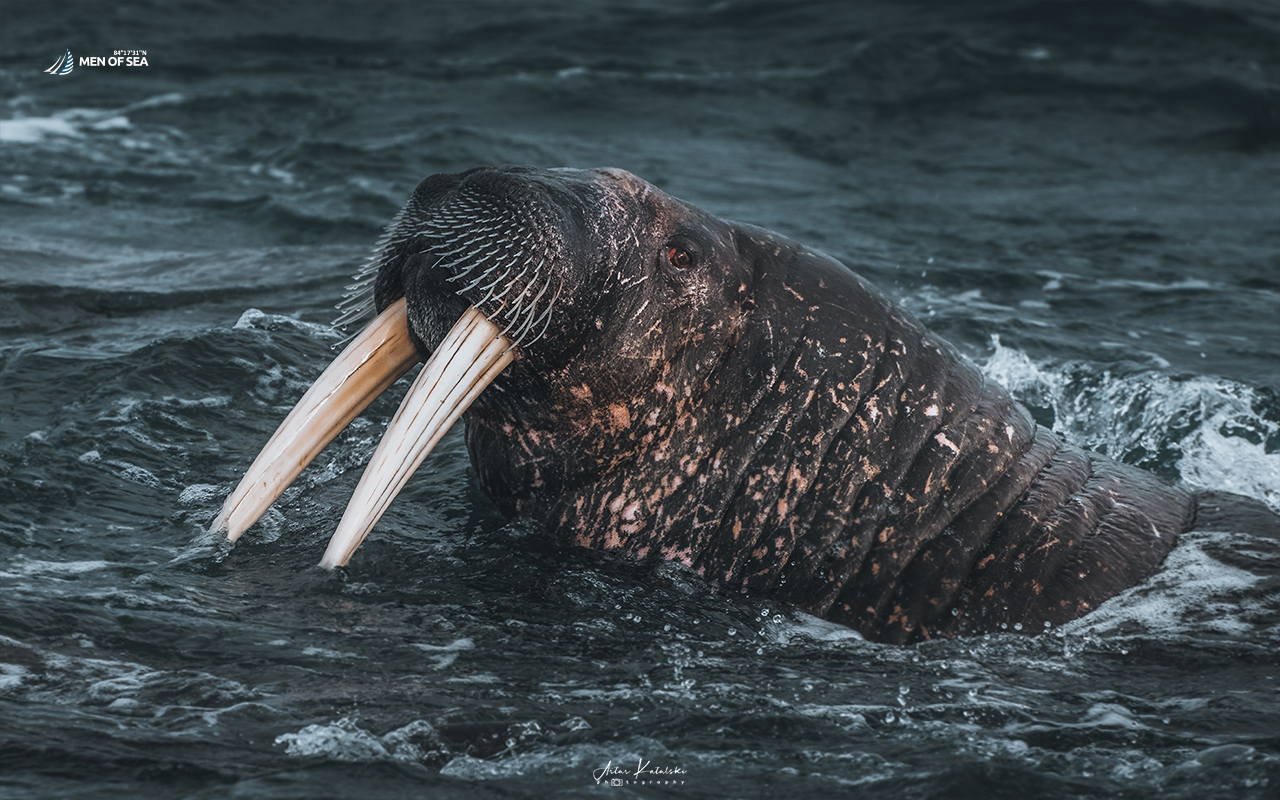
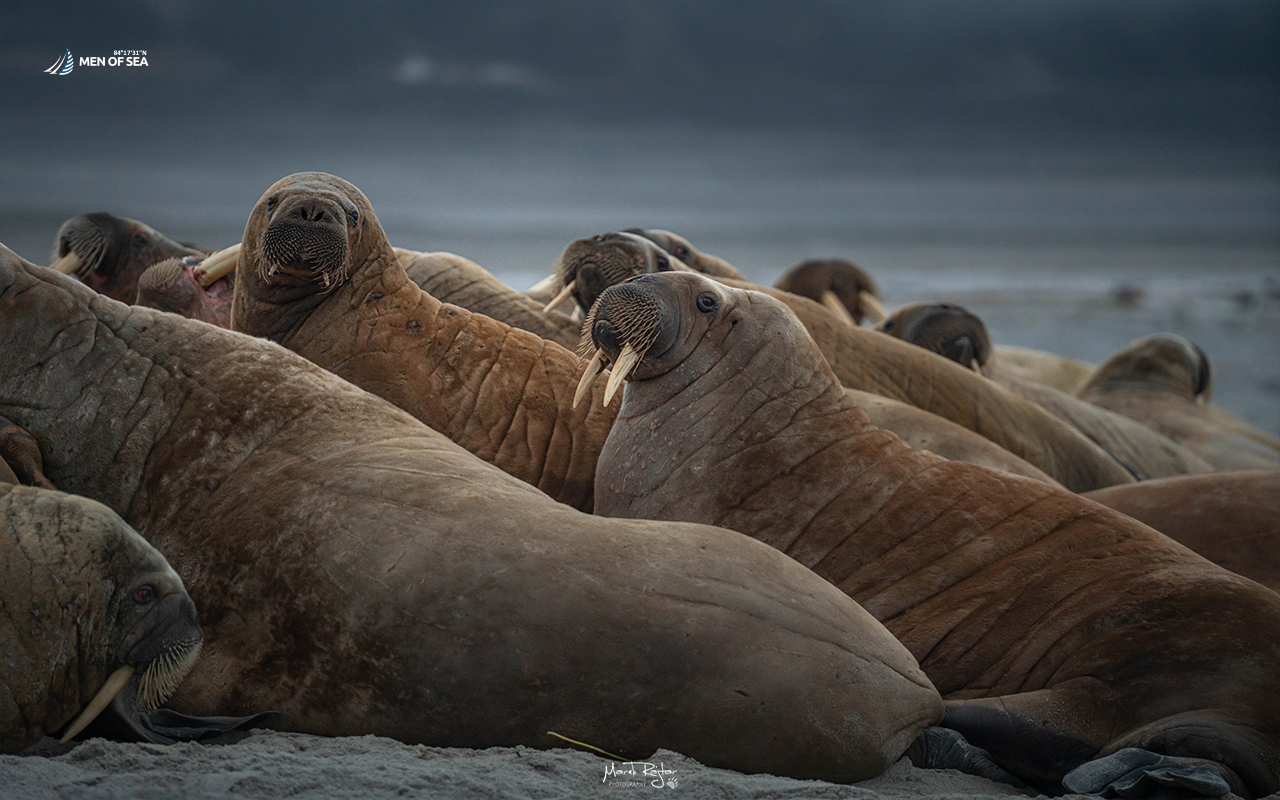
Walruses are usually brown or cinnamon-coloured, but after spending time in cold water they can appear paler. When resting on land and blood flow to the skin increases, they may develop a noticeable pinkish colour.
What Are Walrus Whiskers Used For?
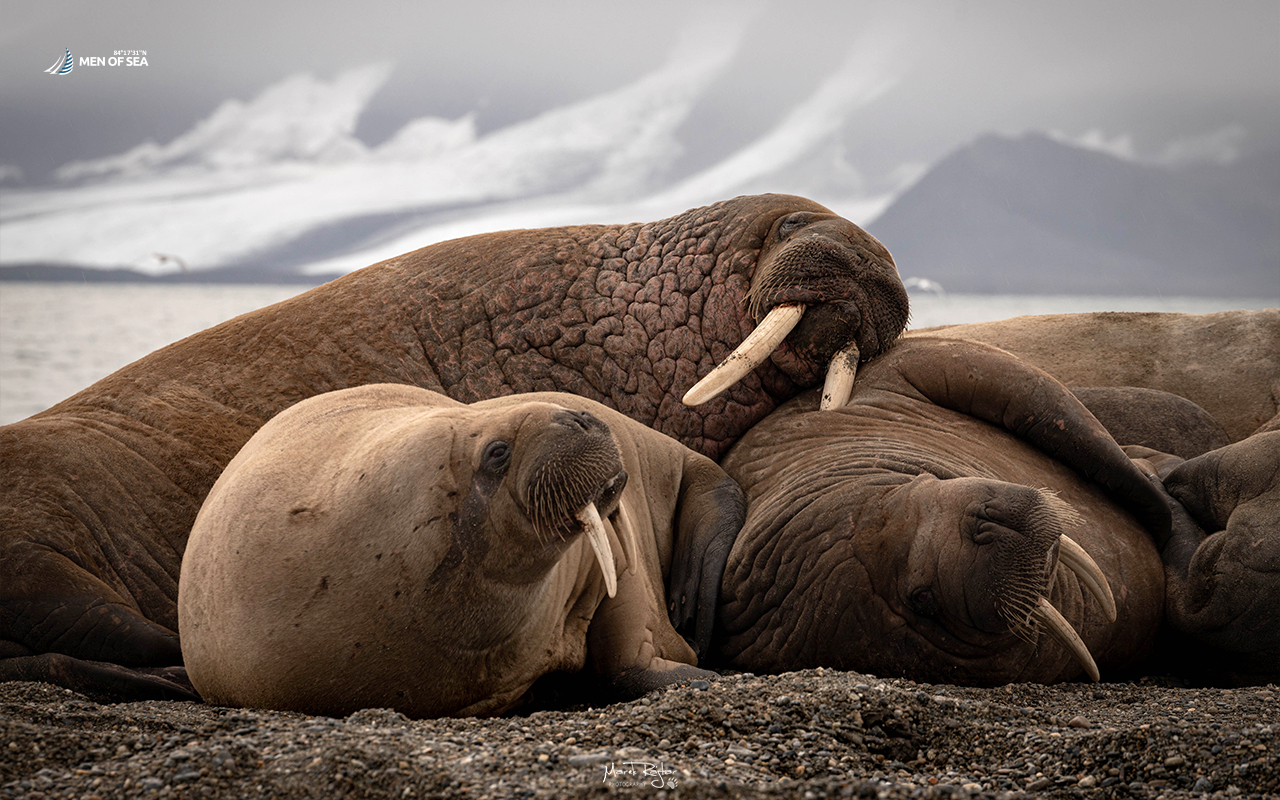
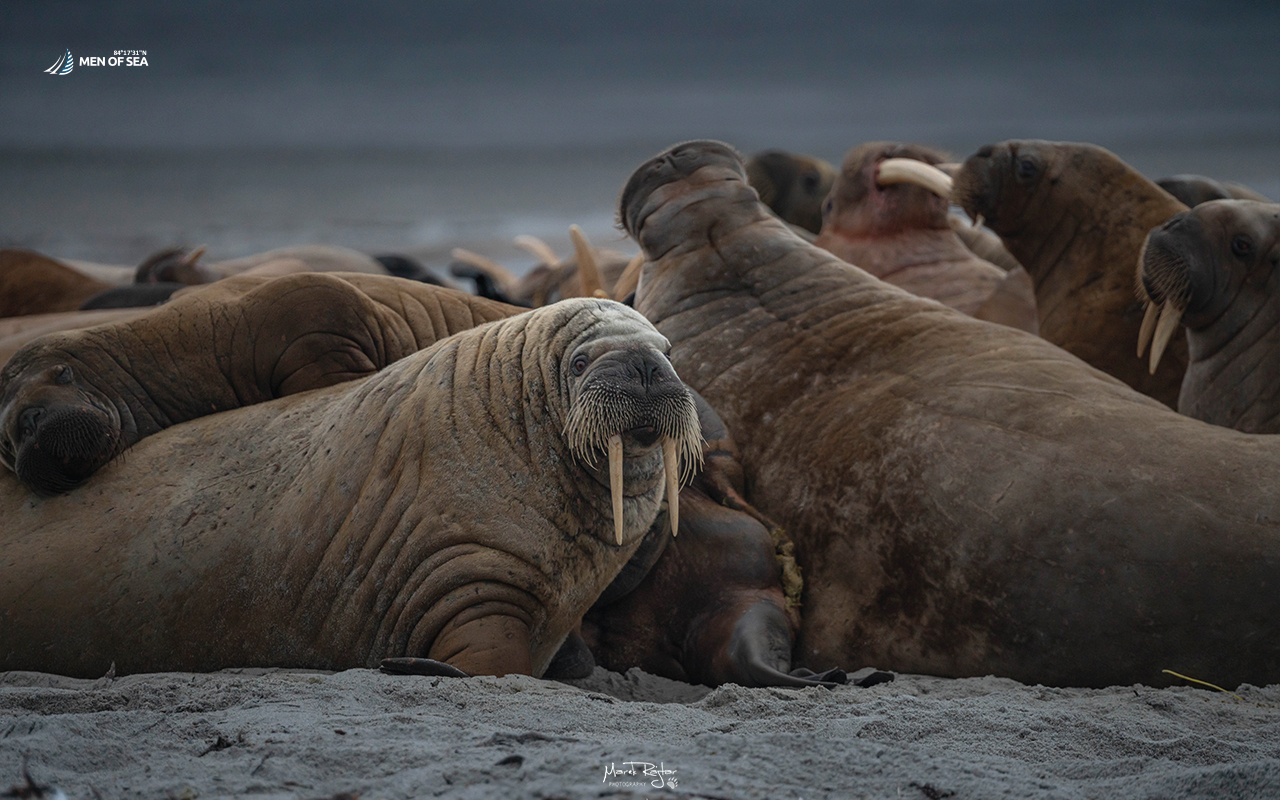
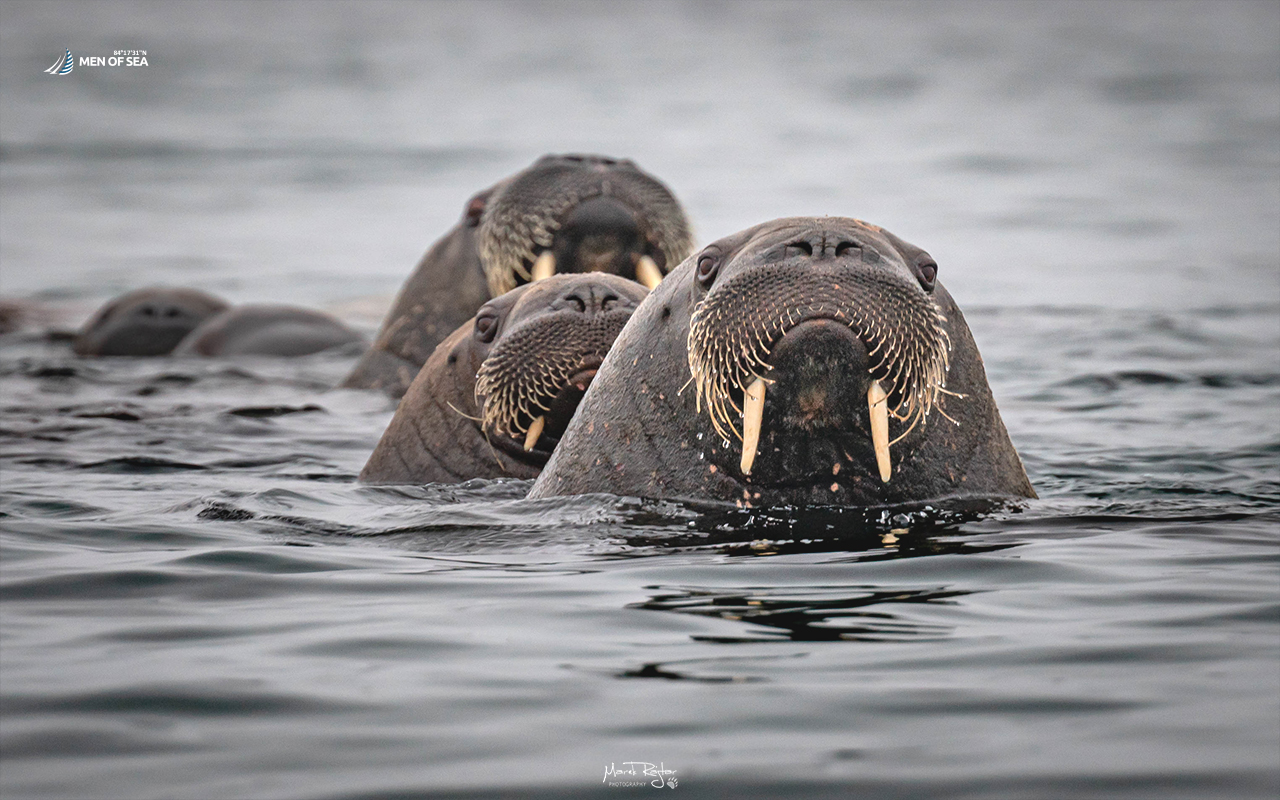
One of the most remarkable features of a walrus is its highly sensitive facial whiskers, known as vibrissae. These stiff sensory hairs are arranged in dense rows around the muzzle and help walruses locate food on the seafloor.
Walruses often feed in dark or murky water where visibility is poor. They move their muzzle close to the bottom and use their vibrissae to detect animals hidden in soft sediment.
This makes the whiskers an extremely important sensory tool.
What Do Walruses Eat?
The diet of walruses consists mainly of animals living on or beneath the seafloor. Their favourite food includes:
- clams,
- other bivalves,
- crustaceans,
- marine worms,
- sea cucumbers,
- other benthic invertebrates.
Once a walrus finds food buried in sediment, it can clear the bottom using its flippers and powerful water movements. It then uses strong suction to extract the soft parts of shellfish.
Some individuals, especially large males, may also occasionally prey on birds or other marine mammals, including seals. This is not typical behaviour for most walruses, but it has been documented.
What Are Walrus Tusks Used For?
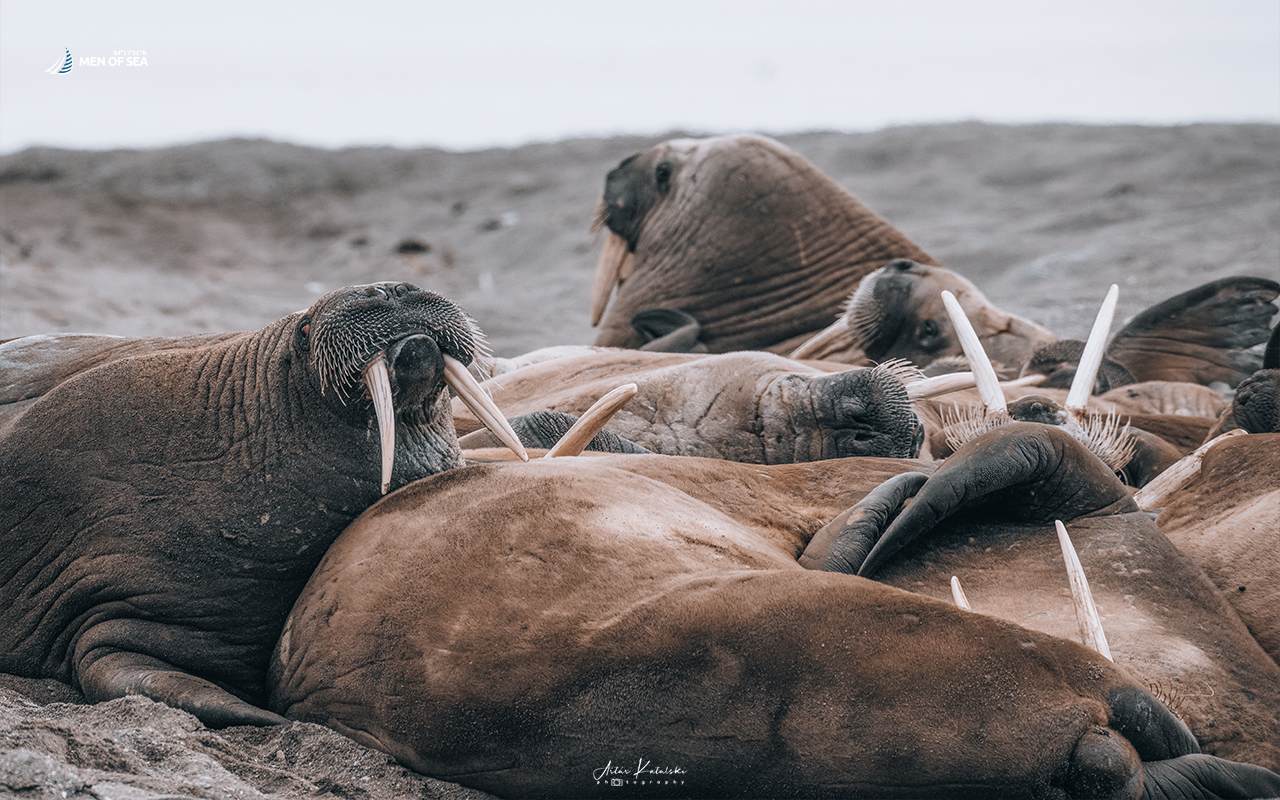
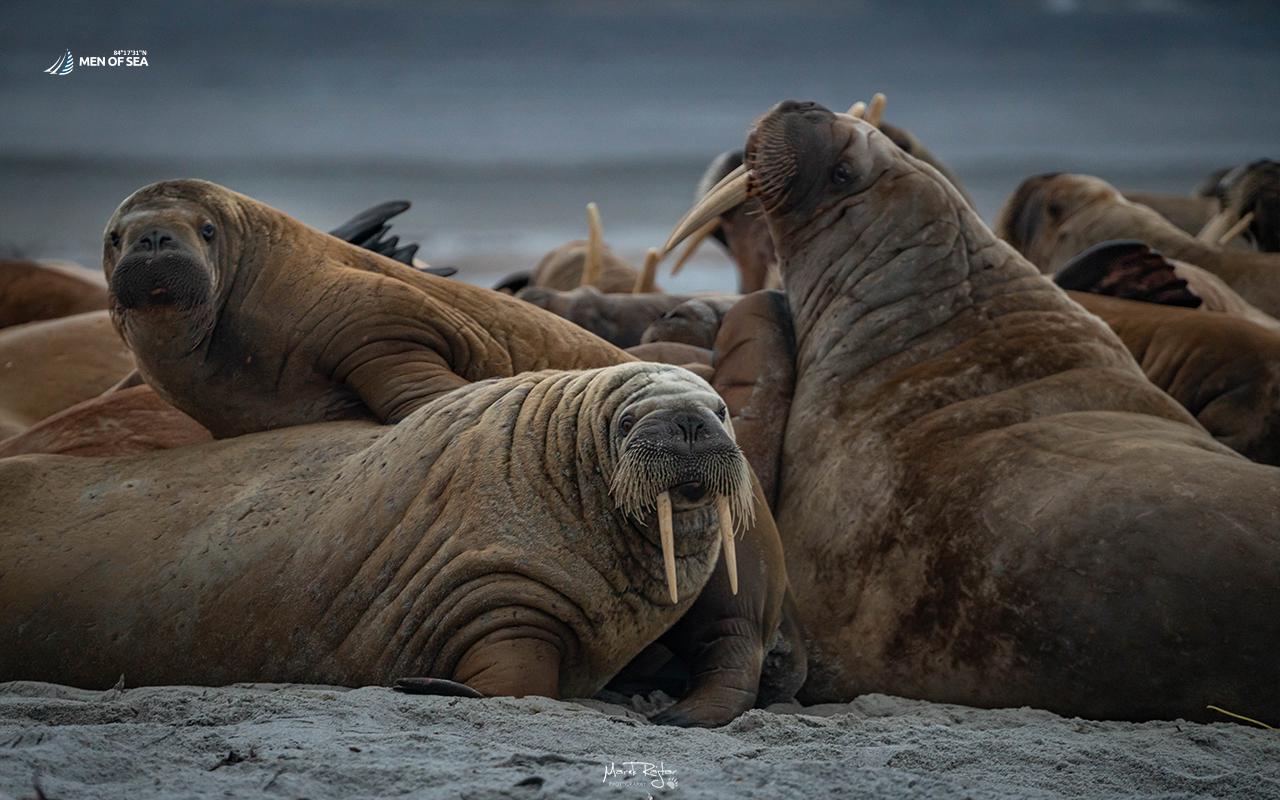
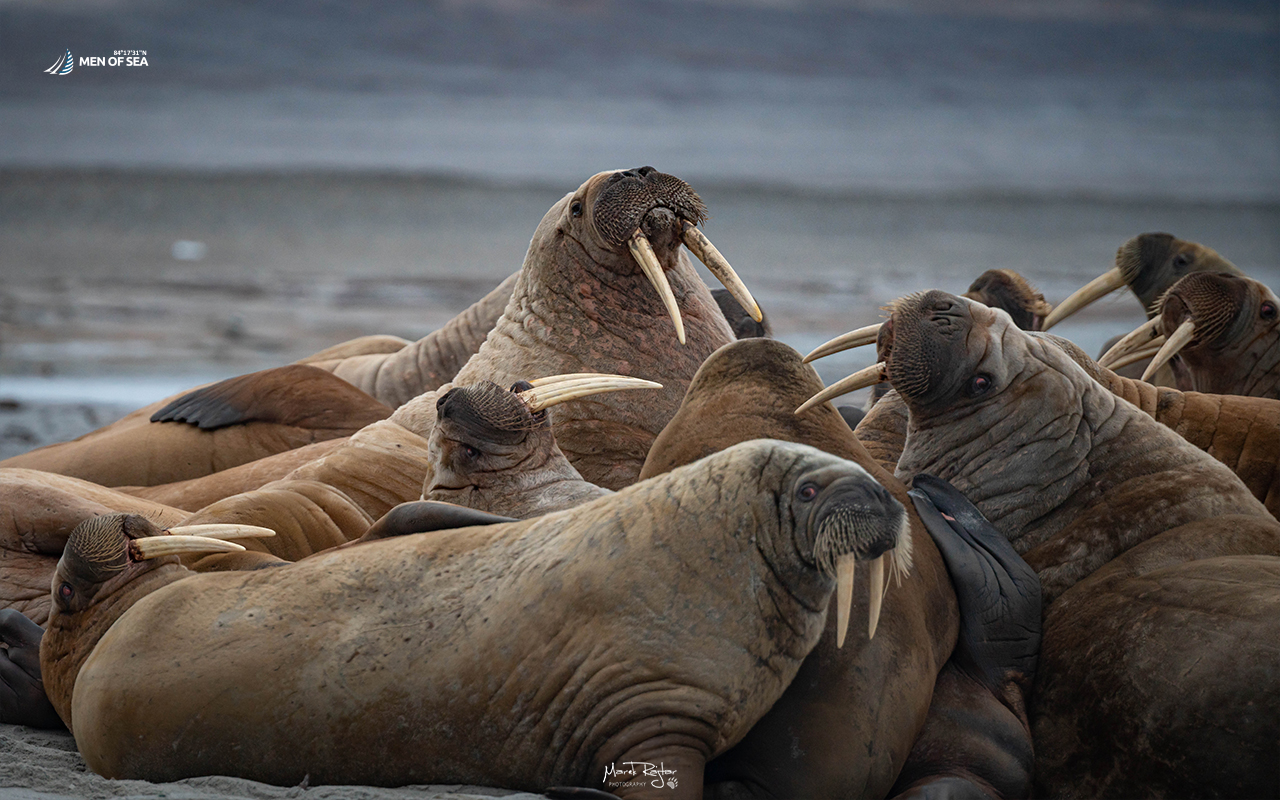
The long tusks are the most recognisable feature of a walrus. Both males and females have them. In large adults, the tusks can reach around one metre in length.
They are used for several purposes, including:
- helping the animal pull itself onto ice,
- defence,
- competition between individuals,
- social dominance,
- fights during the breeding season.
Tusks continue growing throughout much of a walrus’s life. They can break, however, and damaged tusks regrow only slowly.
Can a Polar Bear Kill a Walrus?
Yes, but a healthy adult walrus is a very difficult and dangerous opponent. Polar bears may attack walruses, but they are more likely to target young, injured or weaker individuals.
A large adult walrus can weigh more than a tonne and is armed with powerful tusks. Groups of walruses may also defend themselves collectively.
The main natural predators of walruses are polar bears and orcas, although calves are generally more vulnerable than fully grown adults.
How Deep Can Walruses Dive?
Walruses usually feed in relatively shallow coastal waters. Many dives are made at depths of less than 50 metres, because the animals prefer productive areas where benthic food is abundant.
However, walruses are capable of much deeper and longer dives. Recorded dives have exceeded: 450 metres in depth and 37 minutes underwater.
This shows just how well adapted walruses are to marine life.
Where Do Walruses Live in Svalbard?
Walruses occur around Svalbard throughout the year. They prefer:
- shallow coastal waters,
- areas rich in shellfish and benthic life,
- locations close to open water,
- places where they can rest on land or sea ice.
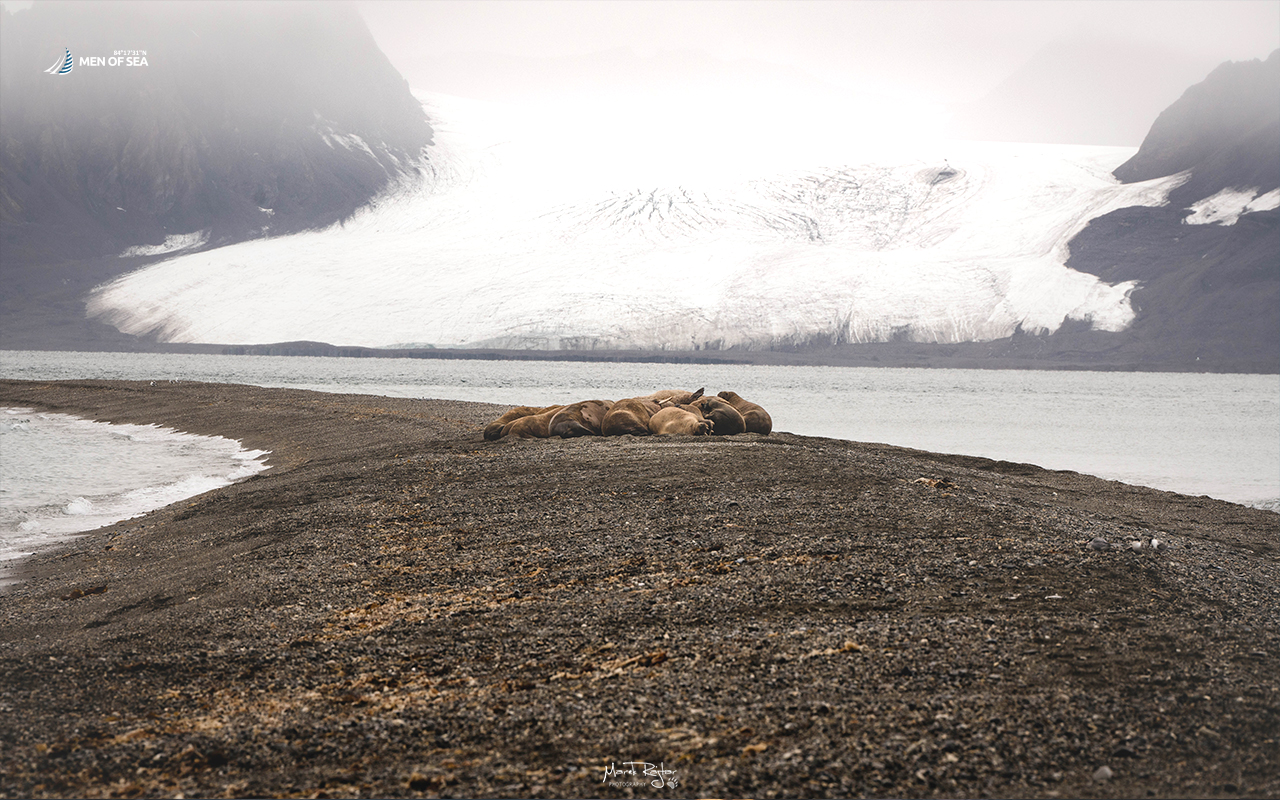
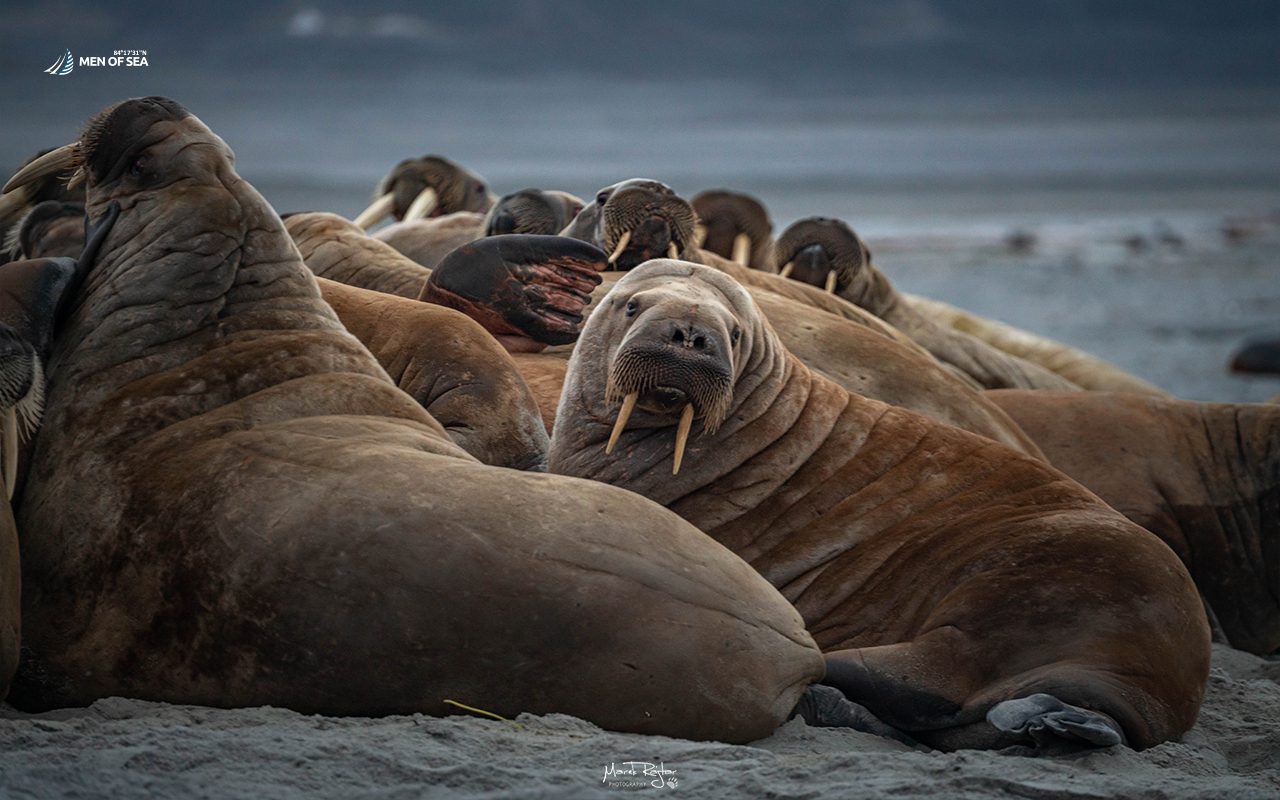
During summer, walruses often gather at traditional haul-out sites, where groups of animals leave the water to rest on beaches or rocky shores. They are highly social animals and may lie extremely close together in large groups.
Which Walrus Species Lives in Svalbard?
The walruses found in Svalbard are Atlantic walruses: Odobenus rosmarus rosmarus
The other major subspecies is the Pacific walrus, which occurs mainly in waters around Alaska and the Russian Far East. The walruses found around Svalbard are part of a larger population connected with Franz Josef Land and the Barents Sea region.
How Many Walruses Live in Svalbard?
The history of walruses in Svalbard is a remarkable example of wildlife recovery. For centuries, walruses were intensively hunted for:
- tusks,
- blubber,
- skin.
This exploitation reduced the population to extremely low levels. Walruses became fully protected in Svalbard in 1952, when only a few hundred animals may have remained.
Since then, the population has gradually recovered. Surveys conducted in the 2000s and 2010s showed a clear increase in walrus numbers around Svalbard, and animals have returned to traditional haul-out sites that had been abandoned for decades.
Are There Female Walruses and Calves in Svalbard?
Historically, many of the walruses observed around Svalbard were males. Females and calves were more commonly associated with areas farther east, especially around Franz Josef Land.
In recent decades, however, females with calves have increasingly been observed in Svalbard. This is considered an important sign that the population is expanding and recolonising parts of its former range.
How Do Walruses Reproduce?
The main breeding period usually occurs during winter, especially around December and January. Males compete for access to females and can become aggressive toward one another. Calves are generally born in spring, commonly around May.
A female usually gives birth to a single calf. Young walruses remain with their mothers for an extended period and can stay dependent on them for more than two years.
Walruses reproduce slowly, which is one reason their populations can take many decades to recover after heavy exploitation.
When Is the Best Time to See Walruses in Svalbard?
Walruses can be found in Svalbard all year round. For visitors, however, the easiest period to observe them is generally from May until the end of summer.
The reason is simple. As the marine season develops, more walrus haul-out sites become accessible to yachts and boats.
During summer, walruses may be seen:
- resting on beaches,
- lying on sea ice,
- swimming close to the coast,
- feeding in shallow water,
- travelling between feeding grounds and haul-out sites.
There is no exact “best date”. As always in Svalbard, sea ice, weather and wildlife behaviour matter more than the calendar.
Where Can You See Walruses in Svalbard?
Walruses use many traditional haul-out sites across the archipelago. The best habitats generally combine:
- shallow coastal waters,
- rich feeding grounds,
- easy access to the sea,
- undisturbed resting areas.
Some locations are used regularly, while others may only be occupied during certain parts of the season. During yacht expeditions, walruses may be encountered both on land and in the water. Sometimes the first sign is a characteristic breath or a sequence of heads appearing above the surface.
Walrus Encounters on Men of Sea Expeditions
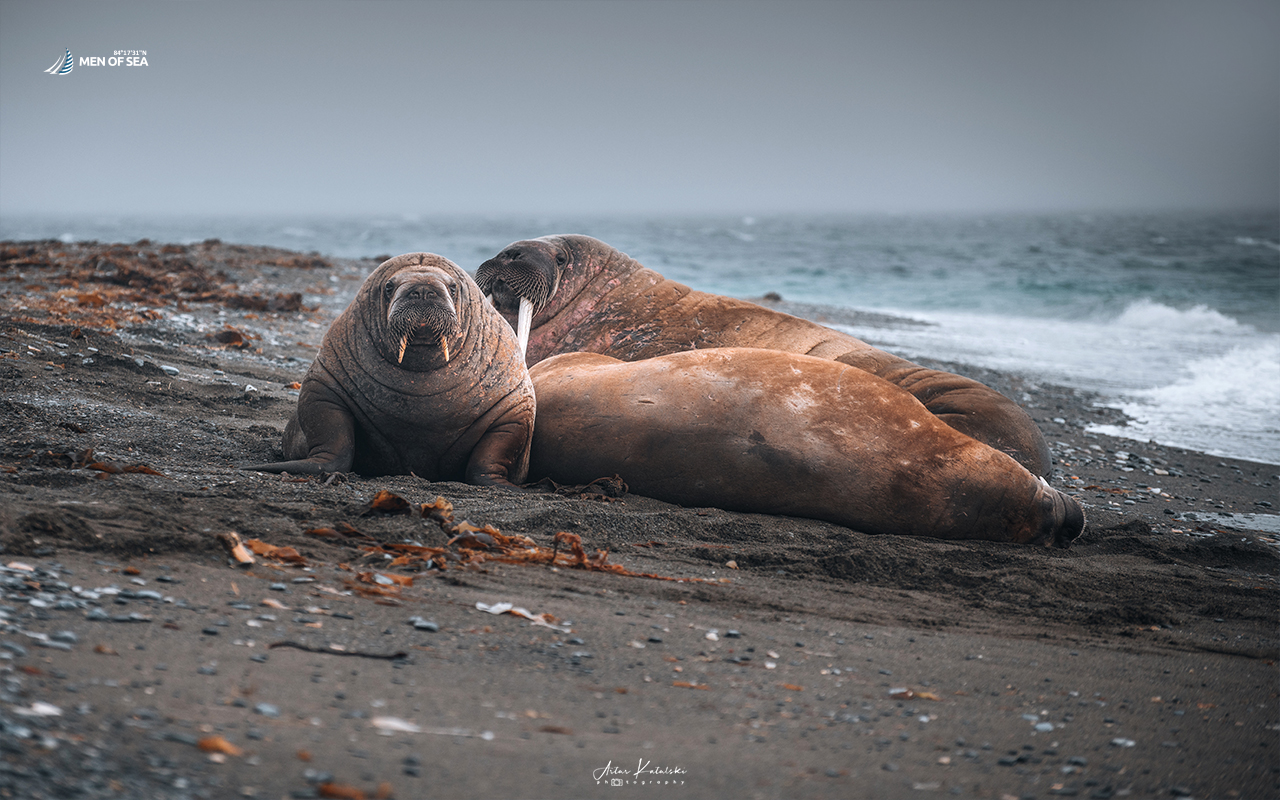
Walruses are among the animals we regularly encounter during expeditions around Svalbard. Some of the most impressive sightings occur when larger groups are resting together on Arctic beaches.
If conditions and regulations allow, they can be observed from an appropriate distance from land or from the yacht. Walruses can also be surprisingly curious.
Sometimes they approach a yacht or Zodiac on their own. This can be an extraordinary experience, but it is important to remember that a walrus is an extremely large and powerful wild animal.
Are Walruses Dangerous?
Walruses do not normally hunt people and are not generally aggressive toward humans. However, that does not mean they are harmless. An adult walrus can weigh well over one tonne and has enormous strength combined with long tusks. If it feels threatened, is disturbed or has its escape route blocked, it may react defensively.
Extra caution is needed when using small inflatable boats. From our own experience, we know that a curious walrus can approach very closely, and contact between tusks and an inflatable boat can cause serious damage.
How Close Can You Get to Walruses in Svalbard?
This is an important part of responsible wildlife watching. Current Svalbard regulations include specific rules for walrus haul-out sites.
Motorised vessels must keep at least 150 metres away from a walrus haul-out site. Within 300 metres, the maximum permitted speed is 5 knots.
The aim is to prevent unnecessary disturbance. The best walrus encounter is one in which the animals can continue resting and behaving naturally.
Why Should Walruses Not Be Disturbed?
Walruses come ashore or rest on sea ice primarily to recover energy. Forcing them back into the water unnecessarily means additional energy expenditure.
In large groups, sudden disturbance may also cause panic and increase the risk of animals trampling one another. For this reason, observers should keep their distance, avoid unnecessary noise and never block the animals’ route back to the sea.
Why Is the Walrus a Symbol of the Arctic?
Few animals look more unmistakably Arctic. The walrus combines many features associated with the Far North: enormous size, adaptation to freezing water, life connected with sea ice and spectacular tusks.
Its history in Svalbard also shows both the impact people can have on wildlife and the ability of a protected population to recover over time. After being almost eliminated from the archipelago, walruses gradually returned to areas from which they had disappeared.
Today they are once again one of the most iconic animals of Svalbard.
FAQ – Walruses in Svalbard
Are there walruses in Svalbard?
Yes. Atlantic walruses occur around Svalbard throughout the year and are part of a wider population connected with Franz Josef Land and the Barents Sea.
When is the best time to see walruses in Svalbard?
Walruses are present all year, but the easiest period for visitors is usually from May through the end of summer, when more haul-out sites can be reached by boat or yacht.
Where can you see walruses in Svalbard?
They are most often found in shallow coastal areas and near traditional haul-out sites with good access to rich feeding grounds.
How much does a walrus weigh?
A large adult male Atlantic walrus can weigh around 1,500 kg, while females are generally smaller and often weigh around 900 kg.
How long are walrus tusks?
The tusks of large adult walruses can reach approximately one metre in length. Both males and females have tusks.
What do walruses eat?
Their diet consists mainly of clams and other benthic animals, including crustaceans, worms and sea cucumbers.
How deep can a walrus dive?
Most dives are relatively shallow, but recorded dives have exceeded 450 metres and lasted as long as 37 minutes.
Are walruses dangerous?
They are not usually aggressive toward humans, but they are extremely large and powerful wild animals. A threatened or disturbed walrus can react defensively.
How close can boats get to walruses in Svalbard?
Motorised vessels must remain at least 150 metres from walrus haul-out sites, and within 300 metres the speed limit is 5 knots.
Were walruses once nearly extinct in Svalbard?
Yes. Centuries of hunting reduced the population dramatically. Walruses became fully protected in Svalbard in 1952, and their numbers have gradually recovered since then.
Trips connected with WALRUSES
Across the Arctic Seas

12 dni
Animals of Svalbard Photo Safari #01
8 dni
Polar bears #01
10 dni
Spitsbergen in a week #01
8 dni
Polar bears #02
10 dni
Animals of Svalbard Photo Safari #02
8 dni
Polar bears #03
10 dni

Spitsbergen in a Nutshell
5 dni
Spitsbergen in a week #05
8 dni
To the Edge of the North #03
10 dni
Spitsbergen in a week #07
8 dni