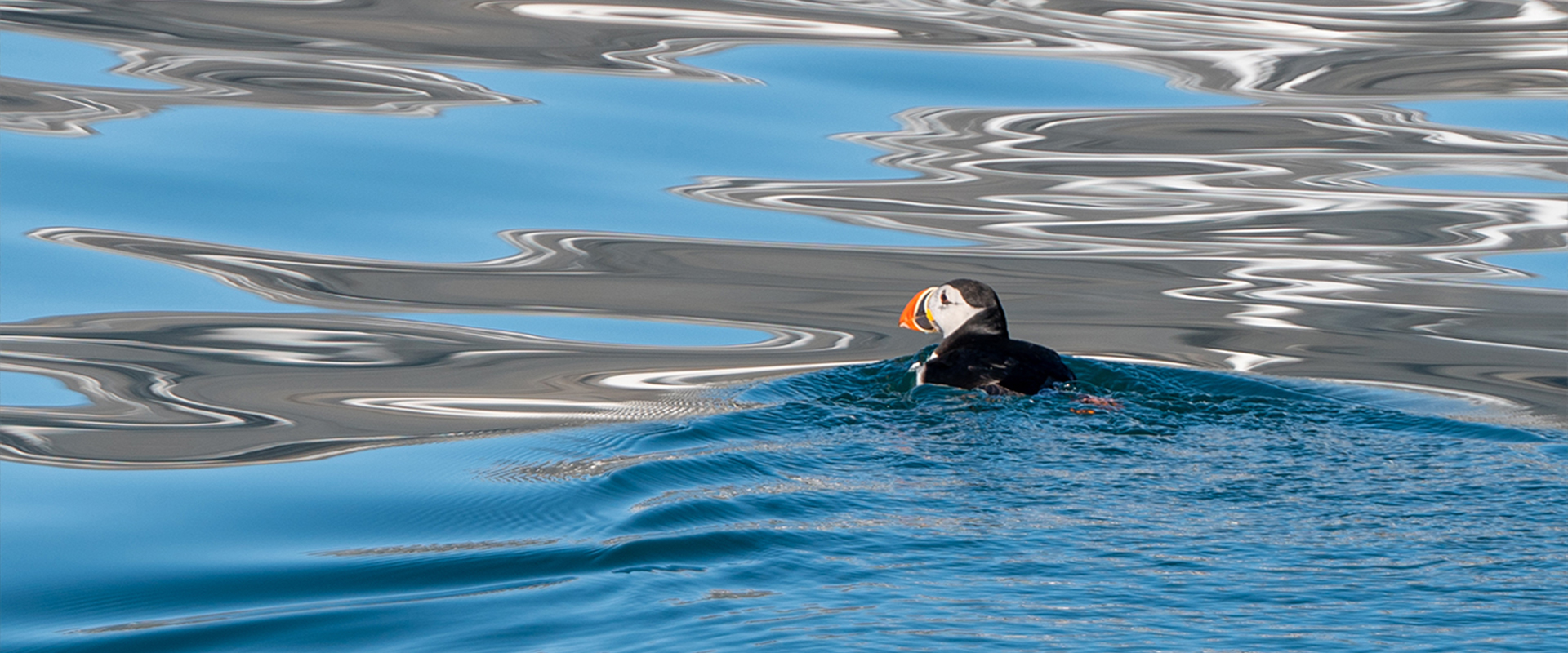
Puffins
Friendly Flying Creatures
Atlantic Puffin in Svalbard: Meet the Cutest Bird of the Arctic
Key Information about Puffins (Quick View / TL;DR):
Species: Common Puffin, also known as the Atlantic Puffin.
Status: Despite a large population, it is recognized as a vulnerable species.
Skills: Flies at speeds up to 90 km/h and dives to depths of over a dozen meters.
Hunting: Thanks to an extra bone in its jaw, it can catch and hold up to 10 fish simultaneously.
Fun Fact: A watermark of a puffin is featured on every modern Norwegian banknote.
Appearance and Extraordinary Hunting Techniques
The puffin, despite its fairly large population, is currently recognized as a vulnerable species to extinction. Its comical appearance—a large, rounded head with a bright, red beak resembling a mask, and short orange legs—makes it one of the most endearing birds of the North.
This adorable look goes hand in hand with incredible adaptations for foraging. Puffins have a special groove in their beak and an additional bone in their jaw. Thanks to this mechanism, they can lock their prey in place and catch up to 10 fish at the same time, making them highly effective hunters.
Masters of Diving and Comical Aviators
Atlantic puffins are excellent swimmers and divers. They feel perfectly at home underwater, capable of diving to depths of over a dozen meters. Furthermore, they have a reputation as superb flyers. They can reach speeds of up to 90 km/h, flapping their wings up to 400 times per minute!
However, what catches observers’ attention the most are their takeoffs and landings on water, which look quite comical. When taking off from the sea surface, a puffin must gain significant momentum by comically “running” across the water. When it lands, it does so with great impact, resembling a torpedo crashing beneath the waves.
A Brave Heart and Complex Social Relations
Despite their small size, puffins are very feisty birds. When they feel threatened, they spread their wings, open their beaks wide, and stomp hard, trying to appear much more intimidating. If this tactic fails, they will attack the aggressor with their beak and wings.
Most often, however, these birds prefer peace. To manifest peaceful intentions and avoid provoking other individuals, they characteristically lower their beak to their chest. Studies show that they attach great importance to social interactions, and their behaviors are highly complex. A perfect example is the specific ceremonial gesture of extending one foot forward upon landing—a signal to their peers: “I’m one of you, I’m not a threat.”
“Malicious Pranksters”: Encounters in Svalbard
In the waters of Svalbard, we encounter puffins regularly. Usually, they fly around our yacht or float peacefully on the water. However, they have one very characteristic trait—they dive in a split second as soon as we get too close to them.
According to Marek from our crew, they are the most “malicious” birds in the entire archipelago. Why? Because every time Marek comes on deck with his camera to get the perfect shot, the puffins—as if on command—suddenly start hiding underwater!
Frequently Asked Questions (FAQ) – Atlantic Puffins
Why can a puffin catch several fish at once?
Puffins have a unique beak structure. A special groove and an extra bone in the jaw allow them to hold caught fish while opening their beak to catch more. This way, they can carry up to 10 fish simultaneously.
How fast does a puffin fly?
The Atlantic puffin is an incredibly fast bird. By flapping its wings up to 400 times a minute, it can reach flight speeds of up to 90 km/h.
Are puffins aggressive?
Generally, they are peaceful and try to avoid confrontation by lowering their beak to their chest as a sign of peace. However, when faced with a threat, they become very combative—ruffling their feathers, stomping, and ultimately attacking with their beak.
What connects the puffin to Norwegian banknotes?
The puffin holds a special place in Norwegian maritime culture. A fascinating fun fact is that a watermark featuring a puffin is present on every modern Norwegian krone banknote.


Trips connected with Puffins

Across the Arctic Seas

12 dni
Animals of Svalbard Photo Safari #01
8 dni
Polar bears #01
10 dni

Spitsbergen in a week #01
8 dni
Polar bears #02
10 dni
Animals of Svalbard Photo Safari #02
8 dni
Polar bears #03
10 dni

Spitsbergen in a Nutshell
5 dni

To the Edge of the North #03
10 dni
Spitsbergen in a week #07
8 dni