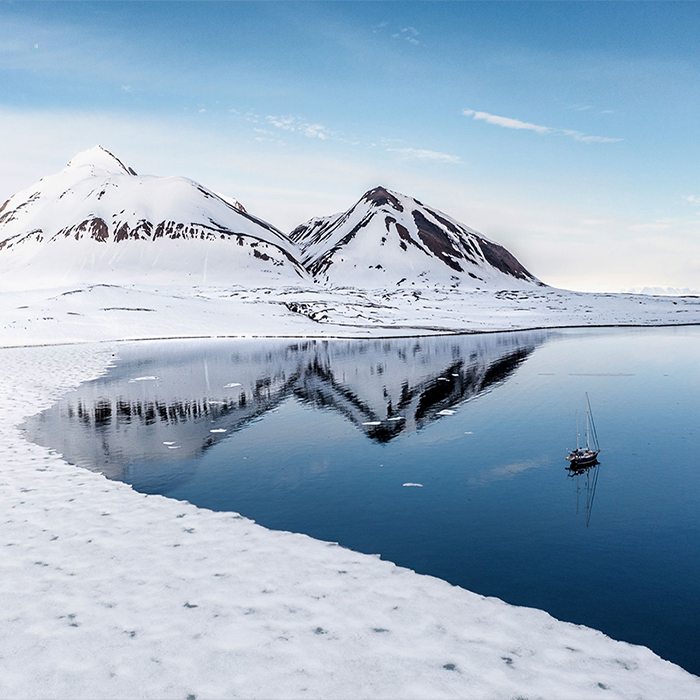
BJØRNØYA
Bear Island
BASIC INFORMATION
Bjørnøya, or Bear Island, is the southernmost part of the Svalbard archipelago. It lies in the western Barents Sea, approximately halfway between Spitsbergen and Norway’s North Cape. Since 2002, the island has been protected as a nature reserve due to its exceptional seabird colonies, including the endangered Ivory Gull.
In addition to its abundant birdlife, the island is home to Arctic foxes, Arctic char in its freshwater lakes, and polar bears during the winter months. Bear Island has no permanent civilian population. The only inhabited site is a meteorological station in the north, established in 1932 and staffed year-round by Norwegian personnel.
The island was discovered in 1596 by the Dutch explorer Willem Barents during his third Arctic expedition. It most likely received its name after Barents unexpectedly encountered a polar bear on the island. Throughout history, Bear Island was frequently visited by trappers who spent the winter there. A reminder of this era is Hammerfesthuset, the oldest surviving trapper’s cabin in Svalbard, located next to the meteorological station.
Coal and lead deposits have been known on the island since the 17th century, and although mining operations were attempted, they remained small in scale.
TOWERING CLIFFS AND EXTRAORDINARY BIRDLIFE
Bear Island covers approximately 178 km² and has a remarkably distinctive landscape. The northern part of the island is relatively flat, gradually rising toward the south, where it ends in dramatic, almost vertical sea cliffs.
The island is also known for numerous caves and striking rock formations, including Sylen and Stappen. The towering southern cliffs, combined with shallow coastal waters, create ideal breeding conditions for seabirds. This area is strictly protected, and access is prohibited during certain times of the year.
A total of 13 bird species breed on Bear Island. Among them, only the Ivory Gull is currently considered threatened. Other breeding species include: Pink-footed Goose, Barnacle Goose, Northern Fulmar, Purple Sandpiper, Red Phalarope, Glaucous Gull, Black-legged Kittiwake, Little Auk, Common Guillemot, Brünnich’s Guillemot, Razorbill, Black Guillemot, Snow Bunting
BEAR ISLAND ON OUR BARENTS SEA ROUTE.
Today, Bear Island is rarely visited, mainly because of its challenging weather conditions and barren landscape. Although temperatures remain relatively moderate throughout the year, typically ranging between -7°C and +5°C, and the island is usually free of sea ice, it experiences strong winds exceeding Force 6 on the Beaufort scale for more than half of the year and is frequently shrouded in dense fog.
Navigation is further complicated by the extensive shallow waters surrounding the southern coast. Vegetation is sparse across the island, with the rocky landscape broken only by its remarkable 740 freshwater lakes.
Bear Island remains one of the most inaccessible places in the European Arctic. Some years, only a single yacht manages to visit the island. During the summer months, vessels are not allowed to approach because the bird reserve protection zone is in force.
Fortunately, when we sail to and from Svalbard, these seasonal restrictions are no longer in effect, giving us the opportunity to approach the island whenever conditions allow. Even then, reaching the shore is never guaranteed. During April and May, we have encountered extensive sea ice surrounding the island, while in September, strong winds across the Barents Sea often make any landing impossible.
Despite these challenges, we have successfully landed on the northern coast, visited the Norwegian meteorological station, and explored the spectacular cliffs of the island’s southwestern coast, including the iconic and unique Sylen sea stack.